🍞 Sourdough in Fridge Fermenting Time Calculator
Estimate cold sourdough fermentation time from dough weight, starter percentage, fridge temperature, flour blend, hydration, salt, dough maturity, desired tang, bulk time before the fridge, and loaf size.
Use this for shaped sourdough that will ferment in the refrigerator after bulk fermentation. The result is a planning window, then dough cues decide the exact bake time.
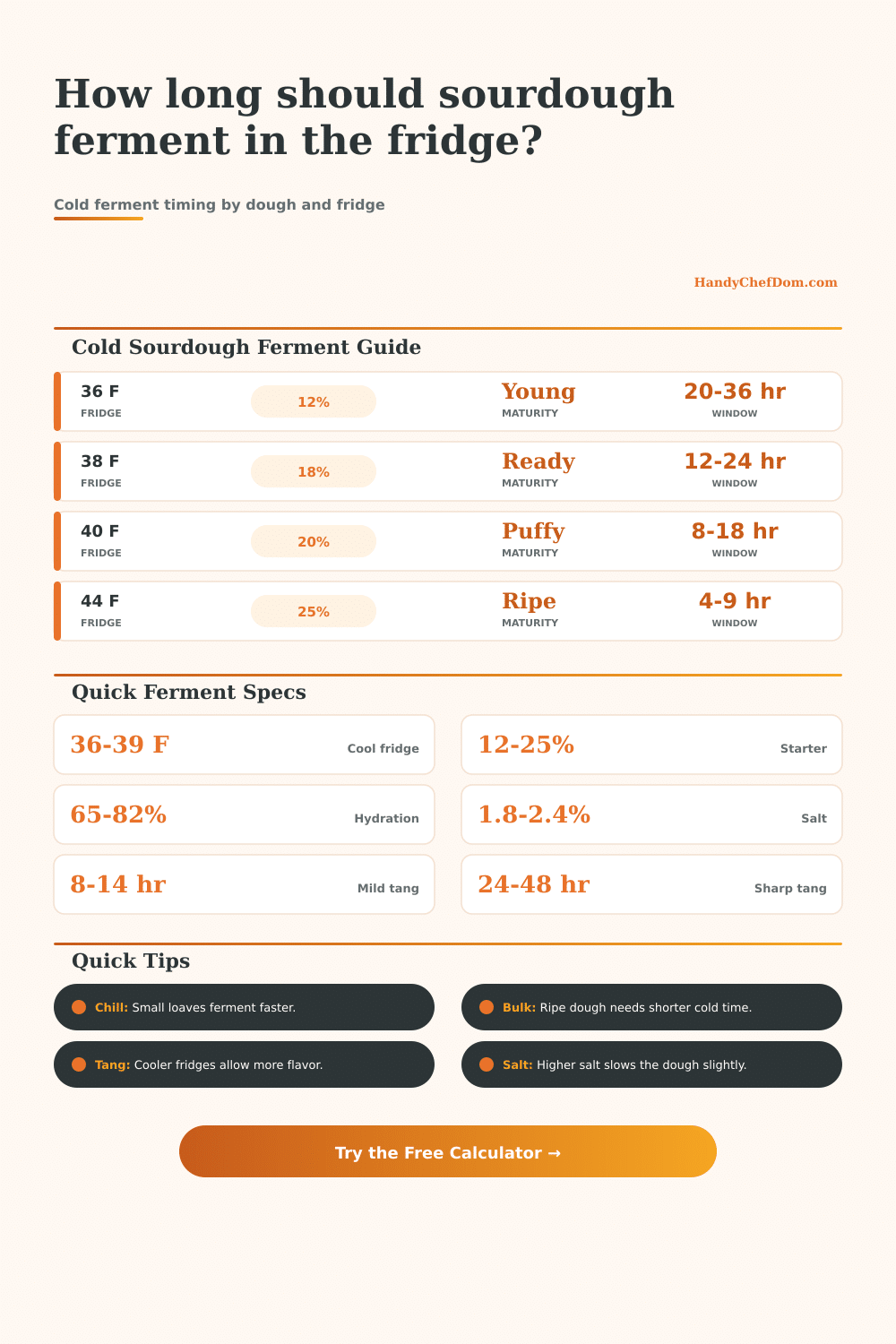
| Fridge Temperature | Typical Window | Best Dough State | Ferment Note |
|---|---|---|---|
| 33-35°F | 24 to 48 hours | Young or balanced dough | Very slow activity; flavor builds gradually. |
| 36-38°F | 14 to 36 hours | Young to ready dough | Reliable long cold ferment range. |
| 39-41°F | 9 to 24 hours | Ready shaped dough | Good overnight balance for most loaves. |
| 42-44°F | 5 to 14 hours | Moderate maturity | Warmer fridge makes dough move quickly. |
| 45-48°F | 3 to 8 hours | Short finish only | Use as a brief chill, not a long hold. |
| Flour Type | Ferment Pace | Timing Effect | Cold Ferment Cue |
|---|---|---|---|
| Mostly white bread flour | Moderate | Baseline | Clean rise with predictable strength. |
| Country bread flour blend | Moderate | Baseline | Good tolerance for overnight timing. |
| Whole wheat blend | Faster | Shorter | Watch for quick puff and stronger aroma. |
| Rye-forward sourdough | Fast | Much shorter | Less gluten strength, check early. |
| Spelt or einkorn blend | Fast | Shorter | Can soften quickly in the fridge. |
| Strong high-protein flour | Slower | Longer | Best for extended cold fermentation. |
| Dough Maturity | Bulk Rise Clue | Fridge Time Left | Risk Level |
|---|---|---|---|
| Young | 40% to 50% rise | Long | May need extra cold hours. |
| Developing | 55% to 65% rise | Moderate long | Low risk for overnight ferment. |
| Ready | 70% to 80% rise | Moderate | Classic balanced timing. |
| Puffy | 85% to 95% rise | Short | Check before the midpoint. |
| Very ripe | Doubled or fragile | Very short | Bake early to avoid collapse. |
| Loaf or Method | Cold Speed | Typical Window | Handling Note |
|---|---|---|---|
| Standard banneton loaf | Baseline | 10 to 24 hours | Good insulation and shape support. |
| Large loaf | Slower | 14 to 30 hours | Center chills later than the outside. |
| Small rolls or mini loaves | Fast | 4 to 12 hours | Small pieces reach fridge temp quickly. |
| Tin or loaf pan | Slightly slower | 12 to 26 hours | Pan mass holds warmth at first. |
| Tray or sheet pan dough | Fast | 5 to 14 hours | Wide surface area cools quickly. |
| Covered tub after bulk | Moderate | 8 to 20 hours | Best when shaping happens after chill. |
Confidently shape the loaf, score it, then slide it in fridge. Bake tomorrow morning. Fall asleep.
Morning comes around. Panic sets in that you’ve turned it into a flat, sour pancake. That’s the anxiety of cold fermentation. It’s the space between what you intended and what happens: biology waiting for you as you sleep.
A Tool for Better Bread
Enter the calculator. Based off your specific variables, it calculates an estimate of the fermentation window. It helps bridge gap between intention and execution.
Remember: it isn’t just temperature. Your typical household fridge is set to thirty-eight degrees Fahrenheit. But the fridge may be cooler (like, on a lower rack) and warmer (like, right next to door). The tool recognizes this because you enter the temperature of your fridge. The fridge happens to run warm, at forty-four degrees? Then the fermentation will speed up accordingly. And that matters, since a loaf that requires sixteen hours at thirty-eight degrees might overproof in only eight hours at forty-four.
Time isn’t everything. Yeast has a thermal environment, too… So you must understand what it is.
Another key variable is what condition the dough is in when you plop it into the fridge. Some bakers wants to chill their dough while it is still rising slowly at room temperature. They figure the slower rise and the cold will slow the rise evenly as the dough chills. Other people want to cool their dough right away, getting a gradual slowdown from the cold. The calculator accounts for that by asking how mature your dough was when you chilled it. When you have young dough that’s just started to double after forty percent rise, the cold will stop it gently, preserving its structure and letting it ferment longer to develop flavor. When you’ve got ripe dough that’s already doubled, all you’re doing is putting on the brakes. The math are different: there’s no yeast left to do much work in one case, but quite a bit in the other.
But there are other factors here, such as strength of your starter. Even if you’re working cold, a strong starter with a large percentage represented in the formula will push that process along. The tool takes into account your starter’s hydration and its percentage of the total recipe. It figures out the likelihood that those microbes will be active. Dough hydrated at a higher level tend to ferment more quickly (water helps make nutrient availability easier for the yeast). Salt is a bit of a brake, though, it slows fermentation down just a little.
All these inputs comes together to form a combined image of the energy level of your dough. And what comes out isn’t one number but a range. It is more realistic different than anything you’d find on a clock.
Also keep in mind: flour makes a difference. White bread flour ferments slower then whole wheat or rye. Why? Because there’s nutrition (bran & germ) in those other flours which feed the yeast. That means your dough will begin to soften sooner in the fridge if it’s made with a whole wheat or rye mix. The calculator accounts for this. Just be aware that you may want to reduce your cold ferment time if you use a whole wheat blend. How much so? It depends on your flour profile. The reference tables on the page gives examples of this. You’ll see that if your dough is rye-heavy, it will get soft sooner in the fridge, requiring an earlier check.
The calculator provides a frame. But the ultimate answer comes from your senses. When to begin? When do I look? The numbers tell you what window. When should you bake? Your eyes will say. Is the surface relaxed, are the edges puffed? Is it light and airy but still holds together? If it looks good and is in the calculated window, then go ahead and bake. If it’s tight, wait longer. It isn’t about hitting the precise moment. It’s about learning the moments that make for readiness.
This learning makes the morning less stressful and builds more confidence. You slide the loaf into oven because you’ve planned, not just guessed. And the dough, at last, repays you by giving you the tangy crust and open crumb you’ve always wanted.
Actualy, it would of helped to plan ahead.