🍞 Sourdough Levain Calculator
Build a levain from the final amount backward: seed starter percentage, fresh flour, fresh water, levain hydration, build ratio, room temperature, maturation time, and inoculation.
Enter the levain amount your dough formula needs. The calculator counts flour and water already present in the seed starter, then gives the fresh flour, fresh water, inoculation, and timing fit for the build.
Loose texture, fast mixing, mild flavor, and easy flour/water subtraction.
Firm build that matures slower and can bring a sweeter, less sharp profile.
Whole rye in the fresh flour often speeds activity and strengthens aroma.
Best for overnight or warm-room builds where a slow peak is desired.
Good default range for 8 to 12 hour levain builds in a normal kitchen.
Useful for same-day levain builds, cooler rooms, or young sweet targets.
Levain flour in the final dough controls bulk speed and flavor intensity.
A small extra amount covers jar loss and makes it easier to keep starter back.
| Common ratio | Approx seed share | Typical hydration | Room timing | Best use |
|---|---|---|---|---|
| 1:1:1 | About 33% of build | 100% | 4 to 6 hours | Fast refresh or same-day bake |
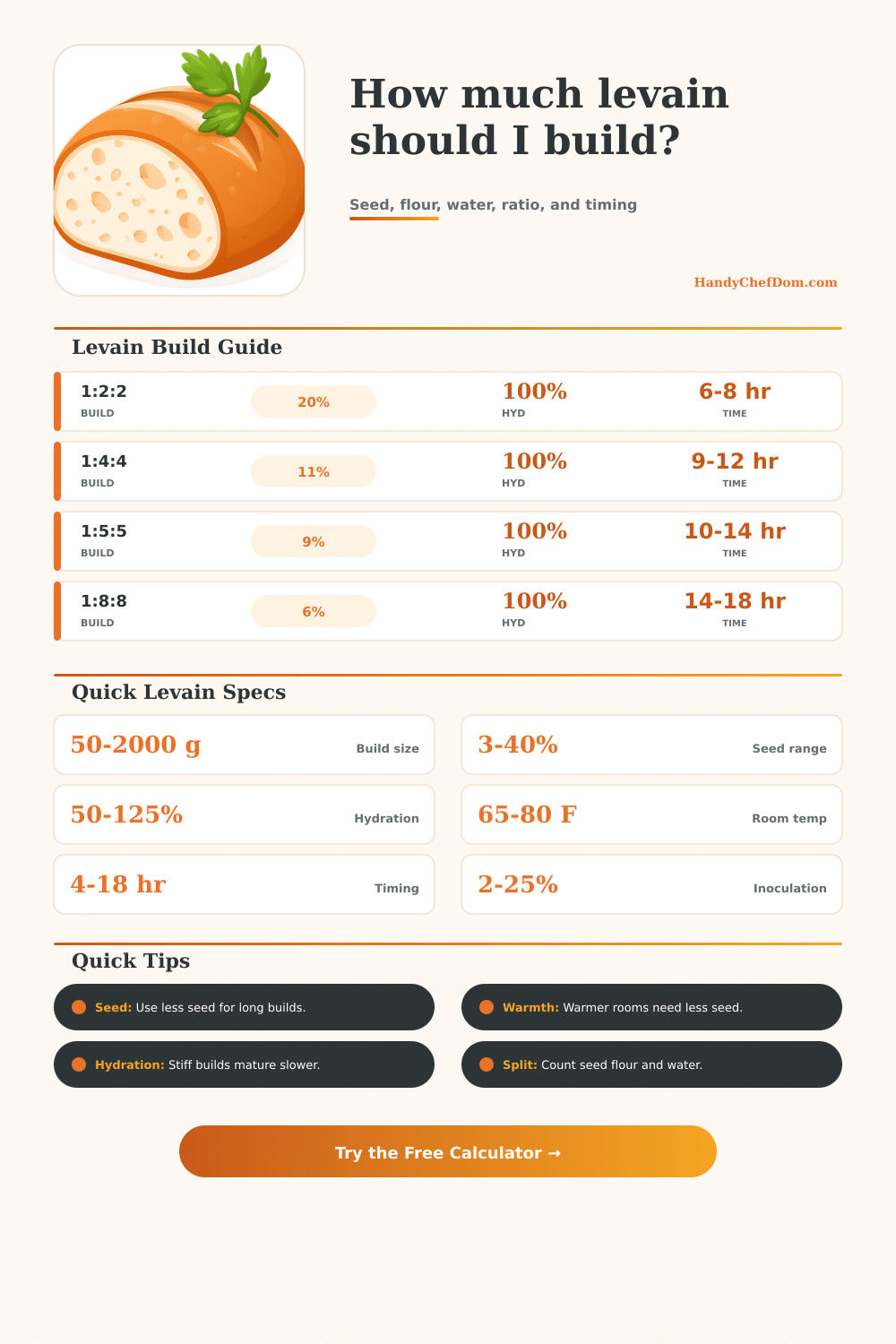
| 1:2:2 | About 20% of build | 100% | 6 to 8 hours | Active daytime levain |
| 1:4:4 | About 11% of build | 100% | 9 to 12 hours | Normal overnight country bread |
| 1:5:5 | About 9% of build | 100% | 10 to 14 hours | Longer overnight or warm kitchen |
| 1:8:8 | About 6% of build | 100% | 14 to 18 hours | Slow build with mature starter |
| Room temperature | Activity pace | Seed adjustment | Timing cue | Calculator note |
|---|---|---|---|---|
| 62 to 65 F | Slow | Use more seed | Add 2 to 5 hours | Watch actual rise more than the clock |
| 66 to 70 F | Moderate | Default range | 8 to 14 hour builds | Good overnight planning zone |
| 71 to 75 F | Active | Use less seed | 6 to 10 hour builds | Good for same-day mixing |
| 76 to 80 F | Fast | Reduce seed sharply | 4 to 8 hour builds | Overnight builds need very low seed |
| 81 F plus | Very fast | Use tiny inoculation | Check early | Best for short warm builds only |
| Levain hydration | Texture | Typical ratio | Maturity cue | Dough formula note |
|---|---|---|---|---|
| 50 to 60% | Stiff dough-like ball | 1:5:3 or similar | Domed, expanded, aromatic | Subtract less water from final dough |
| 65 to 80% | Firm paste | 1:4:3 to 1:4:4 | Rounded top with bubbles | Useful for stronger dough feel |
| 90 to 105% | Classic spoonable levain | 1:4:4 or 1:5:5 | Doubled, bubbly, slightly domed | Easiest all-purpose calculation |
| 110 to 125% | Loose and pourable | 1:4:5 or higher water | Bubbly surface, fragile peak | Subtract extra water from dough |
| Levain flour in dough | Bulk speed | Flavor direction | Good pairing | Planning cue |
|---|---|---|---|---|
| 6 to 9% | Slow | Milder acidity | Warm kitchen or long bulk | Use when dough has time |
| 10 to 15% | Balanced | Moderate sourdough flavor | Most country loaves | Reliable daily bread range |
| 16 to 22% | Faster | More aroma and acid | Cool rooms or same-day dough | Watch bulk expansion closely |
| 23% plus | Very fast | Strong levain presence | Enriched or cool doughs | Shorten bulk or lower dough temp |
Levain timing is a planning estimate. Starter strength, flour ash, water temperature, jar size, and room swings can move the peak, so keep notes and adjust seed percentage by small steps.
A levain is a mixtures of active starter, flour, and water that is prepared for use in a specific bread dough recipe. You create a levain when you would like to provide lift and flavor to your bread doughs. However, the levain isnt the same as the starter that you use to sour your bread dough.
The starter is create to remain in a jar and to be refreshed regularly. However, the levain is created for a specific purpose and for a specific time frame. Because levains is created for a specific purpose, the ingredients can be adjusted to allow for the levain to perform its specific purpose.
What a Levain Is and How to Make It
For instance, you can adjust the amount of starter that is used in a levain, the amount of water in a levain can be adjusted, and the type of flour that is used in a levain can be adjusted in order to make the levain reach the desired timing in relation to the dough that incorporates that levain. The portion of a levain that is created from the active starter is referred to as the seed percentage. If the percentage of the levain that is created from the starter is small, then the levain will take longer to ferment.
However, if the percentage of the levain that is created from the starter are high, then that levain will take less time to ferment. For instance, a levain that has a six percent seed percentage will take longer to ferment then a levain that has a twenty percent seed percentage. Additionally, levains that take longer to ferment will contain more acidity than levains that ferment at a faster rate.
The hydration level of a levain is the ratio of water to flour in the levain. Levains can contain a 100 percent hydration rate, meaning that the levain contains equal amounts of flour and water. Additionally, 100 percent hydration levains are easy to stir with a spoon.
However, if the levain is 60 percent hydration, the levain will be stiff and will take longer to ferment than levains with higher hydration rates. Additionally, if the levain is 120 percent hydration, the levain will be liquid and will ferment quick. However, the liquid levain will collapse sooner than the levain that contains flour.
The type of flour that is used in a levain will change the way in which the levain ferments. For instance, levains that use whole grain flour will ferment faster than levains that use white bread flour. This is due to the higher amount of minerals in whole grain flour as compared to white bread flour.
These minerals will contribute to the faster fermentation rate. The last variable that must be accounted for in the creation of levains is the room in which the levain will be prepared. For instance, warm kitchens will contribute to the faster fermentation of the levain as compared to kitchens that are cold.
Therefore, if the kitchen in which the levain will be prepared reaches a room temperature of 68 degrees, more seeds is required to initiate the levain to reach the same rate of fermentation as kitchens that reach 76 degrees in the same amount of time. Therefore, the temperature of the kitchen will change the rate at which the levain ferments, thus requiring adjustments to the percentage of seed in the levain according to the temperature of the kitchen. Another variable to account for in the preparation of levains is the inoculation of the levain.
The inoculation is the amount of levain that is to be added to the dough that is being prepared. A common inoculation is between eight and twelve percent of the total weight of the flour that will be used in the dough. If percentages of levain are increased in the dough, the levain will set the dough to ferment at a faster rate, and the resulting dough will contain more acidity.
Alternatively, if the levain percentage in the dough is lowered, the levain will contribute to the slower fermentation rate of the dough, and the flavor of the dough will be more gentler than levains that contain higher percentages of levain. In addition to the percentages of levain that is to be added to the dough, it is necesary to account for the levain that will be lost during the mixing of the dough. Some levain may get stuck on the sides of the container, or it may become mixed with the spoon that stirs the levain.
In these instances, you can prepare a reserve percentage of three to eight percent of the levain in addition to the levain that is to be added to the dough. This will ensure that there is enough levain to perform its designated function within the dough, and there is enough levain left over to maintain the levain starters. The levain should be ready for use when specific criteria are met during its preparation.
During preparation, look at the levain to ensure that the levain has developed a domed surface on top of the levain starter. Additionally, ensure that there are bubbles that extend to the edges of the container in which the levain is prepared. Additionally, ensure that the levain has a sweet and tangy smell.
Each levain is different, so these criteria will differ according to each individual levain. Even if levains are calculated to reach the proper ingredients, it is up to the individual to observe the levain to ensure it is ready to be add to the dough.