🍞 Yeast Propagation Calculator
Plan multi-step yeast starters by pitch target, starting viability, starter strength, growth style, and flask limits.
The calculator estimates required cells from volume, gravity, and pitch rate, then models starter growth across up to three propagation steps.
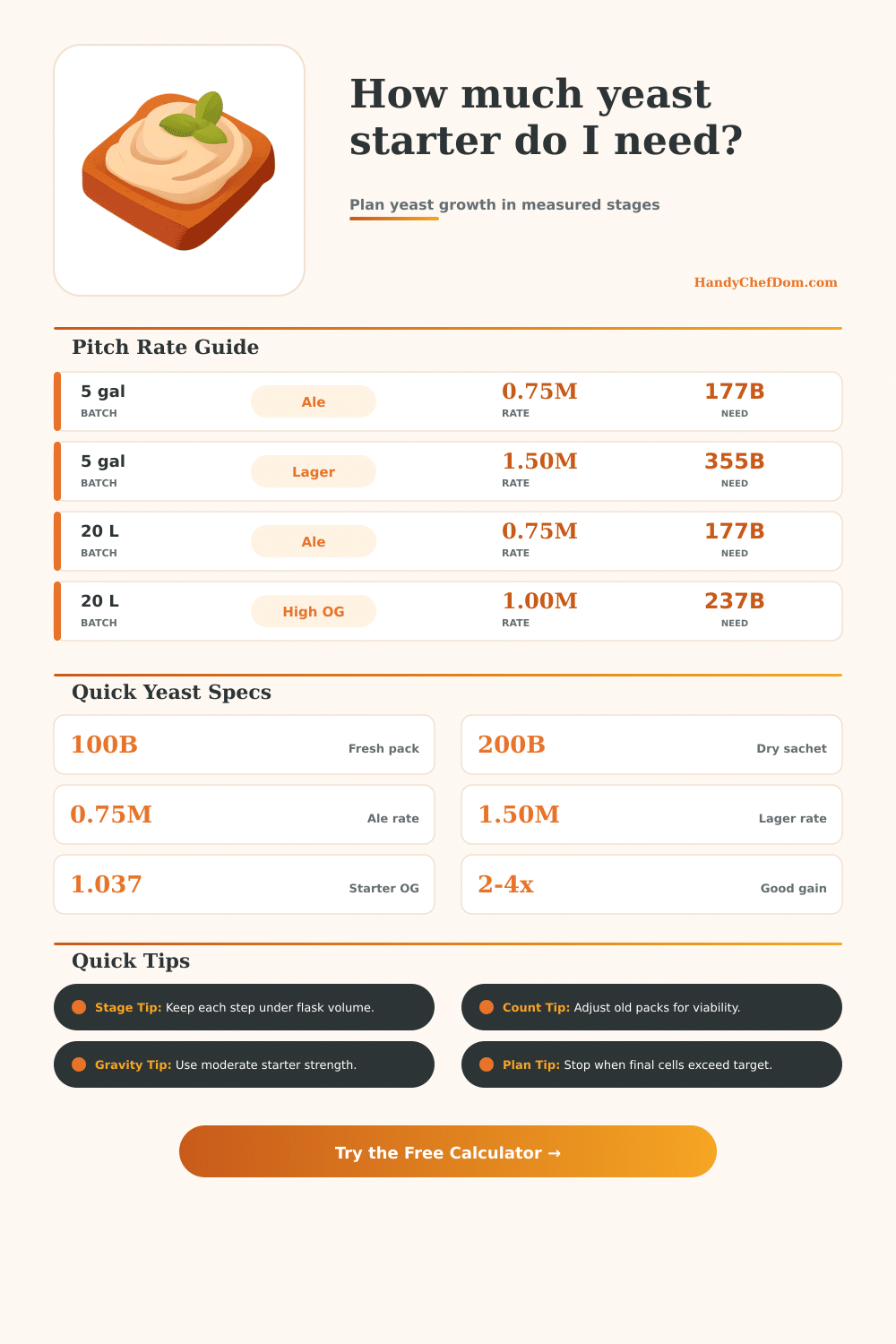
| Fermentation Target | Typical Pitch Rate | Example 5 gal at 1.050 | Use In Calculator |
|---|---|---|---|
| Standard ale | 0.75 million cells per ml per degree Plato | About 177 billion cells | Balanced everyday ales |
| Hybrid or warm lager | 1.00 million cells per ml per degree Plato | About 237 billion cells | Clean ale-lager profiles |
| Cool lager | 1.50 million cells per ml per degree Plato | About 355 billion cells | Lower temperature fermentation |
| High gravity ale | 1.00 million cells per ml per degree Plato | About 237 billion cells | Strong wort cell demand |
| Low pitch kveik style | 0.35 million cells per ml per degree Plato | About 83 billion cells | Intentional low pitch plans |
| Expressive Belgian ale | 0.60 million cells per ml per degree Plato | About 142 billion cells | Lower than neutral ale |
| Starter Gravity | Plato Approx. | Growth Factor | Planning Note |
|---|---|---|---|
| 1.030 | 7.5 P | 0.92x | Gentler but slightly less growth |
| 1.037 | 9.2 P | 1.00x | Standard propagation strength |
| 1.040 | 10.0 P | 1.03x | Common dried malt extract target |
| 1.045 | 11.2 P | 0.96x | Stronger wort with more stress |
| Growth Style | Model Boost | Best Range | Why It Changes Growth |
|---|---|---|---|
| Shaken starter | 0.90x | Small one-step builds | Less continuous oxygen exposure |
| Intermittent swirl | 1.00x | General flask starters | Moderate oxygen and suspension |
| Stir plate | 1.25x | Two-step builds | Better gas exchange and movement |
| High oxygen stir plate | 1.40x | Large propagation plans | Highest model growth boost |
| Low nutrient starter | 0.72x | Conservative estimates | Reduced growth assumption |
| Starter Size | Fresh Pack Estimate | Older Pack Estimate | Planning Use |
|---|---|---|---|
| 0.5 L | Small top-up | Viability recovery | Small batch or fresh ale |
| 1.0 L | Moderate ale build | First stage for older yeast | Common first starter |
| 1.5 L | Strong ale build | Second stage support | Useful flask sweet spot |
| 2.0 L | Large ale build | Lager first stage | Typical maximum home flask |
| 3.0 L | High demand build | Large lager stage | Use with bigger vessel |
Yeast propagation is the process of creating an adequate number of yeast cells for the fermentation process. Propagating yeast is important because a lack of yeast cells will lead to a thin and sluggishly fermentation. Many people believe the number of yeast cells mentioned on the package is the number of yeast cells that will be contained within the wort.
However, the number of yeast cells contained within the wort will be less than the number mention on the yeast package. The reason for this is due to the age of the yeast as well as the conditions in which it was stored. The calculator allows you to enter information regarding your batch size, your gravity, your yeast source, and your yeast growth conditions.
How to Grow Enough Yeast for Your Beer
Using this information, the calculator can create a plan for yeast propagation that respect your target yeast cell count and the number of flasks that you have. The growth of yeast are not linear, which means that yeast does not always grow at the same rate within a given period. Furthermore, employing a large amount of yeast will result in diminuishingly returns.
Therefore, splitting your yeast propagation into separate stages allows for each stage to contain an amount of yeast that will achieve more diminishing returns. In order to create an accurate plan for yeast propagation, you must understand the various inputs for the calculator. Your batch size and gravity will determine the number of yeast cell required for your batch.
A standard ale contains fewer yeast cells than a lager or a batch of high-gravity beer. The viability percentage of your yeast will inform your yeast propagation plan. For yeast packs that are of high ages, there may be a high number of yeast cells within the pack, but they will not be able to perform their required tasks of fermenting the wort.
Therefore, by entering the viability percentage of your yeast, your yeast propagation plan will be informed of the number of active yeast cell. The growth style and gravity for your yeast will also inform the yeast propagation plan. A stir-plate will expose the yeast to oxygen, which will help it to growing at a faster rate than shaking methods.
However, only if the nutrients and temperature in the environment are appropriate for yeast will a stir-plate method exhibit its full potential. Additionally, using a lighter gravity will allow for the steady growth of yeast, while utilizing a stronger gravity will allow the yeast to reach higher numbers of yeast cells. However, the yeast will have to grow at a faster rate than yeast with a lower gravity.
The reference tables for yeast propagation contain the different assumptions that the calculator made for your batch. For instance, different types of beer will contain different amounts of yeast cells. Lagers will contain more yeast cells than ales, as will high-alcohol beers.
Furthermore, different methods of aeration will expose yeast to different amounts of oxygen, which will affect how fast the yeast can reach the target amount of yeast cells. These reference tables will allow you to understand whether your yeast propagation plan is aggressive or conservative for your batch. Many people make mistakes with yeast propagation.
For example, people do not understand the importance of yeast propagation to create an appropriate amount of yeast for their batch. Furthermore, many people assume that each yeast cell will divide at the same rate. Many people also do not understand the importance of splitting yeast propagation into separate stages, and often attempt to create one large batch of yeast.
Additionally, many people do not understand the importance of decanting the yeast from the container in which it was propagated. These types of errors will create a lack of yeast cells in the batch, which will become visually apparent during the fermentation process. While the yeast propagation calculator considers various factors to inform the yeast propagation plan for your batch, there are a variety of factors regarding the batch itself that may change the outcome of yeast propagation.
Factors such as temperature swings in the environment, nutrient content of the extract, and the amount of oxygen delivered to the yeast will impact the outcome of the yeast propagation process. However, a buffer percentage for yeast propagation allows for these variable to be accounted for. By using the same type of flasks, employing the same methods for aeration, and using the same amount of time for each batch, you will reduce the variables within the process.
The pitching rate for your batch is the amount of yeast cells that will be pitched into your fermentation vessel. Some beer types can contain low pitching rates, while other beer types will require a more precise pitching rate to remain within the required parameters of the beer type. By entering different targets for the pitching rate, you can create a plan that matches the pitching rate to the type of beer that you are brewing.
Another benefit of using the calculator is that you can begin to understand the different patterns of yeast propagation. For example, fresh yeast packs will often require only one stage of yeast propagation, while aged yeast packs will require more stages. Additionally, dry yeast often contains the amount of yeast cells required for fermentation.
By using the calculator to inform your yeast propagation plan using your batchs numbers and parameters, you can eliminate guesswork in creating the required amount of yeast for your batch. Additionally, the goal of performing yeast propagation is to allow for your batch to undergo fermentation in a timely manner. The calculator allows people to reach this goal using the yeast and equipment that they already own.