🌡 Celsius to Fahrenheit to Kelvin Calculator
Convert temperature in all three scales, compare cooking anchors, and check altitude-adjusted boil points for kitchen, weather, or science use.
Enter one temperature and the calculator will translate it across Celsius, Fahrenheit, and Kelvin, then show a cooking-friendly boil point at your altitude.
| C | F | K | Use |
|---|---|---|---|
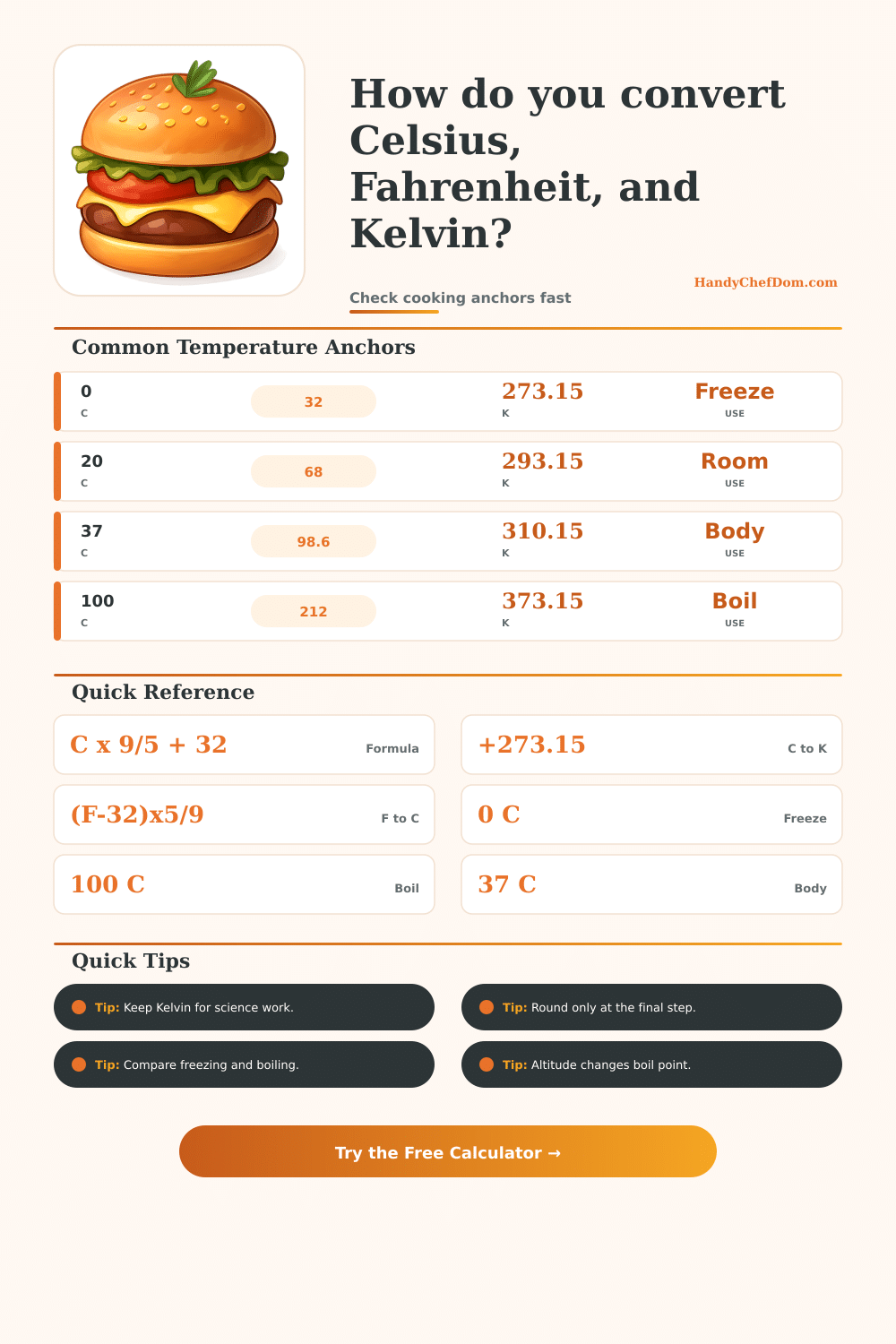
| 0 C | 32 F | 273.15 K | Freeze |
| 20 C | 68 F | 293.15 K | Room |
| 37 C | 98.6 F | 310.15 K | Body |
| 85 C | 185 F | 358.15 K | Simmer |
| 100 C | 212 F | 373.15 K | Boil |
| 180 C | 356 F | 453.15 K | Hot oven |
| Weather | C | F | Note |
|---|---|---|---|
| Cold snap | -10 C | 14 F | Wind chill |
| Cool day | 10 C | 50 F | Jacket weather |
| Mild day | 20 C | 68 F | Comfort zone |
| Warm day | 27 C | 80.6 F | Short sleeves |
| Hot day | 35 C | 95 F | Heat caution |
| Very hot | 40 C | 104 F | Take breaks |
| Kitchen | C | F | Use |
|---|---|---|---|
| Fridge | 4 C | 39.2 F | Cold storage |
| Warm water | 40 C | 104 F | Yeast proof |
| Simmer | 85 C | 185 F | Gentle heat |
| Boil | 100 C | 212 F | Rolling boil |
| Low oven | 120 C | 248 F | Slow roast |
| Hot oven | 180 C | 356 F | Common bake |
| Science | C | F | Context |
|---|---|---|---|
| Absolute zero | -273.15 C | -459.67 F | Physics edge |
| Ice melt | 0 C | 32 F | Phase shift |
| Human body | 37 C | 98.6 F | Core temp |
| Pasteurize | 71 C | 159.8 F | Heat hold |
| Steam point | 100 C | 212 F | Water boil |
| High heat | 200 C | 392 F | Lab / oven |
Temperature scales is used to measure the temperature of an object or environments. Furthermore, each temperature scale allow a person to convert the measurements from one scale to another, such as from Celsius to Kelvin or Fahrenheit. Each temperature scale have different values that relate to specific physical phenomenon, and there are errors that can occur in the conversion of one temperature to another.
As such, it is important to understand each of these scale, the errors that can occur with them, and the reasons that each type of scale is utilized in certain situations. The Celsius scale measure temperatures with 0 degree as the freezing point of water and 100 degrees as the boiling point of water. The Fahrenheit scale indicate that 32 degrees is the freezing point of water and 212 degrees is the boiling point of water.
Temperature Scales and How to Convert Them
The Kelvin scale set 0 degrees as absolute zero, which is the point at which all molecule stop moving. Because of this value, the Kelvin scale never utilize negative numbers. Each of these scales can be verified with certain fixed points within the scale, such as the freezing point of water, the boiling point of water, or the body temperature of a human.
For instance, water freezes at 0 degrees Celsius, 32 degrees Fahrenheit, or 273 Kelvin. Additionally, water boils at 100 degrees Celsius, 212 degrees Fahrenheit, or 373 Kelvin. Finally, the body temperature of a human is approximately 37 degrees Celsius, 98.6 degrees Fahrenheit, or 310 Kelvin.
A variety of task require precise measurement of temperature. For instance, if a person is cooking and the recipe require a specific temperature to be use in the cooking process, that recipe may use the Celsius temperature scale, but the person may need to convert that value to the Fahrenheit scale that is depicted on there thermometer. If the individual makes such a mistake in converting the correct Fahrenheit temperature for the recipe, the food may not cook proper.
Furthermore, the altitude at which the individual is cooking also affects those temperature, as the boiling point of water decrease as the altitude increases. Thus, at higher altitude, the temperature at which liquids boil in comparison than sea level will be lower than 212 degrees Fahrenheit. Due to these factor, cooks must adjust the cooking time of their foods to ensure the food cook properly.
In science projects and science classrooms, the measurements of temperature must also be precise. For instance, science equation often utilize the Kelvin scale. Furthermore, the equations often cannot utilize negative number.
Thus, scientists use the Kelvin scale to ensure that there are no negative numbers in their scientific calculations. Scientists must use these scales to ensure that their calculations are precise and that they are not utilizing a negative number in a situation where there cannot be a negative number. Finally, weather interpretation also utilize the knowledge of each of these temperature scales.
However, the perception of the temperature of the weather can vary from region to region due to factors like humidity and wind. For instance, 20 degrees Celsius may be considered comfortabley for most individual, but 35 degrees may be felt as hot weather. The presence of wind can make the feeling of the weather colder, or the humidity of the region can make it hotter.
Thus, individuals must consider these factor in relation to the temperature value to ensure that the individual is properly prepared for the weather that is occur. There are some common mistake associated with temperature scale conversions. For instance, individuals may make a mistake using the formula to convert from Celsius to Fahrenheit.
Additionally, some individual may not use decimal when converting the numbers to Kelvin. Furthermore, another mistake may be rounding the temperatures too soon in the equation. To avoid these common mistake with temperature scales, individuals should of retain all decimal place until the last step in the equation to retain the precision of the initial number being measured.
Depending on the task, certain precision is required in the measurement of temperature, and the more precise measurements is required in situations like science versus cooking.