🌡 Oven Temperature Adjustment Calculator
Adjust oven temperature for convection, glass pans, altitude, rack position, and covered dishes with confidence.
Enter the recipe's stated temperature, then var the calculator offset it for oven style, pan material, altitude, and other real-world heat losses.
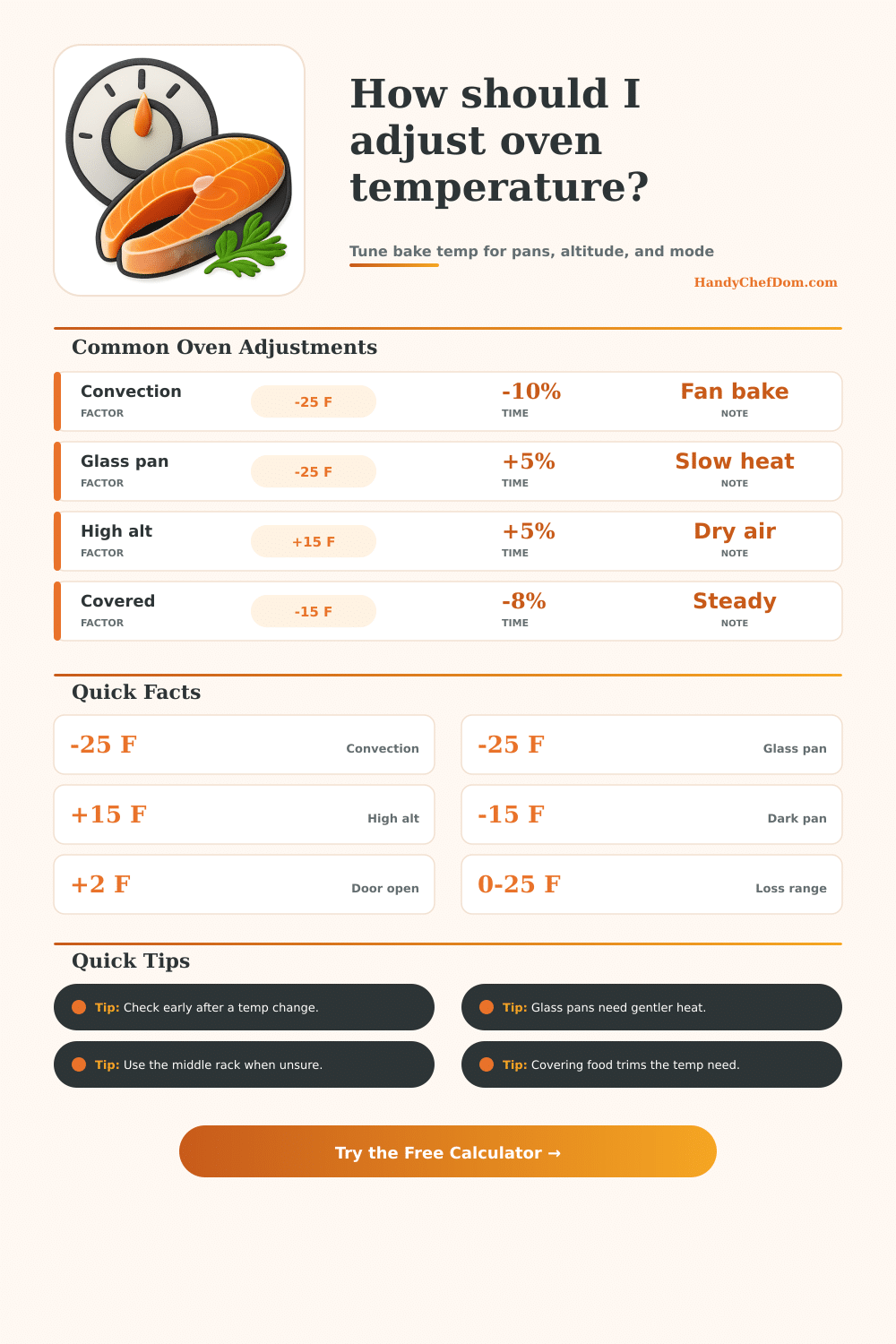
| Oven Type | Temp Adj. | Time Adj. | Best For |
|---|---|---|---|
| Conventional | 0 F | 0% | Most recipes |
| Convection | -25 F | -10% | Fast even heat |
| Fan bake | -20 F | -8% | Circulated air |
| Air fry | -50 F | -15% | Thin fast foods |
| Gas oven | +10 F | 0% | Gentle heat loss |
| Toaster | +5 F | -5% | Small batches |
| Pan | Heat Behavior | Temp Adj. | Check |
|---|---|---|---|
| Aluminum | Even | 0 F | Baseline |
| Glass | Holds heat | -25 F | Look early |
| Dark nonstick | Brown fast | -15 F | Short watch |
| Cast iron | Heat sink | -10 F | Preheat long |
| Ceramic | Slow release | -10 F | Even bake |
| Stainless | Reactive | 0 F | Use liner |
| Altitude | Temp Boost | Time Boost | Note |
|---|---|---|---|
| 0-3000 ft | 0 F | 0% | Sea level |
| 3000-5000 ft | +5 F | +2% | Dry air |
| 5000-7000 ft | +10 F | +4% | Fast evaporation |
| 7000-9000 ft | +15 F | +6% | Lean moisture |
| 9000-11000 ft | +20 F | +8% | Big boost |
| 11000+ ft | +25 F | +10% | Cap applied |
| Condition | Temp Adj. | Time Adj. | Why |
|---|---|---|---|
| Open dish | 0 F | 0% | Direct heat |
| Foil tent | -10 F | -4% | Slows browning |
| Covered | -20 F | -8% | Traps steam |
| Lid on | -15 F | -6% | Gentler bake |
| Top rack | +15 F | -2% | More top heat |
| Lower rack | -10 F | +2% | Less browning |
Cooking results may vary due to the fact that teh oven does not always cook the food to a specific temperature that the recipe require. Most recipes are written with the assumption of a standard cooking setup. A standard cooking setup mean that the rack positioned in the oven is in the middle of a conventional electric oven at sea level.
If any of the variable in the oven are changed, the cook have to change the temperature settings to compensate for the difference. Convection ovens use a fan that circulates the hot air within the oven. Because the hot air circulates within the oven, the convection setting make the cooking process for the food faster and eliminates the hot spots in the oven.
How to Cook Evenly in Your Oven
In this instance, the temperature setting within the oven have to be reduced. The type of pan that is use also changes how fast the food cooks. If glass pans are used, the pans retain the heat long.
With this type of pan, the bottom of the food continue to cook even after the pan is removed from the oven. In this instance, the oven temperature has to be lowered to prevent the edge of the food from burning before the top of the food is cooked. If the rack within the oven is positioned high within the oven, food will be exposed to intense radiation from the top of the oven.
High rack position are used for broiling food. Using these positions to cook cakes can result in the bottoms of the cakes burn before the rest of the cakes are cooked. If the rack is positioned low within the oven, the food will cook more slow because the bottom of the oven is shielded from the heat.
If the food is covered when cooking, the steam will exit the pan. If the pan is covered, the food will be moister because the steam will be trapped within the pan. If the pan is not covered, the food will brown faster because the food will be exposed to the heat direct.
At high altitudes, the air within the earth is thinner so the liquids will evaporate at a faster rate. Because of this, batters cook to form a crust too quick and cookies spread too wide on the baking sheet. To compensate, the oven temperature should be increased.
Opening the oven door release the heat within the oven. Every time the oven door is opened, the oven will take time to reach its cooking temperature again. The density of the food and the temperature of the food will impact the cooking time.
A lasagna that is thick and cold from the refrigerator will take longer to cook than cookies that are thin and are at room temperature. Cooking time can be adjusted according to the depth of the food being cook and the starting temperature of the food to be cooked. The materials of the pan can also change the cooking process.
If shiny aluminum pan are used to cook food, the pans will reflect the heat even throughout the pan. Shiny aluminum pans are the baseline for cooking. If dark nonstick pans are used, the food will absorb the heat quick.
To compensate, the cook has to lower the cooking temperature. If cast iron pans are used, they will absorb and radiate the heat quick. However, the cast iron pan will take longer to preheat than most other type of pans.
If ceramic pans are used to cook food, the heat will release slowly from the pan. Because of this, ceramic pans will provide the most reliable result when cooking food. If the pans that are used are stainless steel, they may react with the acidic food.
To avoid this reaction, the bottoms of the pans should be lined with parchment paper if the food to be cooked contain alot of fruit. Not all ovens are the same. If the oven is a gas oven, the flame will cycle on and off as the recipe cooks the food.
Gas ovens reach higher temperature than electric ovens. If the oven is a toaster oven, the cooking area is smaller so the temperature has to be adjusted for the smaller cooking area. If the oven is an air fryer, intense airflow is used to cook the food.
To compensate for the intense heat created by the air fryers, the cooking temperature has to be significantly lower. For most ovens, the temperature settings have to be preheated for at least ten to fifteen minute. The light within the oven indicate that the thermostat has reached the cooking temperature setting for the food.
However, the heat within the oven is not necessarily even throughout the oven. To accurately read the temperature within the oven, an oven thermometer should be used. Most built-in oven thermometers are not accurate and will read the temperature of the oven differently than the actual temperature of the oven.
Food should be rotated within the oven halfway through the cooking period if the oven does not have even heat distribution because the back and the top of the oven tend to reach higher temperature than the rest of the oven. Avoid opening the oven door to check the food while it is cooking. Opening the oven door release the heat within the oven and the oven will take time to reach the cooking temperature.
This will extend the cooking time of the food. If the food that is cooking starts at a cold temperature, the cooking time will have to be extended. However, care should of been taken to avoid overcooking the food.
By adjusting the cooking temperature for the mode of oven, the pan material, the rack position in the oven, and the altitude of the area in which the oven is located, more even cooking result can be achieved.