Beer Keg Calculator for Events and Draft Service
Estimate pours, keg count, and serving cost using real keg sizes, foam allowance, and reserve margin before you place the order.
Set keg style, pour size, and margins. Core logic: usable volume = keg volume minus foam waste and reserve holdback.
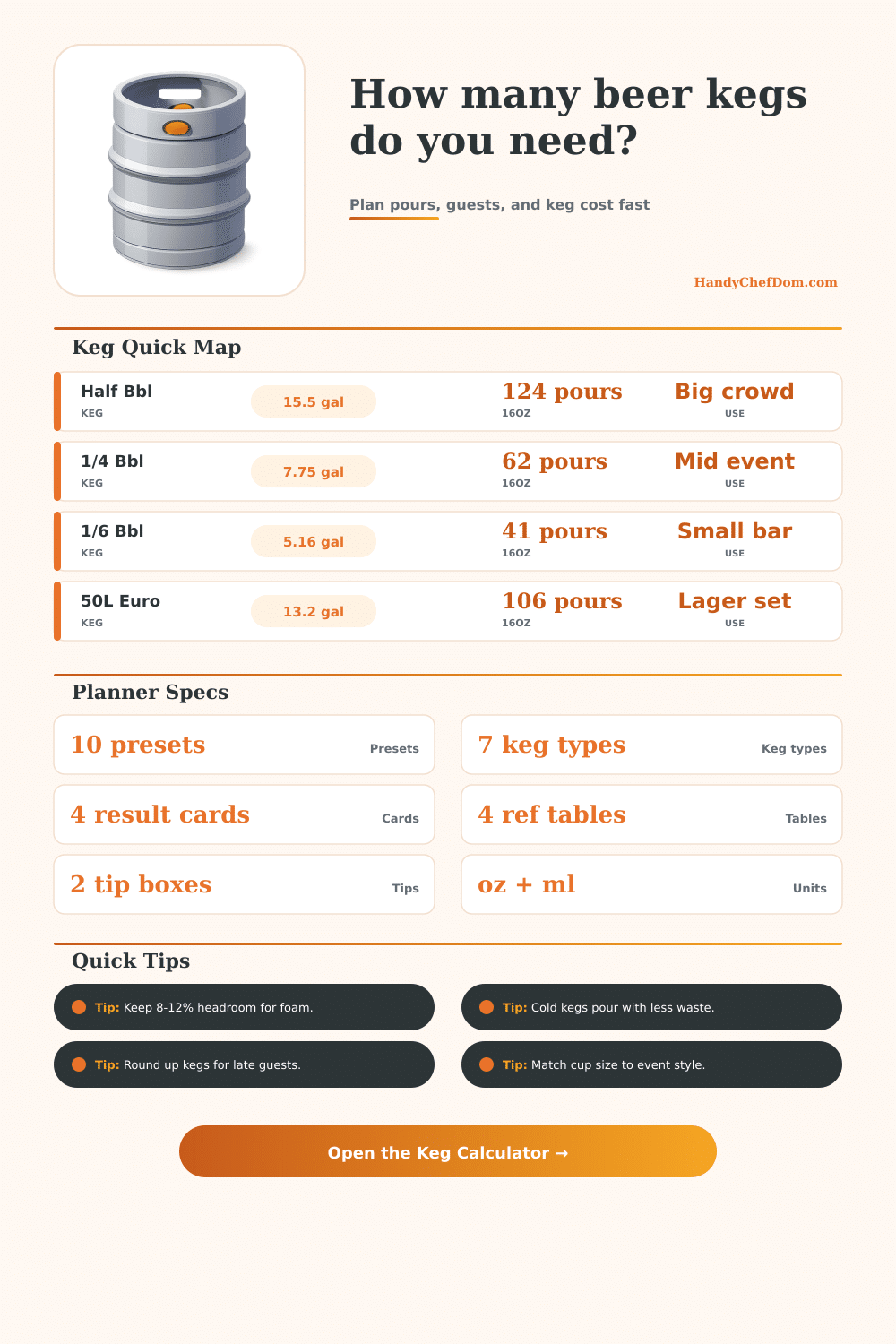
| Keg type | Gallons | Liters | 16 oz pours |
|---|---|---|---|
| Half barrel | 15.5 | 58.7 | 124 |
| Quarter barrel | 7.75 | 29.3 | 62 |
| Sixth barrel | 5.16 | 19.5 | 41 |
| Euro 50 L | 13.2 | 50.0 | 106 |
| Euro 30 L | 7.9 | 30.0 | 63 |
| Corny 5 gal | 5.0 | 18.9 | 40 |
| Mini 5 L | 1.32 | 5.0 | 10 |
| Cup size | Ounces | Milliliters | Style |
|---|---|---|---|
| Taster | 5 oz | 148 ml | Flight |
| Half pint | 8 oz | 237 ml | Sample |
| US pint | 16 oz | 473 ml | Core pour |
| Imperial pint | 20 oz | 568 ml | UK style |
| Stadium cup | 24 oz | 710 ml | High volume |
| Stein | 33.8 oz | 1000 ml | Festival |
| Guests | Pours/guest | 16 oz need | Sixth kegs |
|---|---|---|---|
| 40 | 2 | 80 pours | 2 |
| 60 | 2 | 120 pours | 3 |
| 80 | 2 | 160 pours | 4 |
| 100 | 2 | 200 pours | 5 |
| 120 | 3 | 360 pours | 9 |
| 160 | 3 | 480 pours | 12 |
| Style | Keg size | Avg beer $ | Deposit $ |
|---|---|---|---|
| Domestic lager | Half bbl | 180-210 | 30-60 |
| Craft IPA | Half bbl | 220-290 | 30-60 |
| Pilsner import | 50 L | 210-280 | 40-70 |
| Seasonal ale | Sixth bbl | 95-145 | 20-40 |
| Stout specialty | Quarter | 140-200 | 25-50 |
| Homebrew keg | Corny | 45-90 | 0-25 |
Planning a party with draft beer requires that you take into account several different variable. With draft beer systems, not every drop of the liquid in the keg is served to the guest. The keg contains a specific amount of beer, but the amount of beer that is actualy usable is less than the total volume of the keg due to the amount of foam that is created when pouring the liquid and the loss of beer that the guests themselves can cause during pouring.
To calculate the number of kegs of beer that will be needed for the party, the following information are necessary: the style of keg that will be used, the pour size of the beer, the allowance for foam that will be created when pouring the beer, and the number of guests that will attend the party. The size of the keg will determine the volume of the beer that can be dispensed from the keg. For example, a half barrel keg holds 15.5 gallons of beer; however, there will always be less beer that is usable from the keg than the total volume of the keg.
How Many Kegs Do You Need for a Party
This is due to the formation of foam from the pouring of the beer as well as the loss of beer that occur from the pouring of the beer by the guests at the party. Additionally, the servers may also lose some of the beer from the keg as they perform test pours of the beer prior to begin to serve the guests. Foam loss and reserve holdback are two variables that are often underestimate when throwing a party with draft beer.
With foam loss, some of the beer will become foam once it is poured from the keg; this lost portion of the beer cannot be used. The percentage of foam loss can be set in the calculator. For instance, ten percent of the beer may become foam once it is poured from the keg.
This can be more if the beer is poured during a warm afternoon or if there are long lines of guests for whom the bartender is pouring the beer. Reserve holdback is not the same than foam loss, but is another way to lose some of the beer to the keg. The amount of beer that is held back in the keg ensure that the keg does not sputter and spit when the last guest is served from the keg.
This beer is lost, as well, but is done intentionally so that there is no problem with the keg when serving the last few guest of the evening. The size of the pour of beer from the keg will also impact how many kegs is necessary to provide enough beer for the guests. If the beer is poured in 12-ounce servings, more guests can be served from a single keg than if the beer is poured in 16-ounce servings.
This pour size can be tested in the calculator so as to determine if fewer kegs are necessary to supply beer for each guest at the party. The number of guests attending the party and the number of pours of beer that each guest will consume will impact the amount of beer that is needed. The more guests that show up to the party, the more beer will be consumed.
The same is true of the number of pours that each guest will have; the more pours that is required of each guest, the more beer will be consumed from the kegs. For instance, if every guest is to have two beers, the total amount of beer that is required will double. If every guest has three beers at the party, the number of kegs required will increase quick.
The field for service time in the calculator will show the length of time that the beer will be poured at the party. This can be helpful for those throwing the party in that they may need to hire additional bartender to keep up with the service time requirements of the guests. There are different types of kegs that may be used for different purpose.
For instance, a sixth-barrel keg is relatively light so as to be carried by one person to the party. Additionally, a sixth barrel keg will chill quickly if placed in a tub of ice. A half barrel keg is used for larger parties; however, a half barrel keg will require a jockey box or kegerator to properly function at the party.
Euro 50-liter kegs are also available for those throwing parties; these kegs will fit many commercial draft systems. The different types of kegs have different requirements that must be met by the party hosts, such as how the keg will need to be moved to the party, how quickly it will chill, and whether it is compatible with the draft systems that will be used at the party. Another important number is the cost per pour of draft beer.
The cost per pour is calculated by adding the price of the beer and the deposit to be placed into the keg; the cost will be divided by the number of pints of beer that can be obtained from the keg. While many parties may consider the deposit to be a sunk cost, it can be refunded to the party host once the keg is drained of beer. By calculating the cost per pour, the host can determine whether the cost of the beer is affordable for the party.
Many people make mistakes when estimating the amount of draft beer that will be needed for a party. One of the most common is that they do not account for the last few gallons of beer that may remain in the keg; the draft beer is often poured until the foam becomes too thick to allow for proper pouring, or the line pressure of the beer drops to the point where proper pouring is again not possible. Additionally, people do not account for the fact that some types of beer will foam more than others.
For instance, an IPA may have higher level of carbonation that results in more foam being created when the liquid is poured from the keg than, say, a lager. Thus, the foam loss field can be used to account for the type of draft beer that will be served at the party. The temperature to which the keg is heated can also play a role in how much beer is wasted in the pouring process.
If the keg is warm, it will create alot of foam when it is poured. Warm kegs waste beer. Cold kegs, which are kept at 38 degrees or lower, will waste less beer while being poured.
Thus, a host should take care to keep the kegs cold in order to waste as little beer as possible during the party. There are reference tables that may assist in understanding the size of the cups that may be used for the beer at the party. For instance, 5-ounce cups may be used for guests who are having a tasting flight of beers from the keg; however, 24-ounce “stadium” cups may be used for a group of guests who are having a tailgate party.
Using the wrong size of cup for the type of party can result in guests finishing their beer too quick; they may ask for more beer than is currently being dispensed from the kegs. Thus, the size of the cup may be adjusted according to the type of party that is to occur. In most cases, it is better to order one extra keg of draft beer than to risk running out of beer for your guests.
The calculator will tell you how many kegs you need based on the parameter for draft beer such as foam loss, reserve holdback, and pour size. However, it is best to round up to the next keg so that you have some extra beer for those late arrival to the party. The factors that you should pay the most attention to include the foam loss and reserve holdback variables; both will reduce the amount of beer that is usable from the keg.
The number of guests and the number of pours that each guest will have will impact how many kegs you will need; thus, you should pay attention to those variable. The price of the keg and the required deposit should also be paid attention to; these will impact the total cost of the party. With these number known, the calculator will provide an order for the number of kegs and in what size to order for your party.