Sausage Meat to Fat Ratio Calculator
Plan a fresh sausage batch by target fat percentage, starting meat fat, added fat purity, binder, ice water, salt, batch loss, and casing diameter.
Pick a style, then adjust the meat and fat you actually have. The calculator solves for added fat instead of assuming every trim pile is perfectly lean.
Firm bite, best for poultry or diet batches.
Good for smoked links with a cleaner finish.
Juicy pork texture for patties and links.
Very rich; chill well and stuff gently.
| Style | Target | Use |
|---|---|---|
| Turkey | 15% | Lean links |
| Andouille | 20% | Smoked links |
| Bratwurst | 25% | Grilling |
| Pork | 30% | Classic links |
| Venison | 35% | Game blend |
| Source | Fat | Note |
|---|---|---|
| Pork shoulder | 15-25% | Great base |
| Pork belly | 45-60% | Rich blend |
| Back fat | 85-95% | Clean fat |
| Venison | 2-6% | Needs fat |
| Chicken thigh | 10-18% | Mild base |
| Add-in | Rate | Purpose |
|---|---|---|
| Salt | 1.5-2% | Flavor bind |
| Ice water | 3-8% | Juice and bind |
| Milk powder | 1-3% | Moist texture |
| Rusk | 3-5% | Soft bite |
| Sugar | 0.5-1% | Round flavor |
| Casing | Size | Length |
|---|---|---|
| Sheep | 22 mm | 3.4 ft/lb |
| Sheep | 28 mm | 2.1 ft/lb |
| Hog | 32 mm | 1.6 ft/lb |
| Hog | 35 mm | 1.3 ft/lb |
| Beef | 42 mm | 0.9 ft/lb |
How the sausage ratio math works: the calculator separates the fat already present in your starting meat from the lean portion, then solves how much added fat is needed to reach the selected finished fat percentage.
When the target is impossible: if your starting meat is already fattier than the target, adding fat cannot make it leaner. Use leaner meat, reduce belly, or choose a higher target fat percentage.
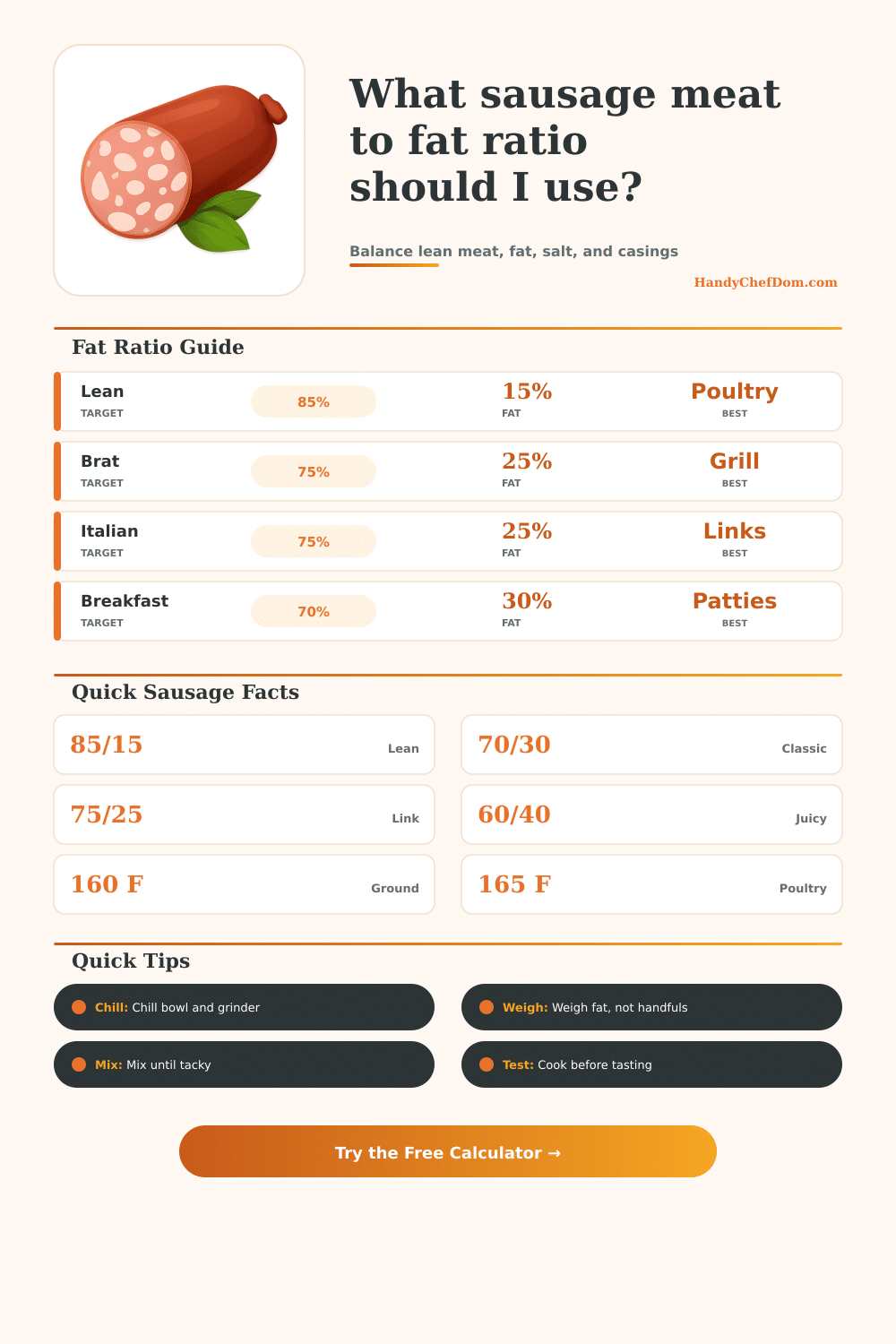
Food safety note: USDA guidance lists 160 F for ground meat and sausage, and 165 F for poultry. Use a food thermometer and follow tested curing or smoking instructions when making cured sausage.
Making sausage at home require you to manage the fat content of the meat. The fat content of the meat will determine the texture and the moisture of the sausages that you create. If the fat content is too low, the texture of the sausage will be dry and crumble.
However, if the fat content is too high, the fat will render out of the meat and the sausage will be too greedily. You must know the exact amount of fat that is already contained within you meat before you begin to add fat to the meat. Many sources of meat trim will not contain the same percentage of fat as the percentage that is listed on the package of the meat.
How to Use a Sausage Calculator
For example, pork shoulder may contain 18% fat but venison trim may contain only 5% fat. The calculator will allow you to enter the fat percentage of your meat as well as the purity of the fat that you plan to add to your meat. For instance, back fat is not usually 100% pure fat, if you enter 90% purity for the added fat, the calculator will account for the lean meat that is also contained within the back fat.
Additional inputs include the percentages of salt, binder, and ice water that you will use in the creation of your sausages. While salt, binder, and ice water will change the total weight of your sausage mix, these ingredients will not change the lean-to-fat ratio of your sausage mix. Salt is typically used in amounts between 1.5% and 2% of the total weight of your meat because salt help to draw out moisture from the meat and helps the proteins within the meat to bind together.
Binders and ice water is also typically used in the creation of sausage, binders and ice water add weight to the mix and help the meat to remain emulsified throughout the stuffing of the sausages. The calculator will account for the weight of the salt, binders, and ice water that will be used in the creation of your sausages. Another of the inputs that the calculator requires is the diameter of the casings in which you will stuff the sausage.
The diameter of the casings will have an impact upon the amount of casings of a given diameter that you will need to contain all of your sausage mix. For instance, sheep casings are typically narrower than beef casings, so you will need more feet of casings of a smaller diameter than you would need for a larger diameter casing. For instance, if you calculate that you will need 10 pounds of sausage, a 28-millimeter casing will require a different length of casing than a 35-millimeter casing.
This input allows the calculator to provide an estimate of the length of the casings that you will need. In addition to the sausage recipes that is available in the calculator, there are several reference tables that list the fat-to-lean ratios that are typically used for different types of sausages. For example, a ratio of 70% fat to 30% lean is a good target ratio to use for breakfast patties.
Similarly, a 75% fat to 25% lean ratio is a good target ratio to use for Italian links. Venison blends, however, typically require 35% fat because venison contains very little fat. These target ratios provide an idea of the fat content of sausage recipes that you can make at home with the meat that you have in your kitchen.
Before you grind the meat for your sausages, calculating the fat content of the meat and the amount of fat that will be added to the meat allows you to identify whether any of the targets that you wish to create are impossible to achieve. For instance, if your pork shoulder contains 25% fat, you cannot create sausages that have 20% fat by adding fat to the meat. This calculation allows you to rule out impossible targets before you begin to prepare your ingredients.
All of the ingredients for your sausages should be chilled prior to grinding the meat. Fat that is too warm will smear out over the grinder plate. Chilling your bowls and your hands prior to the preparation of your sausage will prevent the fat from warming and changing the texture of your sausage mix.
You should not taste the raw sausage mix prior to cooking. While it is possible to determine the level of salt in the raw sausage mix by tasting it, the more reliable method is to cook a small patty in a skillet and taste the cooked patty. The level of salt that the recipe calculates is based upon the assumption that the salt level will be adjusted after tasting the cooked test patty.
Additionally, the cooked test patty will allow you to determine if the fat is rendering correct. Another of the inputs that the calculator collects is batch loss. Some loss of the sausage mix is inevitable when using the grinder, the stuffer, and the mixing bowl.
A batch loss of 2% is typically used to account for loss in these ingredients. If your grinder leaks sausage mix or if you plan on making a large batch of sausage, you may want to account for these scenarios by increasing the batch loss percentage. In addition to all of the other information that is provided in the calculator, there is additional safety information provided at the bottom of the results of the calculator.
This information describes the internal temperature to which the meat must be cooked. Ground red meat should reach an internal temperature of 160 degrees with a thermometer while cooking. Poultry, however, should reach an internal temperature of 165 degrees.
While the sausage calculator will not replace a kitchen thermometer, the calculator will help to ensure that the internal temperature of your meat reaches the correct temperature during the cooking process. Fatty cuts of meat can be used in place of added fat. However, adding fat separately to the meat is typically the preferred method of achieving fat content to lean meat ratios.
If you use fatty cuts of meat alone, the fat may not be distributed even throughout the sausage. Additionally, if the fat is weighed separately from the lean meat, the fat distribution can be controlled and the texture of the sausage made more predictable. However, the fat ratio cannot be changed once the sausage is completed.
Any changes can be made to the level of salt or the herbs after cooking the test batch of sausage. Planning the fat ratio of your recipe prior to beginning the preparation of the sausage is, therefore, an essential step in creating sausages. Using the sausage calculator is one way to transform what may be an uncertain process of creating sausages at home into a repeatable process.