🍕 Pizza Dough Ball Size Calculator
Estimate dough ball size from pizza diameter, pizza style, crust thickness, hydration, dough density, pizza count, proof loss, and baker percentages for flour, water, salt, yeast, and oil.
Use round mode for diameter-based pizzas and pan mode for sheet pizzas. Dough density is the main sizing control: lower values make thinner pies, while higher values support pan, Detroit, and Sicilian styles.
Light center, larger rim, and moderate density for 12 inch pies.
Foldable 14 inch slice with balanced hydration and a sturdier center.
Lower density and thinner center for 14 to 16 inch crisp crusts.
Higher density supports a soft interior and taller edge.
Rectangular pan dough needs more mass for a thick, airy crumb.
Large sheet pizzas use a generous ball and high hydration.
Moderately thin round pizza with a light but structured profile.
Small density target for a very thin, cut-square pizza base.
| Diameter | Thin or tavern | Neapolitan | New York | Pan style |
|---|---|---|---|---|
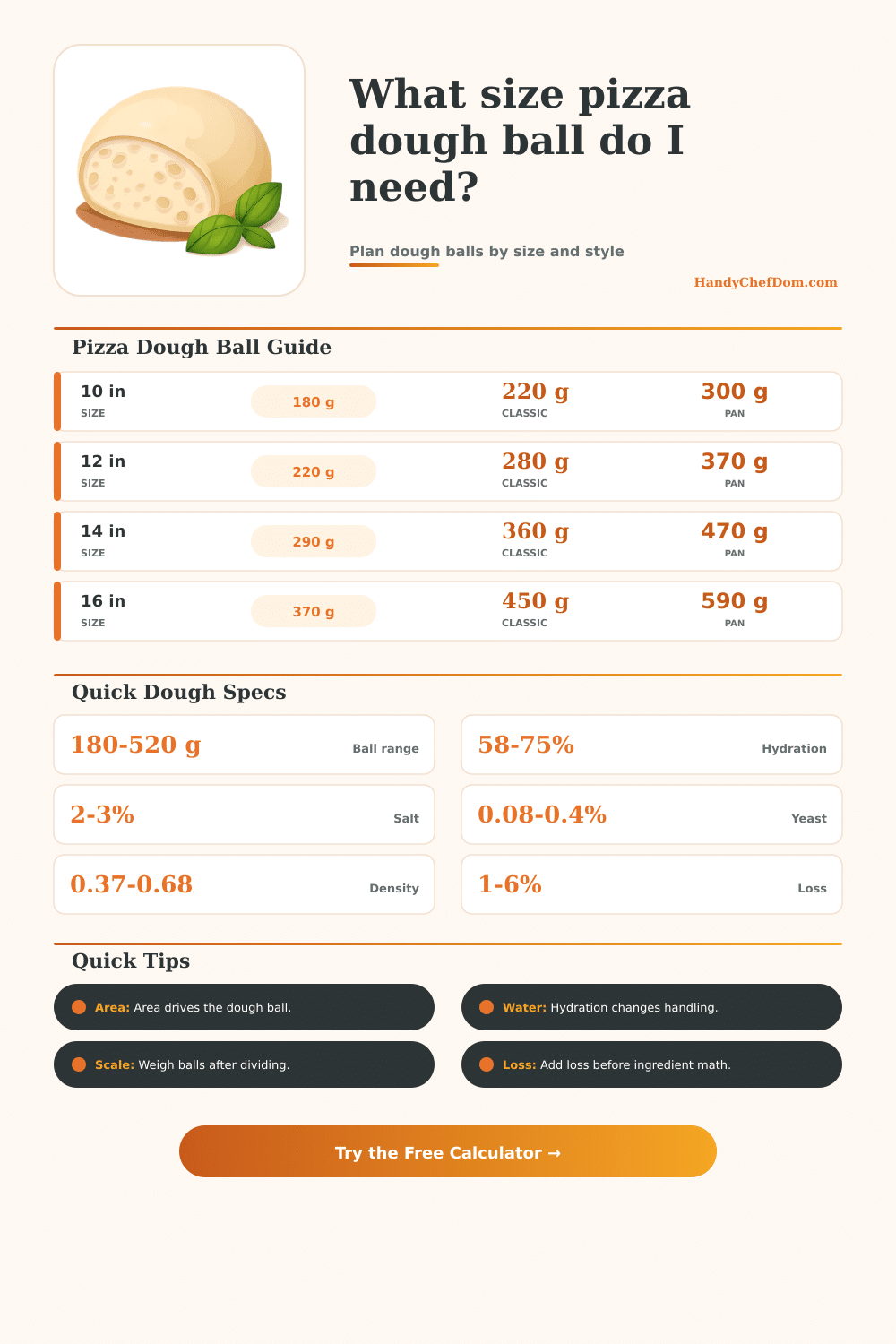
| 10 inches | 165 to 195 g | 210 to 240 g | 230 to 270 g | 285 to 340 g |
| 12 inches | 210 to 250 g | 250 to 295 g | 285 to 335 g | 360 to 430 g |
| 14 inches | 280 to 330 g | 330 to 390 g | 355 to 420 g | 460 to 540 g |
| 16 inches | 360 to 430 g | 420 to 500 g | 455 to 535 g | 590 to 700 g |
| Pan size | Classic pan | Detroit | Sicilian | Grandma pan |
|---|---|---|---|---|
| 8 x 10 inches | 330 to 410 g | 430 to 520 g | 470 to 560 g | 350 to 430 g |
| 10 x 14 inches | 570 to 700 g | 700 to 850 g | 820 to 980 g | 600 to 760 g |
| 12 x 16 inches | 780 to 960 g | 960 to 1150 g | 1100 to 1320 g | 850 to 1050 g |
| 13 x 18 inches | 950 to 1180 g | 1180 to 1420 g | 1350 to 1600 g | 1020 to 1280 g |
| Hydration | Dough feel | Suggested density | Good style | Handling cue |
|---|---|---|---|---|
| 56 to 60% | Firm | 0.060 to 0.078 oz/in2 | Thin crisp | Easy to sheet |
| 61 to 65% | Balanced | 0.078 to 0.095 oz/in2 | NY or Roman | Stretchable |
| 66 to 70% | Open and tacky | 0.088 to 0.115 oz/in2 | Neapolitan | Use light flour |
| 71 to 76% | Slack | 0.110 to 0.150 oz/in2 | Pan or Sicilian | Oil the pan |
| Flour base | Water at 62% | Salt at 2.5% | Yeast at 0.16% | Total lean dough |
|---|---|---|---|---|
| 500 g flour | 310 g water | 12.5 g salt | 0.8 g yeast | 823 g dough |
| 1000 g flour | 620 g water | 25 g salt | 1.6 g yeast | 1647 g dough |
| 1500 g flour | 930 g water | 37.5 g salt | 2.4 g yeast | 2470 g dough |
| 2000 g flour | 1240 g water | 50 g salt | 3.2 g yeast | 3293 g dough |
Pizza dough ball sizing is an estimate for planning and repeatability. Weigh each ball after dividing, then use your own stretch preference to adjust density for the next batch.
The size of the dough ball has a major impact upon the quality of the resulting pizza. The size of the dough ball impact the ability of that dough to stretch, as well as the way in which the pizza will cook. If the dough ball is too small, the dough may stretch too thinly during the forming of the pizza, which may lead to the dough tearing or cooking before the toppings has reached there desired level of doneness.
Conversely, if the dough ball is too large, the center of the pizza may remain doughy while the edges of the pizza cook too quick. The mass of the dough ball will impact the thickness of the crust of the pizza. While many may believe that the weight of the dough ball is a matter of personal style, the area and thickness of the pizza calculates the actual weight of the dough ball.
How Dough Ball Size Affects Pizza
Each of the different styles of pizza require a different weight of dough balls. Furthermore, each of those styles has different diameter or pan sizes. To ensure that each pizza has the desired thickness and diameter, a calculator can help to determine the weight of the dough balls that should be create by the recipe.
One of the variables that can impact the behavior of the dough is the hydration of that dough. Dough hydration is a measurement of the amount of water that is contained within the dough. Dough that contains a high percentage of hydration will be softer than dough that contain a lower percentage of hydration.
For instance, dough that contains 72% hydration will behave differently than dough that contains only 60% hydration. However, you can adjust the hydration within the calculator to ensure that the ingredient list for the dough will remain consistant with the weight of each dough ball. In addition to dough loss due to the amount of salt and yeast that is included in the dough balls, there is also proof loss.
Proof loss can occur due to the dough sticking to the mixing bowl, the loss of flour due to the dusting of dough during kneading, and the loss of moisture from the dough during the resting portion of the proving process. A buffer of 3-4% can be added to the total weight of the dough to account for proof loss. This percentage are included in the total weight of the dough balls calculated in the calculator to ensure that the cook does not make adjustments for proof loss.
Density is a variable that measures the amount of dough mass per square inch of the pizza. Thin crust dough balls will have low density of dough because thin crusts are supposed to be light and crisp. In contrast, Detroit or Sicilian crusts will have high densities of dough to allow the crust to be airy and tall above the pizza.
The density of the dough can be changed in the calculator to provide an estimate of how much dough may be required for each pizza batch with a specific diameter. The density can be adjusted to change the recipe for the dough balls. Reference tables provide examples of different sizes of pizzas and different sizes of pans.
These tables allow for comparisons between the different types of crusts and their recommended densities. These tables also provide information regarding the differences between hydration percentages and densities. For instance, the table may indicate that open crust pizzas have higher percentages of hydration than thin crusts, and that thicker crusts have higher densities of dough than thinner crusts.
Furthermore, these tables allow cooks to make adjustments to one variable at a time. In addition to the variables described above, there are also environmental factors that can impact the behavior of the dough balls. For instance, the protein levels of the flours, the temperatures of the kitchens in which the pizzas are prepared, and the way in which the dough is degassed will have some impact upon the dough balls.
While the dough ball calculator will provide a recipe based off numbers, adjustments will need to be made to account for environmental factors during the preparation of the pizzas. One of the ingredients that will have the most impact upon the crust of the pizza is the type of oil that is included in the pizza dough balls. The oil will tenderize the crust of the pizza, but if too much oil is included in the recipe, the crust may become too soft.
Furthermore, the dough ball calculator also accounts for the amount of oil included in the recipe; adjustments to the amount of oil will require adjustments to the other ingredients of the pizza dough balls. An additional variable to consider is the amount of yeast that is included in the pizza dough balls. The amount of yeast that is used will impact the proofing time for the dough balls.
For instance, more yeast will allow the dough balls to proof in less time, but less yeast will produce a crust with more flavor due to the increased proofing time. You can adjust the amount of yeast that is included in the recipe in the calculator based upon the number of hours for which the pizza dough balls are to be proofed. The first batch of pizza dough balls can be used as a test to determine the consistency of the dough balls, the thickness of the crust of the pizzas, and the weight of each batch of dough balls.
After baking the pizzas with the first batch of dough balls, the cook should note the thickness of the crusts. Furthermore, the cook can measure the weights of each batch of dough balls. These notes can then be used to adjust the density or the thickness of the center of the pizza balls for the following batches of pizza dough balls.
Ensuring that each batch of dough balls weighs the same will ensure that each batch of pizzas will have the same thickness of crust.