🍞 Yeast Doubling Time Calculator
Estimate how long yeast needs to double or reach a target growth level using strain, temperature, sugar, salt, hydration, pH, oxygen, and nutrient conditions.
This calculator models yeast doubling time as an estimate. It starts with a strain baseline near its best growth temperature, then adjusts for real kitchen fermentation conditions.
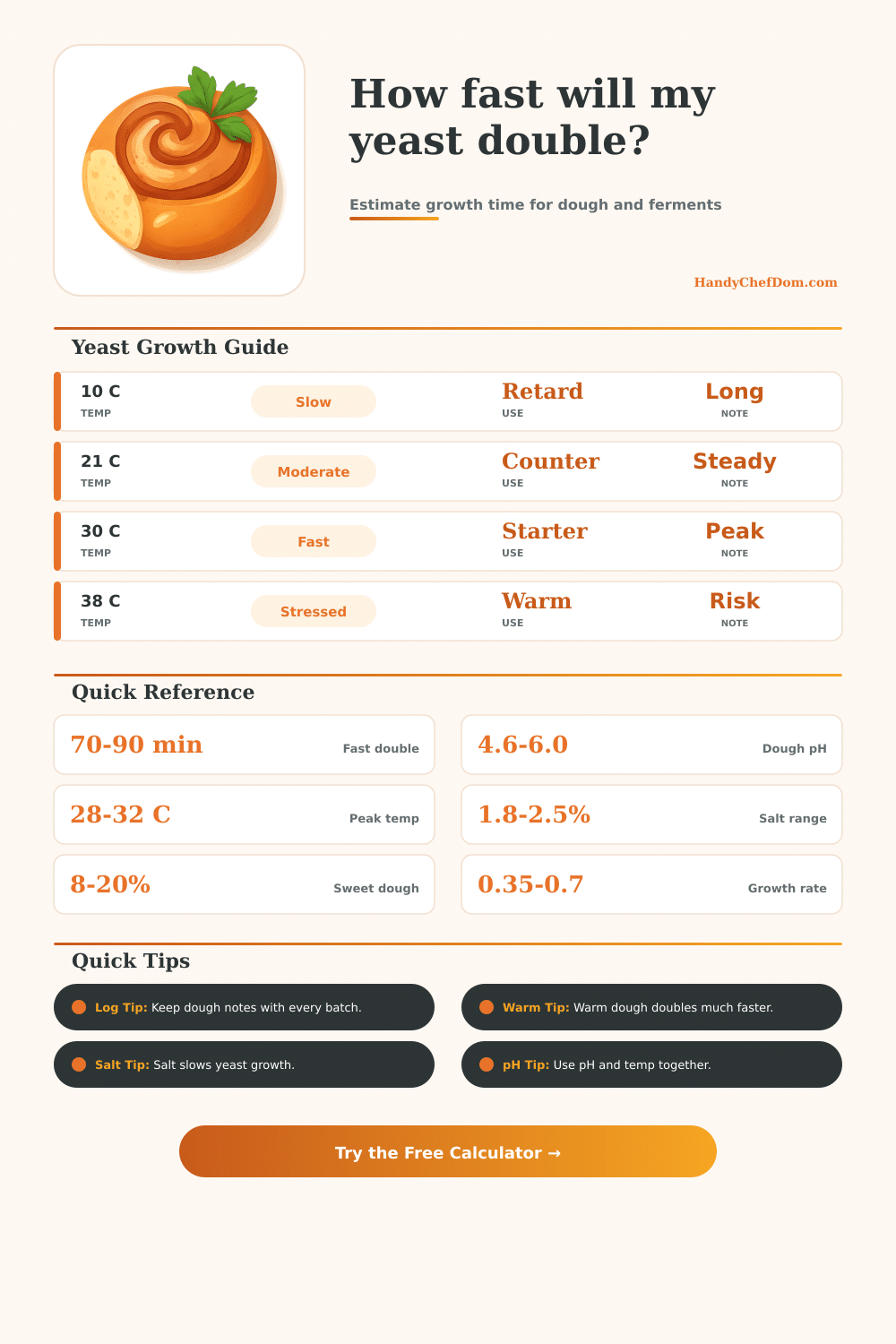
| Temperature | Typical Growth | Kitchen Use | Calculator Effect |
|---|---|---|---|
| 39-50 F / 4-10 C | Very slow | Cold retards | Long doubling time |
| 59-68 F / 15-20 C | Slow to moderate | Cool room dough | Steady but delayed |
| 70-78 F / 21-26 C | Moderate | Counter proofing | Balanced estimate |
| 82-90 F / 28-32 C | Fast | Preferments and starters | Shortest estimate |
| 95-104 F / 35-40 C | Fast but stressed | Very warm ferments | Stress penalty added |
| Above 108 F / 42 C | Poor survival | Avoid for growth | Large penalty |
| Yeast Type | Base Double | Best Temp | Common Kitchen Use |
|---|---|---|---|
| Instant baker's yeast | 80 min | 30 C | Bread and pizza dough |
| Active dry baker's yeast | 95 min | 30 C | Home bread dough |
| Fresh compressed yeast | 85 min | 30 C | Bakery dough |
| Osmotolerant yeast | 110 min | 30 C | Sweet enriched dough |
| Wild sourdough yeast mix | 180 min | 27 C | Levain and starters |
| Ale yeast | 120 min | 25 C | Kitchen wort starter |
| Lager yeast | 180 min | 16 C | Cool ferment starter |
| Wine yeast | 160 min | 25 C | Must and fruit ferments |
| Kveik yeast | 75 min | 35 C | Warm fast starters |
| Ferment Scenario | Sugar | Salt | Hydration |
|---|---|---|---|
| Lean bread dough | 0-3% | 1.8-2.2% | 60-70% |
| Pizza dough | 0-2% | 2.0-3.0% | 58-68% |
| Sweet roll dough | 8-20% | 1.5-2.2% | 55-70% |
| Poolish preferment | 0-1% | 0% | 100% |
| Liquid starter | 2-8% | 0% | 100-140% |
| Fruit must or wort | 10-24% | 0-1% | Liquid |
| Condition | Fast Zone | Slow Zone | Why It Matters |
|---|---|---|---|
| pH | 4.5-5.5 | Below 3.5 | Acid stress slows yeast division |
| Hydration | 75-120% | Below 50% | Water availability controls mobility |
| Salt | 0-1% | Above 3% | Salt pulls water from cells |
| Sugar | 2-8% | Above 18% | High sugar creates osmotic pressure |
| Oxygen | Aerated | Still dense dough | Oxygen supports growth phase |
| Age | Fresh dose | Old or tired yeast | Lag phase may be longer |
Yeast does not grow on a fixed schedule, and the speed at which yeast grow can vary based off several environmental factors. For example, yeast will take less time to double a lean dough than it will to double the same recipes if the dough contains sugar and salt or if the recipe is prepared in a cooler kitchen. Because of the variable nature of yeast, many cooks use a yeast doubling time calculator to ensure that there dough will be ready at a specified time or that their yeast starter will be active enough at a specified time.
The first of the factors that will affect yeast growth is the temperature of the environment. Increasing the temperature will increase the growth rate of the yeast, while decreasing the temperature will slow the growth of the yeast. If the temperature of the environment is a few degrees lower than the optimum temperature for the yeast strain, more time will be required for doubling.
What Affects Yeast Growth and How to Use a Doubling Time Calculator
If the temperature is a few degrees higher than the optimum temperature, the yeast will grow at a faster rate before eventually slowing due to heat stress on the yeast cells. By entering the actual temperature of the kitchen or baking area and the type of yeast that will be used in the recipe, the calculator can provide an accurate estimate of the doubling time. Sugar and salt are two additional factors that can impact the growth rate of the yeast.
Both sugar and salt will impact the environment of the yeast cells; sugar provides food for the yeast cells while too much sugar will draw water out of the yeast cells through osmosis. The same is true of salt, as it will draw water out of the yeast cells. Because yeast cells requires water to perform their cellular functions, removing water from those cells will slow the rate at which the yeast cells can divide.
Doughs that are sweet or contain salt, like pizza dough, will take longer to rise then lean doughs. Using the calculator to input the percentage of sugar and salt in the recipe allows the calculator to take this impact into account. Another factor that affects the growth of yeast is the hydration level of the dough.
Stiff dough will provide less movement of the yeast cells than dough with a more higher hydration level. This is one of the reasons that preferments like poolish and biga often rise at a different rate from the final dough despite containing the same amount of yeast. Using the calculator to adjust the hydration percentage will reflect the impact that hydration has on yeast.
The pH level and the nutrient content of the ingredients also have an impact on yeast growth. As with all living organisms, yeast prefers an environment with a mildly acidic pH. If the pH level is too low, the growth of the yeast will be inhibited.
Similarly, if dough is too dense and does not contain enough oxygen, the yeast will have to work harder to perform their functions than if they were in a more aerated environment. These factors are also taken into account by the calculator to give a total estimated time for yeast doubling. Another factor is the specific type of yeast that is used.
Each type of yeast strain will feature different properties that will impact the doubling time. Instant yeast is a general-use yeast that features an optimized doubling time for baking recipes. Other yeasts, however, are bred for specific environments.
For instance, osmotolerant yeasts are bred to tolerate high levels of sugar. Wild yeast from sourdough cultures take much longer to grow than commercial yeast. Kveik yeast strains are bred to grow at high temperatures.
Each recipe will require the use of a specific type of yeast, and this must be entered into the calculator. Another factor to consider with yeast is the lag phase. During the lag phase, there is no growth of the yeast.
This period occurs after adding the yeast to the dough. The lag phase can last between thirty and ninety minutes depending on the specific type of yeast. The doubling time is entered into the calculator with the lag phase to calculate the total length of time that the recipe will take to double.
The result will be the total amount of time required. The reference tables included in the recipe allow for the verifying of the accuracy of the calculator. The tables include information about how specific temperatures relate to the growth rates of yeast.
The tables also show the impact of sugar, salt, and hydration levels on different types of dough. The information in these tables dont need to be memorized but can be reviewed prior to entering variables into the calculator to ensure that the selected settings are within the normal range for the type of recipe that is being prepared. While yeast doubling time calculators account for the majority of the factors that impact the growth of yeast, there are a few variables that cannot be accounted for.
The protein quality of the flour can vary from batch of flour to batch. Using old yeast can lead to slower growth of the yeast even if the package date has passed. The internal temperature of the dough mass might be different from the air temperature in the kitchen.
The calculator provides an estimate of the doubling time for the yeast given these variables. However, visually checking the dough before the halfway mark of the rising period will allow cooks to adjust the recipe to either provide more warmth for the dough or allow it to rise later. Using the estimate of the doubling time of the yeast can help cooks to plan their kitchen schedule for bread and other baked good preparation.
If the recipe requires cold dough that will take six hours to rise, cooks can decide to move the dough to a warmer location or start the dough earlier in the kitchen schedule. If the recipe features sweet dough, cooks will recognize that the rising time will be longer than for lean dough recipes and will not pull the rolls out of the oven before they are fully proofed. After using the calculator for various recipes, cooks will be able to remember how different variables can impact yeast growth.
The calculator can also be used to test these observations about the growth of yeast.