🍚 Dry Quinoa Per Cup Cooked Calculator
Convert cooked quinoa needs into dry cups, grams, cooking water, and expected yield after type, texture, rinse loss, and batch scaling.
Enter the cooked quinoa you want to end with. The calculator estimates the dry quinoa to measure before rinsing, the dry grams, water, and yield margin.
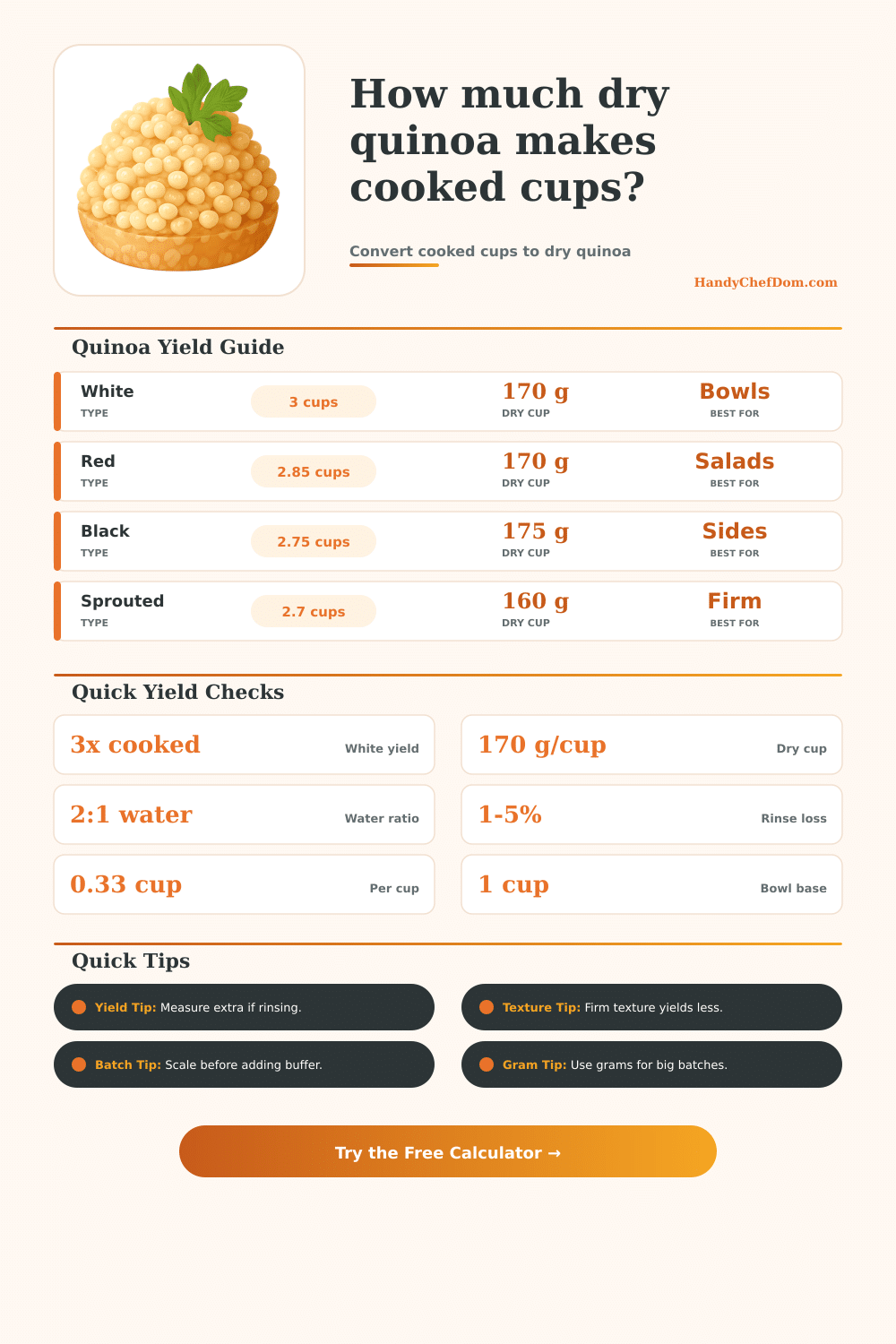
| Quinoa Type | Cooked Yield From 1 Dry Cup | Dry Grams Per Cup | Best Calculator Use |
|---|---|---|---|
| White quinoa | About 3.00 cooked cups | 170 g | Everyday bowls and sides |
| Red quinoa | About 2.85 cooked cups | 170 g | Chilled salads and grain mixes |
| Black quinoa | About 2.75 cooked cups | 175 g | Chewier side portions |
| Tri-color quinoa | About 2.85 cooked cups | 172 g | Mixed texture meal prep |
| Sprouted quinoa | About 2.70 cooked cups | 160 g | Firm, lighter batches |
| Quick-cook quinoa | About 2.40 cooked cups | 165 g | Smaller fast batches |
| Pre-rinsed quinoa | About 3.00 cooked cups | 168 g | Low loss pantry packs |
| Pearled quinoa | About 2.95 cooked cups | 166 g | Tender side dish texture |
| Yield Style | Yield Multiplier | Water Multiplier | Calculator Note |
|---|---|---|---|
| Covered stovetop absorption | 1.00x | 1.00x | Baseline for most quinoa package ratios |
| Rice cooker absorption | 1.02x | 1.02x | Slightly fuller steam hydration |
| Pressure cooker style | 0.98x | 0.86x | Less evaporation and tighter water amount |
| Pilaf saute then simmer | 0.96x | 0.96x | Coated grains finish a little drier |
| Open simmer and drain | 0.93x | 2.50x | Uses extra water that is drained away |
| Pre-soaked absorption | 0.97x | 0.82x | Hydrated grain needs less added water |
| Texture Target | Yield Effect | Water Effect | Dry Planning Cue |
|---|---|---|---|
| Firm salad grains | 0.94x | 0.90x | Plan a little more dry quinoa |
| Meal prep firm after chilling | 0.96x | 0.94x | Holds shape in packed containers |
| Standard fluffy bowl texture | 1.00x | 1.00x | Use as the default conversion point |
| Tender side dish texture | 1.06x | 1.08x | More water gives a softer cup |
| Soft porridge-style texture | 1.14x | 1.20x | Largest cooked volume per dry cup |
| Cooked Cups Needed | White Dry Cups | Red Dry Cups | Typical Use |
|---|---|---|---|
| 1 cooked cup | 0.33 dry cup | 0.35 dry cup | Single bowl base |
| 2 cooked cups | 0.67 dry cup | 0.70 dry cup | Dinner for two |
| 4 cooked cups | 1.33 dry cups | 1.40 dry cups | Family side or bowls |
| 6 cooked cups | 2.00 dry cups | 2.11 dry cups | Meal prep batch |
| 10 cooked cups | 3.33 dry cups | 3.51 dry cups | Potluck salad base |
| 16 cooked cups | 5.33 dry cups | 5.61 dry cups | Large prep tray |
Quinoa expands in volume when it absorb water while cooking. When quinoa is dry, it will expand to become much more larger when cooked. The amounts of dry quinoa you measure will never become the same as the amount of cooked quinoa that you serve.
Therefore, you must plan for this expansion of cooked quinoa based off the type you use, the cooking method used for the quinoa, the amount of water that is used during the cooking of the quinoa, and the portion size you want to serve to each person. The type of quinoa will change the cooked volume of the quinoa. White quinoa will expand to create a light texture then red and black quinoa.
How Much Dry Quinoa to Use
Because of the texture of the red and black quinoa, they will create a slightly differently volume of cooked quinoa than white quinoa. Due to the firm texture of the red and black quinoa varieties, the red and black quinoa will not expand as much as the white quinoa will expand. Therefore, the type of quinoa that you select will impact the amount of dry quinoa that you must measure to achieve the amount of cooked quinoa that you would like to serve to each person.
The cooking method will change the amount of cooked quinoa that will be produced. Methods that retain the moisture within the quinoa will produce more cooked quinoa than methods that drain the quinoa after it is simmered. If you would like your cooked quinoa to have a soft texture, you will need to use more water during the cooking of the quinoa.
Using more water will result in more cooked quinoa. For quinoa that is firm to the bite, you will use less water when you cook the quinoa. Using fewer water will result in less cooked quinoa.
Rinsing the quinoa is necessary prior to cooking, but rinsing will result in a loss of volume of quinoa. Fine dust will come off of the quinoa when rinsing it. Therefore, there will be a small loss of quinoa when rinsing one cup of quinoa.
However, the loss of quinoa will become greater if you are rinsing an large batch of quinoa for many people. To account for this loss of quinoa during the rinsing process, you will need to use a percentage for rinsing loss. Additionally, you will also need to use a percentage for creating a buffer for the amount of quinoa you may need to taste or scoops may not be even.
The portion sizes for cooked quinoa will change the amount of dry quinoa that you need to measure. Portions may include a half cup of cooked quinoa for side dishes, or it may be a full cup of cooked quinoa that is used as the base of a bowl of food. You will need to decide how many cups of cooked quinoa will be served prior to measuring the dry quinoa that is to be cooked.
Once you know how many cups of cooked quinoa you need, you can calculate the amount of dry quinoa that you need. Quinoa can be used as a replacement for other grains like rice or barley. However, cooked quinoa expands in different ways than rice or barley.
For this reason, the amount of dry quinoa that you measure will not be the same as the amount of rice or barley that you would measure for the same number of servings. Therefore, you will need to adjust the amount of dry quinoa that you measure for cooked quinoa compared to rice or barley. To ensure that you have enough food for all of the people that you serve, you should set the target for cooked quinoa.
First, decide on the amount of cooked quinoa that you need. Then use this to adjust the settings for the type of quinoa that you will use, the cooking method, and the loss percentages. By calculating the amount of dry quinoa that you need before you cook the quinoa, you can ensure that you will have enough food for all of the people that you would like to serve.
Therefore, you should of run the numbers prior to cooking the quinoa to ensure that the cooked quinoa will meet the need of your meal.