💧 Water to Grow Almonds Calculator
Estimate an educational almond water footprint from almond count or weight, shell-on loss, climate zone, irrigation method, orchard efficiency, yield per acre, and adjustable gallons-per-almond assumptions.
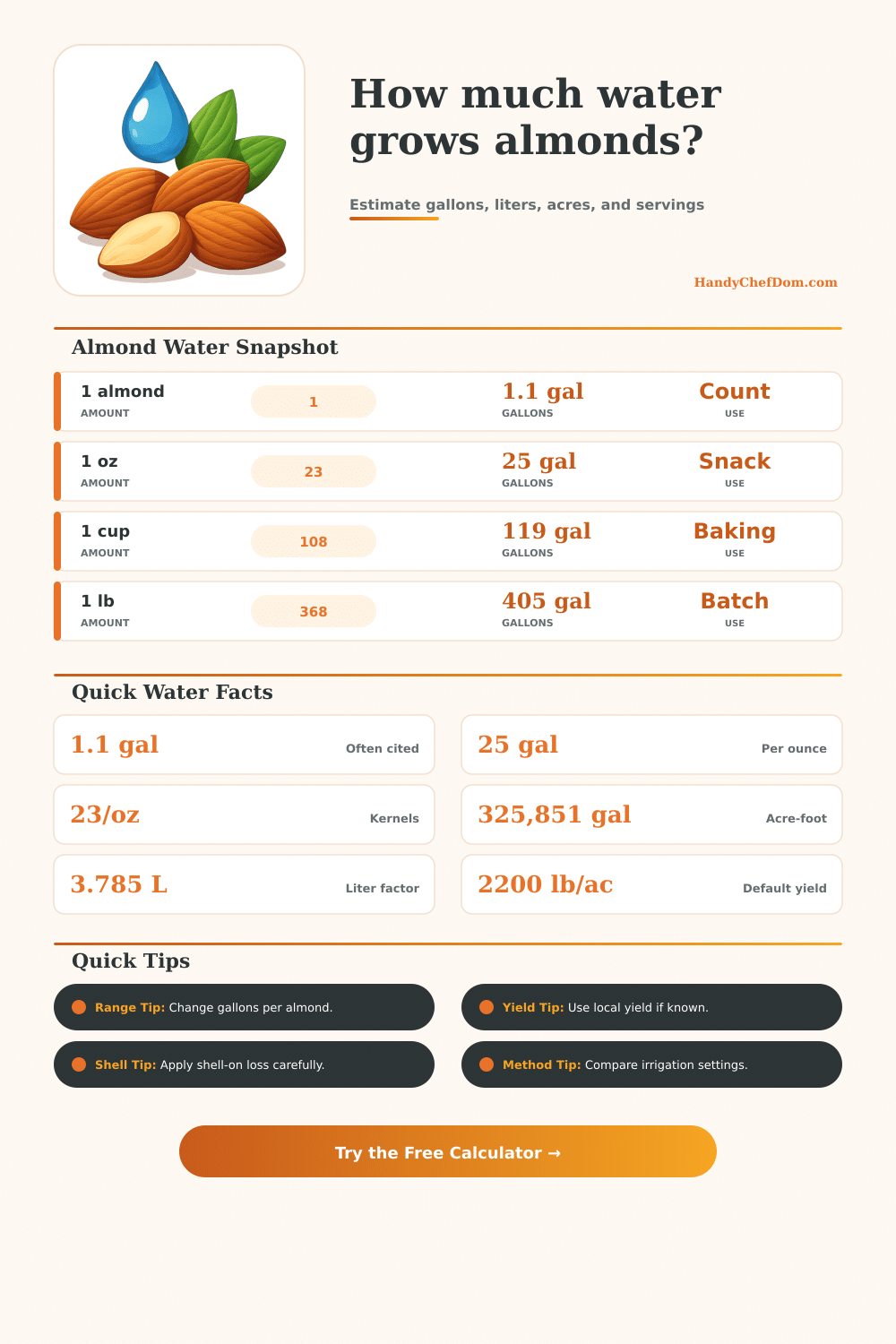
This calculator is a neutral planning estimate, not a farm audit. The often-cited 1.1 gallons per almond is included as a default, and you can change gallons per almond or gallons per ounce to test a different source, crop year, or orchard assumption.
| Almond Amount | Kernel Count Estimate | Kernel Weight | Default Water Estimate | Planning Note |
|---|---|---|---|---|
| 1 almond kernel | 1 almond | 0.043 oz or 1.23 g | 1.1 gallons | Often-cited single almond estimate. |
| Small topping | 8 almonds | 0.35 oz or 9.9 g | 8.8 gallons | Useful for oatmeal, yogurt, or salads. |
| Half-ounce snack | 11 to 12 almonds | 0.5 oz or 14 g | 12 to 13 gallons | A small snack or garnish serving. |
| Standard ounce | About 23 almonds | 1 oz or 28 g | 25.3 gallons | Common nutrition label serving size. |
| Half cup sliced or whole | About 108 almonds | 4.7 oz or 133 g | 119 gallons | Approximate baking or topping amount. |
| One pound kernels | About 368 almonds | 16 oz or 454 g | 405 gallons | Batch estimate before local adjustments. |
| Estimate Setting | Gallons per Almond | Gallons per Ounce | Typical Use | Calculator Note |
|---|---|---|---|---|
| Lower planning estimate | 0.7 to 0.9 gal | 16 to 21 gal | Efficient orchard or conservative source | Enter the exact number you want to test. |
| Default educational estimate | 1.1 gal | 25.3 gal | Common public reference point | Used as the starting preset. |
| Higher planning estimate | 1.3 to 1.6 gal | 30 to 37 gal | Hot, dry, or lower-yield scenario | Useful for sensitivity checks. |
| Per-ounce source only | Derived from count | User-entered | When your source reports ounces | Select ounce basis in the form. |
| Per-almond source only | User-entered | Derived from count | When your source reports almonds | Select almond basis in the form. |
| Irrigation Method | Calculator Factor | How It Is Applied | Best For | Neutral Note |
|---|---|---|---|---|
| Drip irrigation | 0.88x | Reduces the starting water estimate | Targeted root-zone delivery | Actual performance still depends on scheduling and soil. |
| Micro-sprinkler | 0.98x | Near the baseline estimate | Orchard blocks needing wider wetting | Often used in permanent crops. |
| Sprinkler or mixed system | 1.12x | Raises the starting water estimate | Mixed irrigation assumptions | Useful when the exact system is not known. |
| Flood or surface irrigation | 1.32x | Raises the starting water estimate | Broad surface application estimate | Use only when it matches the orchard context. |
| Nut or Seed | Common Serving | Water Footprint Style | Best Calculator Use | Comparison Note |
|---|---|---|---|---|
| Almonds | 1 oz or 23 kernels | Often discussed per kernel or ounce | Use this calculator with adjustable inputs | Estimates vary by region, yield, and method. |
| Pistachios | 1 oz kernels | Tree nut comparison | Use as a broad reference only | Orchard water needs differ from almonds. |
| Walnuts | 1 oz halves | Tree nut comparison | Compare by ounce, not by piece count | Kernel size and yield change the comparison. |
| Cashews | 1 oz kernels | Tropical nut comparison | Compare by weight only | Growing regions and processing differ widely. |
| Peanuts | 1 oz kernels | Legume comparison | Not an orchard crop comparison | Useful only as a broad food footprint contrast. |
Almonds requires a significants amount of water to fully grow their crops. People often believes that every single almond require approximately one gallon of water to grow. While the one gallon of water are the average for every single almond, this number can change depending on various other factor related to the almond orchard.
For instance, variables such as a climate in which the orchard is established, the irrigation methods used in that orchard, and the yield of that orchard all play important role in determining the amount of water that is used to grow each individual almond. These different variable can be tested with the calculator to determine how each of these factor affects the amount of water that is used in the growth of the crop. One of the main variable to consider is the climate in which the orchard is established.
How Much Water Does One Almond Need?
For instance, climates that are hot and dry will require more water to those orchards than climates that receives more rainfall. The reason for this is due to the evaporation of that water from the land and the plants themself. Other variables includes the irrigation methods used within the orchard.
For instance, methods like drip irrigation will allow the orchard to use less water than methods like flood irrigation, where some of that allocated water will evaporate from the land. Even further variable include the efficiency setting for these irrigation systems. For instance, if sensors measure the soil moisture within the orchard, irrigation systems can water the orchard only as much as the system determine the roots need, versus if the orchard does not use those sensors, it may water the orchard more than the amount of water the individual tree require.
Another variable is the yield of the orchard. For instance, if an orchard establishes itself with a high yield per acre, then it can produce more almonds with the same amount of water. Thus, high yields will have a lower water footprint for each individual almond.
However, if an orchard utilize less water to achieve a low yield per acre, then each individual almond will require more water to cultivate within that orchard. Additionally, another important factor is the processing loss of the almonds. For instance, if an individual is eating almonds that are still in there shells, the individual is also consuming the weight of the shell itself.
Thus, the water that is used to grow that shell must also be accounted for in relation to the total amount of water used to grow the almond. The calculator accounts for this variable so that individuals can view the water usage for both shells and kernels of the almond. The calculator will provide two main output.
The first will provide information regarding the acreage context for the amount of almonds that were entered into the calculator. The other output will provide comparisons of the total amount of water to more common unit or objects, such as gallon jugs of water or the amount of water that could be used in the shower for a certain length of time. These two outputs will help provide individuals with information regarding the water footprint for the amount of almonds that were entered into the calculator.
However, the calculator will not perform a farm audit for the orchard. There are some potential mistake that can be made when using the calculator. For instance, an individual may not account for the weight of the shell of the almond.
Additionally, another mistake that can be made is to compare almonds to another type of nut without accounting for the fact that the other nut may incorporate the weight of the shells into its water footprint calculation, as well. Thus, it is important for those using the calculator to ensure that the products being compared are of the same type. Another issue is that orchards requires specific condition to cultivate their almonds.
Furthermore, almond orchards compete with other crops for the rights to water. Thus, while the calculator does not account for these two variables, it does allow individuals to understand the water footprint of the almonds that is cultivated in the orchard. Through understanding each of these variable, individuals will understand that the one gallon of water per almond is just one example of the different outcome that could potentially result for the amount of water required to cultivate each individual almond.