🍝 Tomato Paste in Vodka Sauce Calculator
Scale tomato paste, vodka, cream, sauce cups, pasta ounces, reduction, servings, and tomato intensity for a balanced pink sauce.
Choose whether you know the finished sauce cups or the pasta amount. The calculator estimates a paste target in tablespoons and grams, then balances vodka, cream, tomato intensity, and reduction.
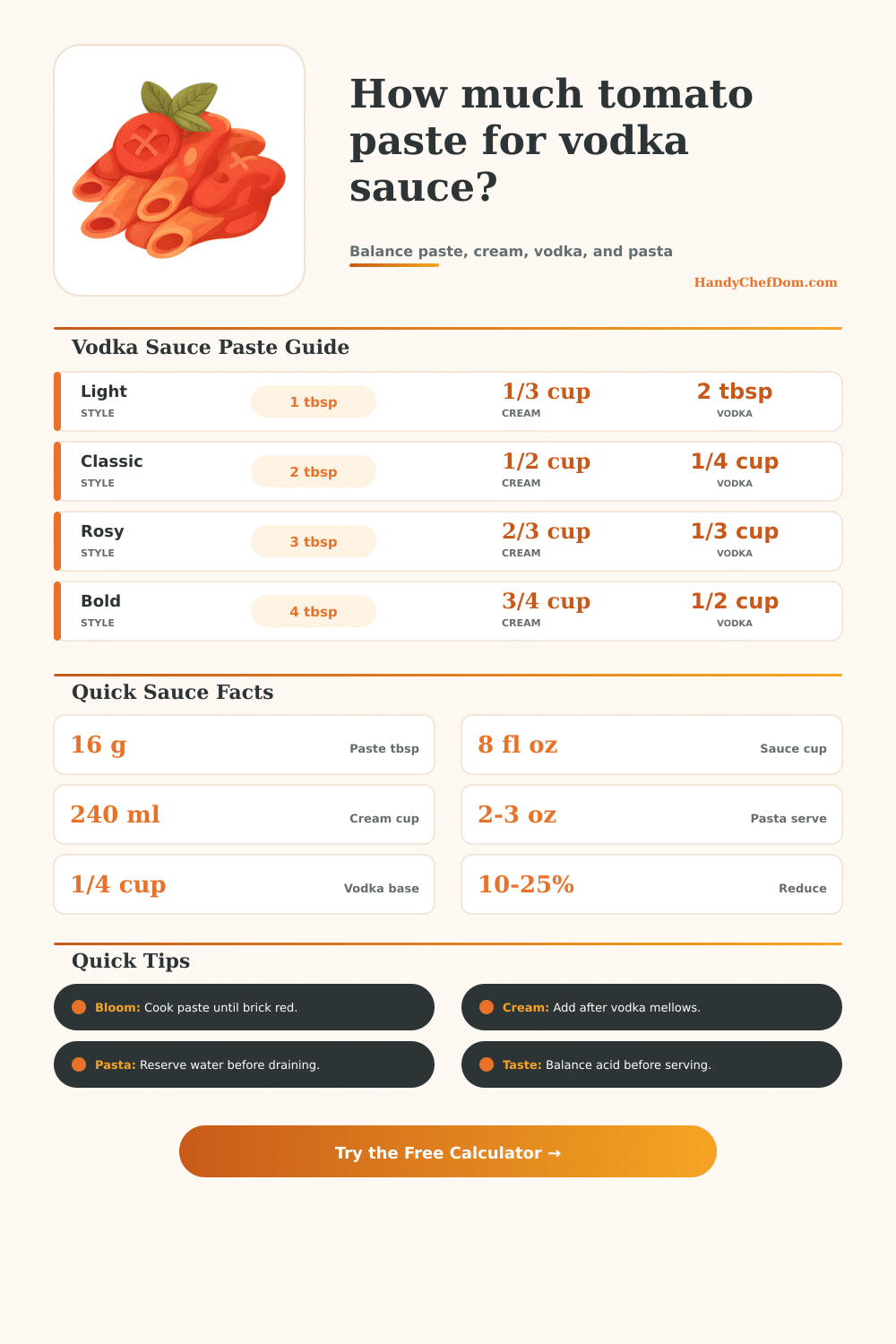
| Vodka Sauce Style | Paste Per Cup Sauce | Cream Per Cup Sauce | Best Use |
|---|---|---|---|
| Soft and creamy pink sauce | 0.40 to 0.55 tbsp | 2.5 to 3.5 tbsp | Delicate penne, kids table, or lower-acid sauce |
| Classic balanced vodka sauce | 0.55 to 0.75 tbsp | 2 to 3 tbsp | Most penne alla vodka and weeknight pasta |
| Rosy tomato-forward sauce | 0.75 to 0.95 tbsp | 1.5 to 2.5 tbsp | Rigatoni, thicker tubes, and bold tomato flavor |
| Paste-rich restaurant style | 0.90 to 1.15 tbsp | 2 to 3 tbsp | Glossy sauce that clings hard to pasta ridges |
| Baked vodka pasta tray | 0.80 to 1.05 tbsp | 2.5 to 4 tbsp | Compensates for pasta absorption during baking |
| Meal prep sauce jars | 0.65 to 0.90 tbsp | 1.5 to 2.5 tbsp | Holds flavor after chilling and reheating |
| Sauce Yield | Classic Paste | Vodka Range | Cream Range |
|---|---|---|---|
| 2 cups finished sauce | 1.25 tbsp or 20 g | 2 to 3 tbsp | 1/3 to 1/2 cup |
| 3 cups finished sauce | 2 tbsp or 32 g | 1/4 to 1/3 cup | 1/2 to 2/3 cup |
| 4 cups finished sauce | 2.5 to 3 tbsp or 40 to 48 g | 1/3 to 1/2 cup | 2/3 to 3/4 cup |
| 6 cups finished sauce | 4 tbsp or 64 g | 1/2 to 3/4 cup | 1 to 1 1/4 cups |
| 8 cups finished sauce | 5 to 6 tbsp or 80 to 96 g | 3/4 to 1 cup | 1 1/3 to 1 3/4 cups |
| 12 cups finished sauce | 8 tbsp or 128 g | 1 to 1 1/2 cups | 2 to 2 1/2 cups |
| Pasta Shape | Sauce Cups Per Pound | Paste Adjustment | Coverage Note |
|---|---|---|---|
| Penne or ziti tubes | 2.5 to 3 cups | Standard | Hollows hold sauce without needing excess cream |
| Rigatoni or paccheri | 3 to 3.5 cups | Add 5% paste | Large ridges and tubes need extra cling |
| Spaghetti or linguine | 2.25 to 2.75 cups | Reduce 5% paste | Long strands coat better with a looser sauce |
| Farfalle or short shapes | 2.75 to 3.25 cups | Standard to +5% | Edges catch sauce but centers can stay dry |
| Gnocchi or ravioli | 2 to 2.5 cups | Reduce 10% paste | Rich fillings need a gentler tomato load |
| Baked pasta tray | 3.25 to 4 cups | Add 10% paste | Pasta absorbs sauce during baking and resting |
| Ingredient | Kitchen Measure | Metric Equivalent | Calculator Role |
|---|---|---|---|
| Tomato paste | 1 tablespoon | 15 to 17 g | Concentrated tomato, body, sweetness, and color |
| Vodka | 1 tablespoon | 15 ml | Helps carry tomato aroma when simmered down |
| Heavy cream | 1/4 cup | 60 ml | Softens acidity and creates the pink finish |
| Tomato base | 1 cup | 240 ml | Dilutes paste and sets the sauce volume |
| Dry pasta | 1 pound | 454 g | Needs about 2.5 to 3.5 cups sauce |
| Pasta water | 1/4 cup | 60 ml | Loosens sauce without weakening cling |
Vodka sauce is made with varying amounts of tomato paste to achieve a certain final taste. Not enough paste and you end up with a weak thin sauce. Too much paste and your sauce becomes thick and heavy. It is a balance of concentrated tomato, creaminess, and the booziness from the vodka. Most cooks mixes these elements and then add more or less to taste.
Know your yield goal beforehand. Have a sense of how much finished sauce you’d like to make. Knowing that will help you get a better idea of how much paste is needed. The calculator on this page adjust based off the size of the yield you want. It adjusts for the volume of cream you want to use. And it adjusts for varying yields per shape.
How to Get Your Vodka Sauce Just Right
Pasta with ripples holds more than straight spaghetti, for example. Different pasta shapes holds different amounts of sauce. Plus, rigatoni require more sauce than spaghetti. Why? It is served in larger portions and the ripples on the pasta catch more sauce.
The level of tomato can be adjusted according to taste. There are some sauces where the tomato is in the background, gently creamy. Others have a tomato flavor that leads, with the cream rounding off the rougher edges. With the calculator you determine this prior to cooking. You won’t find out halfway through that you has used too little cream or too much tomato.
Remember the bloom setting as well. Cooking a paste down till it goes dark will result in slightly sweeter, less raw tasting paste. This means you may get away with using more paste without an aggressive taste. The percent decrease matter, even though you may not notice it. Cooking down the sauce intensifies that tomato flavor. It also makes the vodka taste strongerer. The paste target gets adjusted by the calculator to account for this. Otherwise, if some liquid evaporates during cooking and you add the same quantity of paste… It won’t work out right!
Finally, the calculator tracks how much pasta you plan to cook. So now you know if there is enough sauce to coat it all. In practical terms, consider cream as a factor in your pasta’s flavor balance. On one hand, it adds color and counteracts acidity. On the other, it thins out the tomato taste. Less paste per cup are required for a lighter sauce; more for a bolder sauce that can withstand the dilution caused by reheating or baking. The calculator illustrates this tradeoff for you. There is no need for you to work out math.
But then, as you cook, you also has to taste the sauce. At the very end, pasta water will change things. Reductions will be affected by salt and acidity. The tool is your starting point. The tool is your starting point, so you should of not have to do it from memory every time.