Tomato Paste for Beef Stew Calculator
Estimate the right tomato paste amount for beef stew by beef pounds, broth cups, wine cups, vegetable volume, stew thickness, simmer time, servings, paste style, and tomato-to-wine balance.
Tomato paste gives beef stew color, body, acidity, and savory depth, but too much can make the pot taste sharp or pasty. This calculator weighs paste against beef load, liquid volume, vegetables, reduction, and wine so the stew stays balanced.
Tomato Paste Plan for This Beef Stew
Your tomato paste result will appear here after calculation.
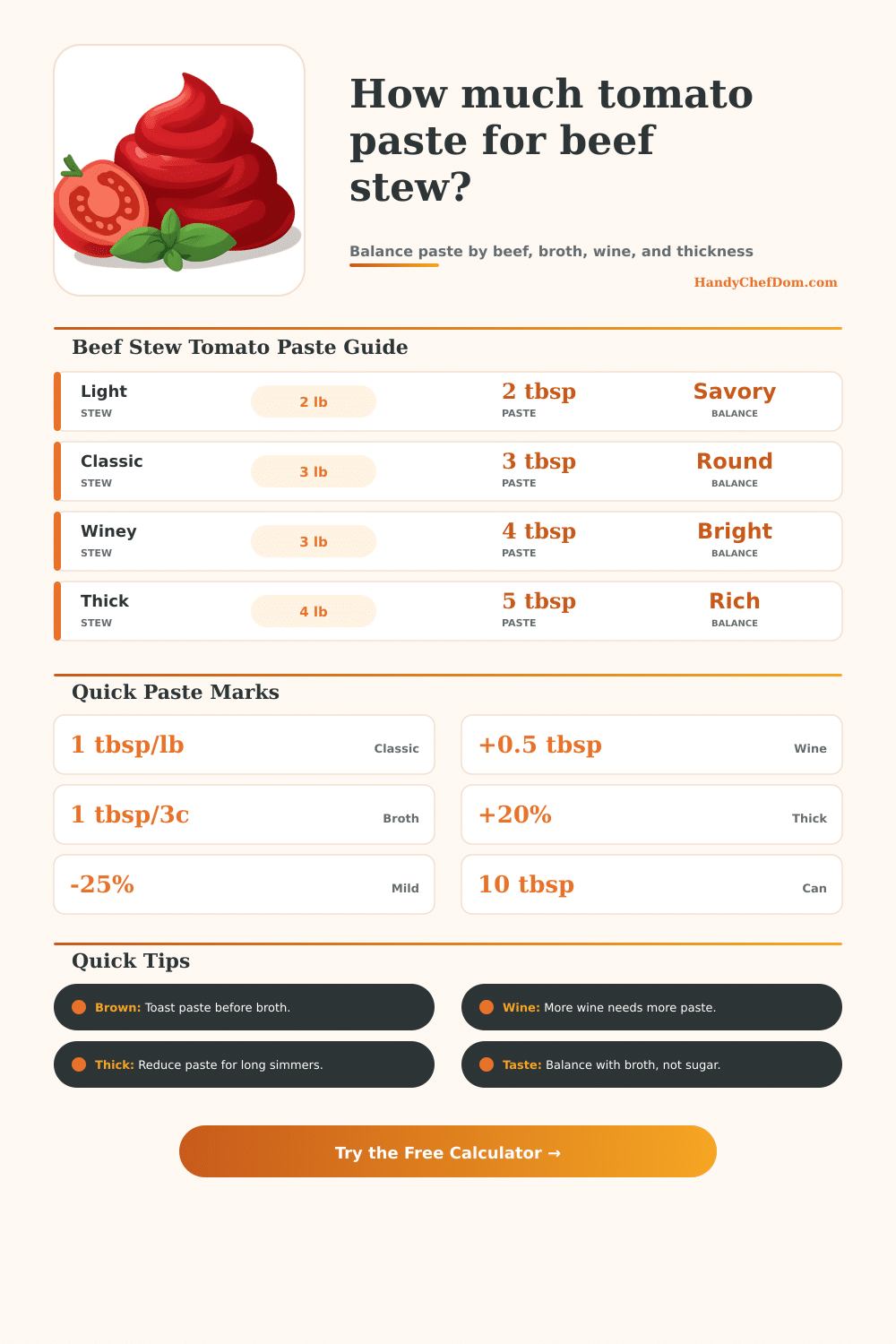
Beef Amount and Tomato Paste Table
| Beef amount | Mild savory stew | Classic balance | Rich or winey stew | Typical servings |
|---|---|---|---|---|
| 1 pound beef | 1 to 2 tsp | 1 tbsp | 1 1/2 tbsp | 3 to 4 bowls |
| 2 pounds beef | 1 1/2 tbsp | 2 tbsp | 2 1/2 to 3 tbsp | 5 to 6 bowls |
| 3 pounds beef | 2 tbsp | 3 tbsp | 4 tbsp | 7 to 9 bowls |
| 4 pounds beef | 3 tbsp | 4 tbsp | 5 to 6 tbsp | 10 to 12 bowls |
| 6 pounds beef | 4 tbsp | 6 tbsp | 8 tbsp | 16 to 18 bowls |
Broth, Wine, and Thickness Table
| Liquid build | Paste cue | Wine balance | Thickness cue | Serving result |
|---|---|---|---|---|
| Brothy, 6 to 8 cups liquid | 0.35 to 0.45 tbsp per cup | Low wine | Keep paste moderate | Clean beef flavor |
| Classic, 5 to 7 cups liquid | 0.45 to 0.6 tbsp per cup | 10 to 20 percent wine | Spoon-coating | Rounded tomato body |
| Wine-heavy stew | 0.55 to 0.7 tbsp per cup | 20 to 35 percent wine | Needs savory base | Bright but balanced |
| Reduced Dutch oven | 0.4 to 0.55 tbsp per cup | Any wine level | Concentrates fast | Rich, not pasty |
| Leftover batch | 0.35 to 0.5 tbsp per cup | Moderate wine | Thickens overnight | Milder next day |
Paste Type Conversion Table
| Tomato product | Strength factor | Grams per tbsp | Use in calculator | Balance note |
|---|---|---|---|---|
| Standard canned paste | 1.00x | 16 g | Baseline | Classic beef stew choice |
| Double-concentrated tube | 1.35x | 18 g | Use less | Strong color and acidity |
| Sweet Italian-style paste | 0.95x | 16 g | Slightly more | Mellower tomato flavor |
| Roasted tomato paste | 1.08x | 17 g | Use a touch less | Deeper browned flavor |
| Paste plus crushed tomatoes | 0.82x | 15 g | Use less paste | Tomato already present |
| Rehydrated tomato powder | 1.20x | 12 g | Use carefully | Concentrated and sharp |
Serving Size and Pot Scale Table
| Stew scale | Beef per serving | Paste per serving | Vegetable load | Best balance |
|---|---|---|---|---|
| Weeknight pot | 4 to 5 oz | 1 to 1 1/2 tsp | 1/2 cup each | Mellow |
| Family dinner | 5 to 6 oz | 1 1/2 tsp | 2/3 cup each | Classic |
| Hearty bowls | 6 to 7 oz | 2 tsp | 3/4 cup each | Rich |
| Party kettle | 4 to 5 oz | 1 to 1 1/2 tsp | 1/2 to 2/3 cup | Moderate |
| Leftover stew | 5 oz | 1 tsp | 2/3 cup each | Looser |
Beef stew gets its red from tomato paste, but it also contributes more than just color. Tomato paste help build body to the stew, adding acidity to cut through fat of the wine and beef. That acid helps the sauce stick to the vegetables rather then running off. The goal is to achieve a rounded flavor; not sharp and not flat. A lack of tomato paste will result in thin-tasting broth. Too much will give your entire pot of stew a metallic aftertaste.
Enter a few numbers into the calculator: how much beef, how many vegetables, how much broth, how much wine, what level of thickness do you want? And then let the calculator handle math. All these variables affects the equation, shifting the balance this way or that. For example, the more wine you use, the more paste is needed to hold the acids in place. The longer you cook the stew, the more concentrated the tomato flavor become, so that initial amount will tasted stronger when serving. The volume of vegetables are another factor, since they give off their own sweetness, which can round out some of the sharper tomato flavors.
Why Use a Tomato Paste Calculator for Beef Stew
Based off that info, the tool tells you how many tablespoons/grams of tomatoes is recommended, and gives a sense of how intense the tomato will feel (per serving). It also indicates if the amount you want to add is more than what the stew “can absorbs.” This is useful, I think, when deciding whether you should of grab an extra can from the pantry or just work with what’s already in the fridge.
The page includes reference tables that shows those same relationships in a simpler format. These allow you to spot the pattern without running the entire calculation again each time.
And then there’s the paste, which so many cooks put in at the wrong time, browning it with the meat for a minute or two before adding liquid will deepen its flavors (and eliminate any hint of rawness). Adding it too late leaves bright, one-note acidity that never quite settles. Likewise, when the broth is thinner different than desired, cooks attempt to compensate by dumping in some more paste later on, but this also results in a one-note outcome. Your starting point is measured so you’re not guessing while you’re standing at the stove.
This brings us back to how important the thickness target are. If your stew is brothy, you have more liquid to spread it out over, and thus can accommodates less paste. If your stew’s rich in gravy, well then the sauce itself is already concentrated; more paste is fine. The tool accounts for both cases, so if your stew cooks down into liquid, it won’t taste pasty as a result.
No one knows what’s on your tongue better than yourself. Does a wine-heavy stew suits? Or do you prefer to keep the beef in the forefront? The balance slider nudges the outcome in those directions, but it will all come down to the spoon at the very end. Try toward the end of cooking to add a little more paste only if the broth is lacking. Conversely, if you go too far the other way, you can always toss in a splash or two of broth.
When done right, the tomato paste doesn’t stand out too much; there is just an overall sense of completeness in a well-balanced beef stew. The calculator gets you there without making dinner a science lab.