🫙 Cornstarch to Thicken Jam Calculator
Estimate a cornstarch slurry for jam by fruit volume or grams, juice level, sugar ratio, pectin strength, target thickness, jars, and simmer time.
The calculator treats cornstarch as a set-assist, not a replacement for a tested canning recipe. It estimates starch for texture, slurry liquid, yield, and jar distribution.
| Fruit | Typical pectin | Juice behavior | Medium dose per cup fruit |
|---|---|---|---|
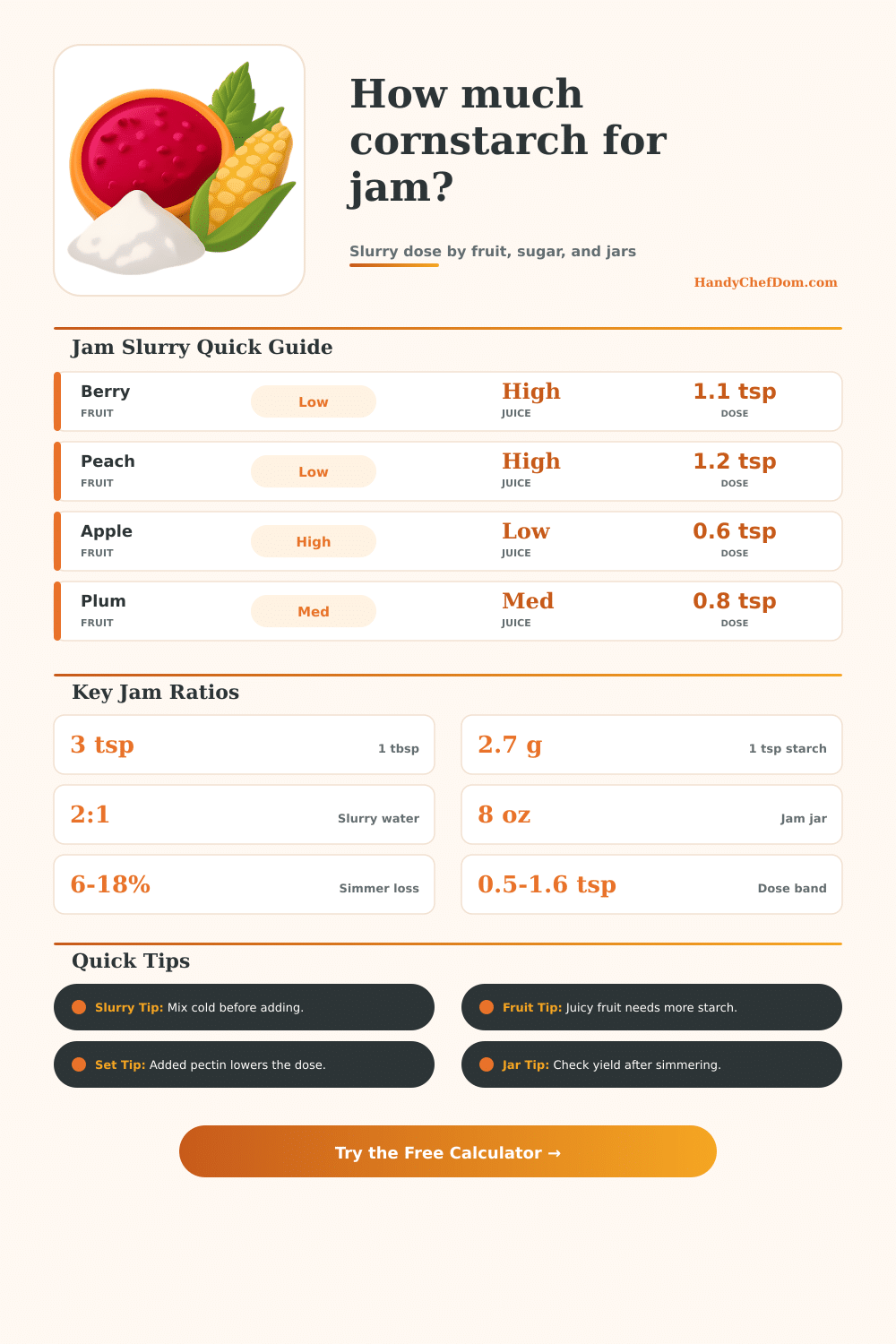
| Strawberry | Low | High juice after sugar | 1.1 tsp |
| Blueberry | Medium | Moderate juice | 0.9 tsp |
| Raspberry | Low to medium | Juicy and seedy | 1.0 tsp |
| Cherry | Low | High juice | 1.15 tsp |
| Peach | Low | Soft and juicy | 1.2 tsp |
| Apple | High | Lower free juice | 0.55 tsp |
| Plum | Medium | Balanced juice | 0.8 tsp |
| Grape | Medium to high | Natural gel support | 0.75 tsp |
| Thickness target | Multiplier | Best fit | Texture cue |
|---|---|---|---|
| Loose spoon jam | 0.65x | Yogurt, bowls | Drips slowly |
| Spreadable toast jam | 1.00x | Toast, biscuits | Mounds softly |
| Thick jar set | 1.35x | Firm spooning | Holds ridges |
| Pie or pastry filling | 1.55x | Filling layers | Holds shape |
| Cornstarch | Weight | Cold liquid | Slurry note |
|---|---|---|---|
| 1 tsp | 2.7 g | 2 tsp water | Mini correction |
| 1 tbsp | 8.1 g | 2 tbsp water | Small batch |
| 2 tbsp | 16.2 g | 4 tbsp water | Large batch |
| 1/4 cup | 32.4 g | 1/2 cup water | Very large batch |
| Batch size | 8 oz jars | Fruit cups | Typical starch band |
|---|---|---|---|
| Small pan | 1 to 2 | 2 cups | 1.2 to 3 tsp |
| Home batch | 3 to 4 | 4 cups | 2.5 to 6 tsp |
| Gift batch | 5 to 6 | 7 cups | 4 to 10 tsp |
| Wide kettle | 8 to 10 | 10 cups | 6 to 15 tsp |
For very firm preserves, use the calculator as a texture guide and compare it with the set test you already trust for that fruit and recipe style.
Things are jamming up. It seems easy enough to get to the proper consistency for jam, but then you go make some, and whoa: Sugar is different! Fruit is different! You have to learn to make little decisions very early on that can mean the difference between a yummy spread or a watery mess.
Adding cornstarch is one surefire method of nudging things along (instead of having to wait for nature’s own pectins). But how much? That depends on a few variables, all being watched at the same time. You add variables like type of fruit, quantity, initial juiciness, sweetness, desired thickness, and whether pectin is present. Then the calculator takes over and does the math.
How to Make Jam with Cornstarch
Every variable alters how that starch behave in the pan. For example, more juice means more liquid will be released when heated, providing more moisture for the starch to thicken. High-pectin fruit is already likely to set by itself; it needs less. And a higher sugar content impacts not only your boiling point but also your finished consistency. Finally, simmer time determine how much water leaves the pot before you put it in jars.
And in practical terms, the math shifts based off texture goals as well. For instance, if you want a firm filling that keeps its shape between layer of pastry, you don’t need as much starch. This is different than a loose spoon jam that will drip out slowly.
Now you can adjust mid-cook with their current plate test option, which is helpful if your jam ends up thicker/lower quicker/slower. Then it gives you the amount of cornstarch and how much cold liquid to mix together to create a smooth slurry. Finally, it gives an estimate of the finished yield so you’ll know how many jar to prep.
People often put dry starch directly into the hot jam; which results in streaks and granular texture, as the powder lumps up before it gets a chance to dissolve. Instead, stir it together with some cold water into a pourable slurry and it dissolves easy. When it hits the boiling jam, it goes to work clean.
People also forget: Starch will thicken best at the very end of the cooking time, not right away. Give the mixture another quick simmer after stirring in your slurry so it has time to thicken to its fullest body before checking again.
There’s also a bit of guesswork involved, since you’ll never be able to predict exactly how much evaporates. Juicy fruits require longer simmering times, both of which result in more moisture lost to air, concentrating the jam and altering its finished thickness. You should of accounted for this. All of this goes into the calculator, resulting in a final number of jars that should fit.
But it’s more valuable to think of the tool as more of a beginning. Not an end. Everything about the fruit, your particular set-up (stove, type/size of pan), and personal preference in texture will affect the outcome. Taste along the way and use it as your guide. Tweak the next batch accordingly.
With time and practice, you will make better jam, one calculation at a time. Actualy, it becomes naturaly easy.