🍞 Nutmeg in French Toast Calculator
Scale nutmeg for French toast by slices, eggs, milk, custard volume, cinnamon ratio, bread absorption, servings, spice freshness, and desired warmth.
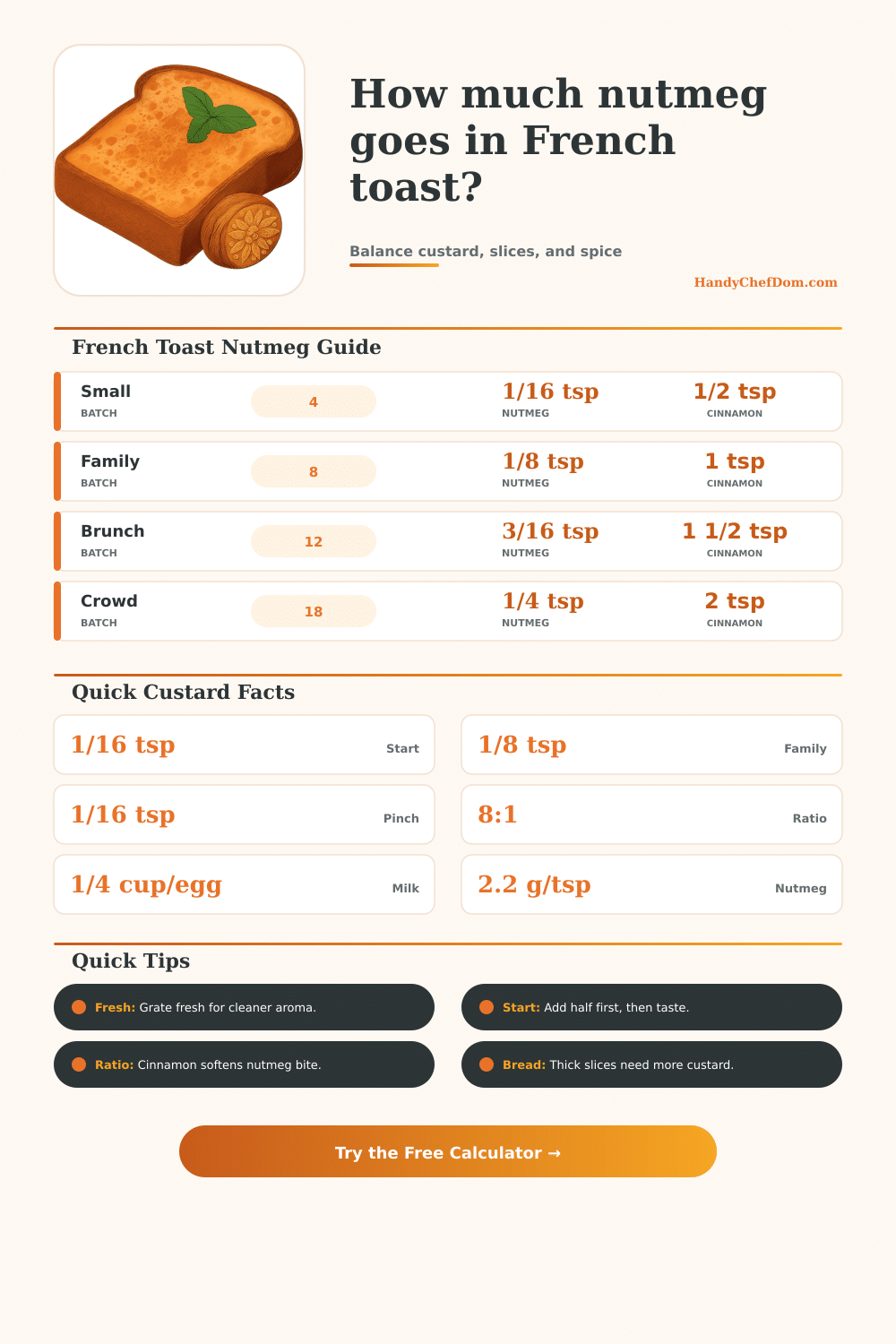
Most French toast batches land around 1/16 teaspoon nutmeg for 4 slices or 1/8 teaspoon for 8 slices. This calculator adjusts that start for custard volume, bread thickness, egg richness, cinnamon balance, and spice strength.
| French Toast Batch | Classic Nutmeg | Fresh Nutmeg | Cinnamon Partner |
|---|---|---|---|
| 2 slices, solo breakfast | 1/32 tsp | Tiny pinch | 1/4 tsp |
| 4 slices, small pan | 1/16 tsp | 1 light pinch | 1/2 tsp |
| 8 slices, family batch | 1/8 tsp | 2 light pinches | 1 tsp |
| 12 slices, brunch plate | 3/16 tsp | 3 pinches | 1 1/2 tsp |
| 18 slices, crowd tray | 1/4 tsp | 4 pinches | 2 tsp |
| 24 slices, large service | 3/8 tsp | 6 pinches | 3 tsp |
| Bread Style | Custard Pull | Nutmeg Factor | Best Ratio |
|---|---|---|---|
| Thin sandwich bread | Low | 0.90x | 10:1 |
| Brioche slices | Medium high | 1.10x | 8:1 |
| Challah slices | Medium | 1.05x | 8:1 |
| Texas toast | High | 1.18x | 6:1 |
| Baguette rounds | Medium | 1.00x | 8:1 |
| Croissant halves | Rich | 0.96x | 10:1 |
| Day-old thick bread | Very high | 1.25x | 6:1 |
| Flavor Goal | Ratio | For 1 tsp Cinnamon | Result |
|---|---|---|---|
| Very subtle nutmeg | 12:1 | 1/12 tsp | Cinnamon leads |
| Soft background | 10:1 | 1/10 tsp | Mellow aroma |
| Classic balance | 8:1 | 1/8 tsp | Warm custard |
| Bakery warmth | 6:1 | 1/6 tsp | Noticeable spice |
| Nutmeg-forward | 4:1 | 1/4 tsp | Bold finish |
| Serving Style | Slices Each | Custard Per Slice | Nutmeg Cue |
|---|---|---|---|
| Light breakfast | 1 to 2 | 2 tbsp | Soft |
| Standard plate | 2 | 2 1/2 tbsp | Classic |
| Brunch plate | 2 to 3 | 3 tbsp | Warm |
| French toast sticks | 2 slices | 2 tbsp | Cinnamon led |
| Holiday brunch | 2 to 3 | 3 1/2 tbsp | Bakery |
| Crowd tray | 1 to 2 | 3 tbsp | Subtle |
French toast with nutmeg is better than french toast without it, but that fine line exist between a hint of nutmeg and a nostril-singeing whiff of it. How much cinnamon did you add to your batter? How thick is your bread? How many slices will you be serving? All of these affect the final outcome… Measure poorly and you’re left with a drug-like, flat taste. More is (not) always more.
You don’t need as much of this recipe as a big potful would make, unless you’re planning to serve more people or you like really thick bread that soak up a lot of custard. Even then, it’s not a straight-up proportion. The reason? Bread with some age absorbs more, taking more custard with it… which means more nutmeg per spoonful.
Why You Should Use the Nutmeg Calculator
That’s why I made my calculator do the heavy lifting: Just plug in how many eggs, cups of milk and cream, etc., and how many slices of bread you’re using. It takes dryness into account, too, since day-old slices pulls in more custard and therefore more nutmeg. The spice flavors are more complex: Cinnamon plays a bigger part. Instead of leaving you guessing whether a half-teaspoon is too little or to much, the tool has you specify the desired proportion and then sees what it does for your end result. While classic recipes feature mostly cinnamon with a lower dose of nutmeg, some cooks want their warm custards to have more pronounced nutmeg (no problem); just use the dial.
Then there’s freshness. Nutmeg that’s been around awhile won’t smell or taste as strong as freshly grated, either. This makes the dose vary. The tool takes this into account and moves recommendation up or down on its strength slider to adjust for that difference. Use the same jar frequently? You could of taken its output as a baseline and then tweak it from there.
Few things matter as much as type of bread you use. Thin sandwich bread won’t absorb as well as brioche or challah, which, in turn, don’t take on as much custard as Texas toast does, pulling extra goop into every slice. Nutmeg follows along for the ride with the custard, concentrating it when using high-absorption bread. You shouldn’t have uneven spice from one slice to another because the calculation already account for that change.
Consistency through batch: running the numbers means that once you have an idea of the right combination for your typical custard and bread, you can adjust strength or ratio slightly to suit the mood. You can go from something closer to holiday baking to something more delicate and get it exactly right every time. This way, you do not have to use trial-and-error again if you decide to make less or more.
This photo was taken by Sarah Wambach. Instead, just put in half the calculated amount. Stir well with the cinnamon (or with the sugar, if that’s what you’re using), and then sample your raw custard before adding bread. One bite can save you from overspicing a whole batch. From there, it’s up to you, but at least you’ll have a reasonable starting point based off the calculator.