🧅 Onion Calorie Calculator
Estimate onion calories, carbs, fiber, sugar, trimmed yield, chopped cups, sliced cups, cooked cups, and recipe portions from one flexible calculator.
Choose whether you are counting whole onions, raw weight, cup measures, or soup, salsa, and saute portions. Trim loss is applied before nutrition is estimated.
| Onion type | Small | Medium | Peel loss |
|---|---|---|---|
| Yellow onion | 70 g | 110 g | 10% |
| White onion | 75 g | 115 g | 10% |
| Red onion | 75 g | 120 g | 9% |
| Sweet onion | 90 g | 150 g | 12% |
| Shallot | 25 g | 40 g | 13% |
| Green onion | 15 g | 30 g | 6% |
| Pearl onion | 10 g | 18 g | 14% |
| Leek | 90 g | 160 g | 18% |
| Cup measure | Approx weight | Best for | Yield note |
|---|---|---|---|
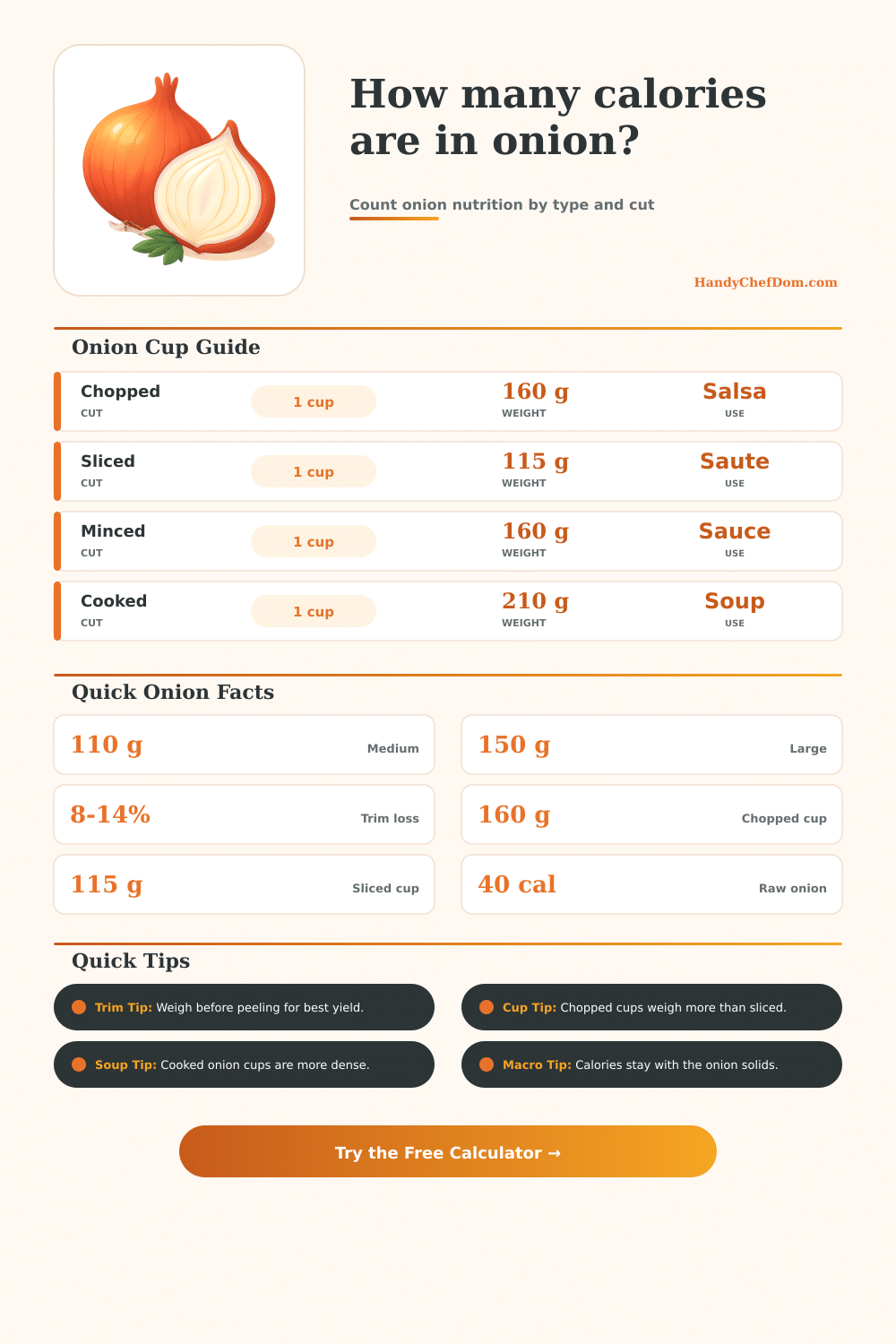
| Raw chopped | 160 g/cup | Salsa, soup | Loose dice |
| Raw diced | 150 g/cup | Tacos, salad | Small pieces |
| Raw sliced | 115 g/cup | Saute, fajitas | Air gaps |
| Raw minced | 160 g/cup | Sauce base | Packed cut |
| Onion rings | 90 g/cup | Raw rings | Very loose |
| Cooked chopped | 210 g/cup | Soup base | Dense cup |
| Sauteed sliced | 190 g/cup | Side dish | Reduced volume |
| Type | Calories | Carbs | Fiber/Sugar |
|---|---|---|---|
| Yellow onion | 40 / 100 g | 9.3 g | 1.7 / 4.2 g |
| White onion | 40 / 100 g | 9.3 g | 1.7 / 4.2 g |
| Red onion | 44 / 100 g | 10.1 g | 1.4 / 4.7 g |
| Sweet onion | 32 / 100 g | 7.6 g | 0.9 / 5.0 g |
| Shallot | 72 / 100 g | 16.8 g | 3.2 / 7.9 g |
| Green onion | 32 / 100 g | 7.3 g | 2.6 / 2.3 g |
| Pearl onion | 38 / 100 g | 8.6 g | 1.8 / 4.0 g |
| Leek | 61 / 100 g | 14.2 g | 1.8 / 3.9 g |
| Recipe use | Raw per portion | Yield factor | Prepared cup |
|---|---|---|---|
| Raw garnish | 20 g | 1.00x | 115 g |
| Salsa onion | 30 g | 1.00x | 160 g |
| Soup onion | 45 g | 0.82x | 210 g |
| Sauteed side | 75 g | 0.60x | 190 g |
| Caramelized | 110 g | 0.35x | 220 g |
| Burger topping | 25 g | 1.00x | 115 g |
What’s that say again? I know we’ve all been in grocery store standing there with a bag of yellow onions in our hand. We wonder if those three bulb are really going to be enough for a dinner for four people.
Why onion volume doesn’t behave like most other vegetables is a common kitchen puzzle: One cup of onion slices appears large, but isn’t as heavy as one cup of chopped onion, for example. That’s why it can be important to keep track of your onion amounts (nutrition-wise or otherwise) so you don’t run short on the base flavor in your soup, or end up with less food then you expected once they’ve been cooked down.
Why Onion Amounts Are Confusing
Once you enter your own desired amount and type of cooking and cut, the calculator do the rest, sparing you guessing about what percentage of chopped onion will get lost in peeling and later wilting.
There’s something else you need to know: not all onions are created equal (in terms of sweetness and density). For instance, a sharp yellow onion will be less dense. It will also contain less natural sugar and water than a sweeter type like a sweet onion. This change the number of calories per hundred grams. Green onions is primarily made up of water and fiber, whereas shallots are even more densely packed with calories and flavor. By allowing you to choose your onion variety before inputting the quantity, the tool takes this into consideration. And that’s what makes the outcome vary based off whether you’re selecting white or red onions. Sure, you may assume that you can interchange them, but their actual density will impact their shrinkage in the cooking process.
And then there’s the matter of peel loss. Most home cooks find that this throws them off. You weigh the onion, but it has those root ends still on and the dry outer skins; so you’re accounting for waste in what’s called the gross weight of the onion. Typically it’s about ten percent of a normal-bulbed onion (you can adjust that trim percentage in the calculator). But if your onions is starting to get shriveled and older, that number increases accordingly. Starting with this knowledge ensures your edible yield calculation is correct from the beginning. You would of been frustrated halfway through chopping because you need another bulb.
But then there’s cooking. Cooked onions (such as caramelized or sautéed) collapse, losing both their volume and shape. This happens because water make up a large portion of an onion’s mass. A cup of chopped raw onion may be reduced to half that when cooked down. That’s where the prepared cup estimates in the tool come into play. They’ll tell you just how much of the real stuff you’re going to end up with once heat has done its thing. The reference table on the page explain this. It shows how much the yield factors drop for caramelized preparations compared to raw garnish ones. Because water cooks off, you need to start with more raw onion if you want the same amount of finished topping.
The type of prep also affects carbohydrates and sugar tracking. Solid foods has roughly the same number of calories, but less volume means more concentrated ingredients. This isn’t only about flavor, such as when caramelizing onions make them taste sweeter due to a chemical reaction. It is also about nutrition, because changing the volume alters the carb and sugar content. Knowing that allows you to monitor your diet without getting lulled into thinking less is better when there’s less to see. The breakdown section reveals exactly how many grams of sugar and fiber end up on your plate, no matter how big or small the portion are.
The real-world value comes with portion sizing. How much onion should I include per serving? Where is the tipping point where it overwhelms everything else in my salsa? This matters especially if I’m preparing it for a crowd. Enter how many portions and the tool will break down the nutrition by the portion you entered. So you can adjust the recipe accordingly and not let one thing take over another. This makes abstract nutrition information usefull for your meal planning decisions.
But really: Working with onions is less about strict measurements and more about understanding their behavior, how fast they shrink, how dense each variety can be, and how much waste you’ll produce. It becomes easier, once you know. You plan rather than guess. And that’s where the calculator comes in. It takes the guess out of the math (and leaves you free to get down to business with your onions). But always keep in mind that a chopped cup won’t weigh like a cup of slices, and the volume of any onion will never equal its cooked yield. Trust none of that.