🍌 Banana Protein Calculator
Estimate banana protein from whole banana size, edible grams, sliced cups, mashed cups, and serving style, with calories, carbs, and fiber alongside the result.
Choose the banana measurement you have. Whole banana mode uses edible size weights, while sliced and mashed modes use kitchen cup weights before dividing totals into snack, smoothie, or baking servings.
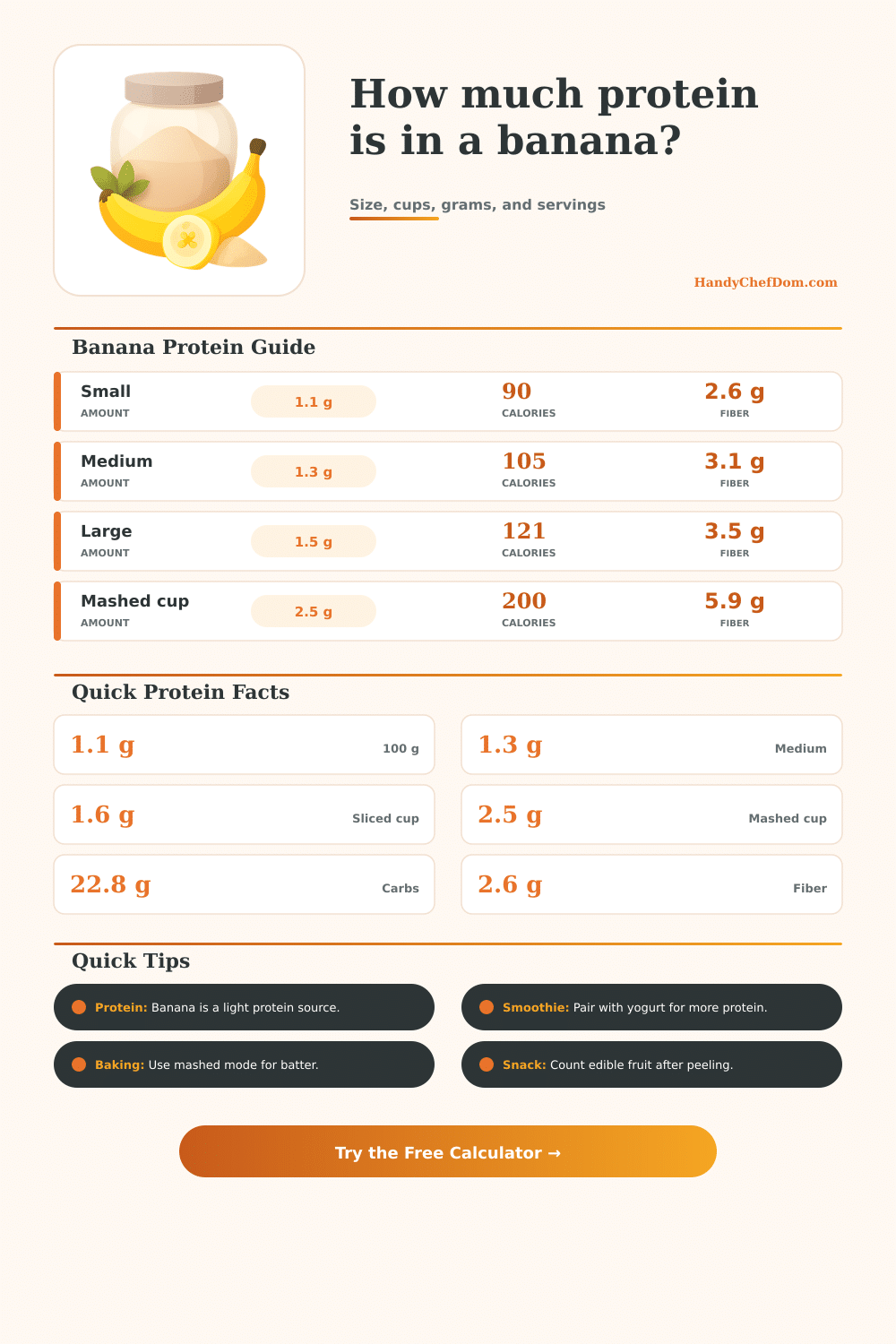
| Banana amount | Edible weight | Protein | Calories | Carbs | Fiber |
|---|---|---|---|---|---|
| Extra small banana | 81 g | 0.9 g | 72 kcal | 18.5 g | 2.1 g |
| Small banana | 101 g | 1.1 g | 90 kcal | 23.1 g | 2.6 g |
| Medium banana | 118 g | 1.3 g | 105 kcal | 27.0 g | 3.1 g |
| Large banana | 136 g | 1.5 g | 121 kcal | 31.1 g | 3.5 g |
| Extra large banana | 152 g | 1.7 g | 135 kcal | 34.7 g | 4.0 g |
| Kitchen measure | Edible weight | Protein | Calories | Best use |
|---|---|---|---|---|
| 1/2 cup sliced banana | 75 g | 0.8 g | 67 kcal | Yogurt bowls |
| 1 cup sliced banana | 150 g | 1.6 g | 134 kcal | Snack plates |
| 1/2 cup mashed banana | 113 g | 1.2 g | 101 kcal | Pancake batter |
| 1 cup mashed banana | 225 g | 2.5 g | 200 kcal | Banana bread |
| 1 ounce edible banana | 28 g | 0.3 g | 25 kcal | Small topping |
| Serving context | Typical banana amount | Protein cue | Calculator note |
|---|---|---|---|
| Snack or lunchbox | 1 medium banana | About 1.3 g | Good for quick fruit tracking |
| Smoothie or shake | 1 to 2 bananas | About 1 to 3 g | Banana adds texture more than protein |
| Baking batter | 1 cup mashed | About 2.5 g | Divide by finished slices or muffins |
| Oatmeal or yogurt bowl | 1/2 cup sliced | About 0.8 g | Use sliced mode for toppings |
| Meal prep portions | Measured grams | Scale by weight | Best when packing multiple containers |
| Kid snack servings | 1/2 small banana | About 0.6 g | Use portions to split totals |
| Ripeness | Cup density cue | Protein effect | Use note |
|---|---|---|---|
| Firm yellow | Slices hold shape | Same per gram | Sliced cups may weigh slightly more |
| Ripe yellow | Standard cup weight | Same per gram | Default for most snacks |
| Spotted sweet | Soft slices | Same per gram | Good for smoothies |
| Very ripe or baking soft | Packs into mash | Same per gram | Use mashed mode for batter |
| Frozen then thawed | Can release liquid | Same per gram | Weigh thawed edible fruit when possible |
When it comes to tracking protein, you’d be forgiven for forgetting all about the banana. Sure, there’s the whey powder, the egg whites and the chicken breast. Those fill plate. The banana, sitting in the fruit bowl, chills out while giving you some potassium along with some carbs. But at just around one gram of protein, you can’t help but think: it doesn’t really count, right? Fruits don’t really count, do they?
That’s missing the entire point. Bananas aren’t meant to be an end-all protein source. Of course not. The problem isn’t that bananas is a major source of protein. The problem is that they’re involved in nearly everything you eat, drink, or bake. If you ignore it, you’re making noise in your nutrition tracking. And knowing exactly how much protein that piece of fruit contributes lets you take it into account. Without over-estimating it in your macros.
Why You Should Count Banana Protein
So what’s it do? When you enter your measuring unit, the calculator (above) figures out the rest for you. No more guesswork: Does a cup of chopped bananas weigh the same as a cup of mashed bananas? Nope. A level cup of sliced banana comes in around a hundred fifty grams of fruit. By comparison, a cup of mashed banana have two hundred twenty-five grams. Why? The mash is compressed to remove air pockets, which changes its texture.
Since protein content increases steadily by weight, the difference add up. A sliced banana offers roughly sixteen milligrams of protein. A mashed banana provides twenty-five. Those numbers sound small. But consider that these are fractions; they add up when making multiple servings of a high-performing smoothie or big batch of banana bread.
When most of us think about bananas, we don’t think about the size category, we simply grab whatever’s nearest and go at it. A “medium” banana is classified as being seven to eight inches long, with the peel yielding approximately one hundred eighteen grams of edible fruit. This equates to about 1.3 grams of protein in each banana. If you reach for an “extra large,” on the other hand, these bad boys can measure upwards of a hundred fifty grams once peeled, you’re talking close to 1.7 grams of protein per banana.
Less than half a gram more, but again, this is the sort of margin that matters when your goal is to follow strict dietary rules or nutritional requirements for your training and/or recovery. With this tool, you’ll be able to choose your desired sizes. You’ll also have the option to type in exact weight of what you’re searching for (if accuracy is more important to you than an estimate).
There’s a bit of subtlety here: how do these measurements translate in the kitchen? Bananas get softer as they approach spots of brown, and change a little in terms of water content. This doesn’t alter their weight-per-protein. It alters the amount of fruit that will fit inside a “normal” measuring cup. A firmer banana will mash less densely than a super-ripe one. That means if you’re following a recipe which specifies one cup of mashed banana, you could end up with too little actual mass if you were to use firmer fruit rather than overripe. To account for this, the calculator allows you to specify how ripe the fruit is, ensuring your volume-to-weight conversions remain accurate across all possible starchy/sweetness levels of your fruit.
Also consider why bananas are paired with protein-rich foods in the first place. Do you really ever eat a banana as a snack if you’re trying to build muscle? No. You throw it in a smoothie with Greek yogurt; you slice it onto a plate of oats covered in nuts. When you do that, the banana adds flavor and substance, but most of the amino acids comes from somewhere else. Understanding how much protein the banana adds helps you properly portion out the remainder of the meal. Underestimating how much structure the fruit provides can cause you to overdose on the real deal.
It’s easy to see the differences laid out on the page (see reference tables). You can see that the mashed cups has a higher nutrient density than the sliced cups. You’ll know if you want to go by whole fruit if it’s just going in someone’s lunchbox as-is, but count cups if they’re getting tossed in a pan of batter for some baking project.
It all boils down to this: If you’re using a measuring cup, measure it. Don’t measure it based off an assumption. Ultimately, keeping track of banana protein isn’t just about adding more muscle-building nutrients; it is about keeping your dietary information accurate. You eat the banana; you’re going to enjoy its sweetness, get some energy from it, etc. But with the banana added, you’ll be able to fully trust everything else you put into your body because you know exactly what you’re eating.
Knowing this, it doesn’t seem like quite as much guesswork… It just seems like a good system for tracking things. It should of been easier to track naturaly.