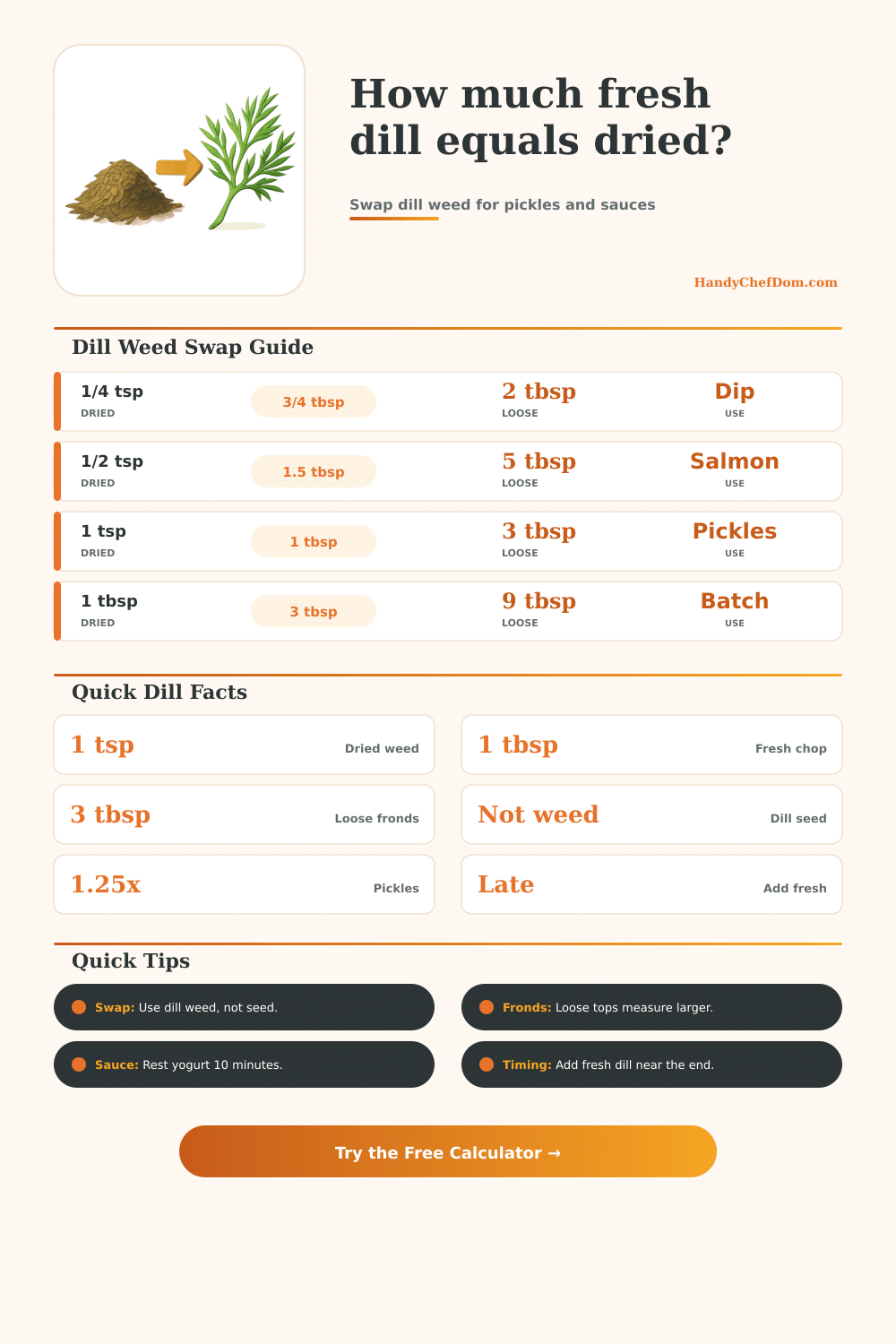
🌿 Dried to Fresh Dill Converter
Convert dried dill weed to fresh chopped dill, loose fronds, and timing-adjusted amounts for pickles, salmon, yogurt sauce, potato salad, and more.
Use dried dill weed for the main swap. Dill seed has a different flavor, texture, and strength, so this converter flags seed separately instead of treating it as a weed substitute.
| Dried Dill Weed | Fresh Chopped Dill | Loose Fronds | Best Use |
|---|---|---|---|
| 1/8 tsp | 3/8 tbsp | 1 tbsp | Small sauce tweak |
| 1/4 tsp | 3/4 tbsp | 2 to 2.5 tbsp | Single salmon fillet |
| 1/2 tsp | 1.5 tbsp | 4.5 tbsp | Yogurt sauce bowl |
| 1 tsp | 1 tbsp | 3 tbsp | Classic herb swap |
| 2 tsp | 2 tbsp | 6 tbsp | Potato salad batch |
| 1 tbsp | 3 tbsp | 9 tbsp | Brine or party bowl |
| Dish | Dill Factor | Timing Cue | Flavor Goal |
|---|---|---|---|
| Pickles or brine | 1.25x | Add fresh after heat | Assertive dill aroma |
| Salmon or trout | 1.15x | Finish or cure surface | Clean grassy lift |
| Yogurt sauce | 0.90x | Rest cold 10 minutes | Soft and rounded |
| Potato salad | 1.00x | Fold into cooled potatoes | Fresh but not sharp |
| Cucumber salad | 0.95x | Add right before serving | Light garden note |
| Ranch dip | 1.05x | Hydrate 15 minutes | Balanced herb finish |
| Fresh Form | Chopped Yield | Frond Volume | Use Note |
|---|---|---|---|
| Chopped fresh dill | 1 tbsp | 3 tbsp loose | Most accurate cup measure |
| Loose fronds | 1 tbsp | 3 to 3.5 tbsp loose | Fluffy before chopping |
| Lightly packed fronds | 1 tbsp | 2 tbsp packed | Good for bunch prep |
| Tender sprigs | 1 tbsp | 3 medium sprigs | Strip thick stems first |
| Thin stems included | 1 tbsp | 2.5 tbsp mixed | Use only tender stems |
| Fine garnish snips | 1 tbsp | 2.5 tbsp loose | Stronger top-note aroma |
| Timing | Fresh Dill Buffer | Dried Weed Note | Seed Warning |
|---|---|---|---|
| Raw garnish | 1.00x | No hydration needed | Seed tastes crunchy |
| Cold sauce rest | 1.05x | Hydrates into dairy | Seed stays gritty |
| Warm dish | 1.15x | Add dried earlier | Seed is briny |
| Hot brine | 1.20x | Use dried in brine | Seed is separate spice |
| Long simmer | 1.35x | Dried holds longer | Do not cup-swap seed |
| Finish after heat | 1.00x | Fresh flavor stays bright | Use seed only by recipe |
Have you ever had one of those moments. When a recipe says “fresh dill” and all you have are some dried? Panic sets in, and you may impulsively fill in missing ingredient with a spoonful or two of the dried variety. This is how flavor troubles start: Fresh and dried herbs simply aren’t interchangeable, even if you use cup-for-cup. There’s more to it than just that; they contains volatile oils and different textures.
To prevent disaster, you need to know how much chopped fresh will equal what amount of dried (and vice versa). I created the tool above to convert your amount of dry dill flakes to the right amount of chopped fresh fronds. This should make your meal delicious instead of a disastrous.
How to Use Fresh and Dried Dill
The main point is that when you dry dill, it is concentrated, meaning it has more flavor but is less watery and less whole. A recipe calling for fresh dill assume you have some bite to it, and a certain amount of wetness. The dried version is more subdued, and needs a chance to open up. Using the same volume of dried dill that you would fresh will result in an overpowering flavor that swamps whatever else is on your plate. With this strong-flavored herb, less is more.
But a number alone isn’t everything. A recipe for brined pickles needs a different touch than one for yogurt sauce or salmon. Vinegar and salt in pickle brine will overtake subtle flavors. You may want to add slightly more dill because some of its punch get lost when preserved. And again, the calculator allows for picking your style of dish, taking care of that variable as well. It recalculates accordingly so that what you end up with is balanced, not dull. That’s the little tweak that can make the difference between a jar that just smells like vinegar, and one that tastes like pickles.
But there’s also the matter of timing, something most home cooks tend to forget about. Heat will wilt your fresh dill. Adding it early on in cooking destroys flavor you’re seeking. The green goes bitter and dull. Fold in fresh dill towards the end, when your dish is cooling off, or just before serving.
Dried dill is able to withstand more heat (which is why it works in brines that get boiled). Knowing that makes all the difference: should you switch from dried to fresh for a cold dish? Or should you stick with dried if it will be sitting in a hot environment for longer?
Then there’s the problem with how the herb is presented. Is it finely chopped dill? Or is it more like loosely piled fronds? A measuring cup full of loose dill may look like three tablespoons, but when you compress those fronds to get the actual herb, what do you have? That’s where the converter comes in, telling the difference between whole sprigs and chopped fresh dill. People can mistake one for the other; they think they’re using three tablespoons because that’s how high a pile it makes, not realizing how much it will shrink when chopped. They measure before cooking, and then wonder why their sauce has no punch.
Nor do you use dill seed for dill weed. That’s another pantry no-no. Dill seed comes from the flower head and has its own flavor, closer to caraway or cumin, hard and earthy and one of a kind. You can’t substitute one for the other and get away with it; a fresh dill garnish won’t be the same as seeds. The calculator alerts you to that variation, since replacing them will mean gritty results in something like a sauce where you’re aiming for smooth. Reserve the seeds for things like bread doughs or robust brines, but stick with the weed for garnishing and even salad.
Then think about how old your dried stuff is. Two-year-old jars that have been sitting on the shelf has little aroma left in them. Sure, it looks like dill, but tastes like dust. Meaning: When you’re using dried, you shouldn’t just swap it cup for cup with fresh because it can end up overwhelming the dish. With this tool, you can choose whether your dried herb is weaker or just older than what you’ll be getting. That adjusts the conversion upwards to account for the reduced strength. So you don’t waste flavorless flakes, and then overdo it with salt, trying to compensate for the fact that there’s no taste.
The moral of the story: Dill isn’t just there for its pretty color; it’s there for flavor (aroma!) as well. No matter which form; fresh or rehydrated dried, you’re using, remember that what you want is a lightening lift, not an ingredient that overpowers anything else in the mix. Work from the basic formula provided by the converter, then rely on your nose to guide the last pinches. Math will tell you where to start; let your tastebuds have the ultimate say about how much green makes it into the bowl.