Waffle Carb Calculator
Estimate total carbs, fiber, net carbs, syrup load, topping carbs, and scaled brunch batches for Belgian, toaster, mini, and specialty waffles.
✨Choose a waffle scenario
🧇Waffle, syrup, and serving inputs
Your waffle carb estimate
📊Waffle size, type, and topping comparison grid
📋Waffle type carb reference
| Waffle type | Typical size | Carbs per waffle | Fiber per waffle | Best use in calculator |
|---|---|---|---|---|
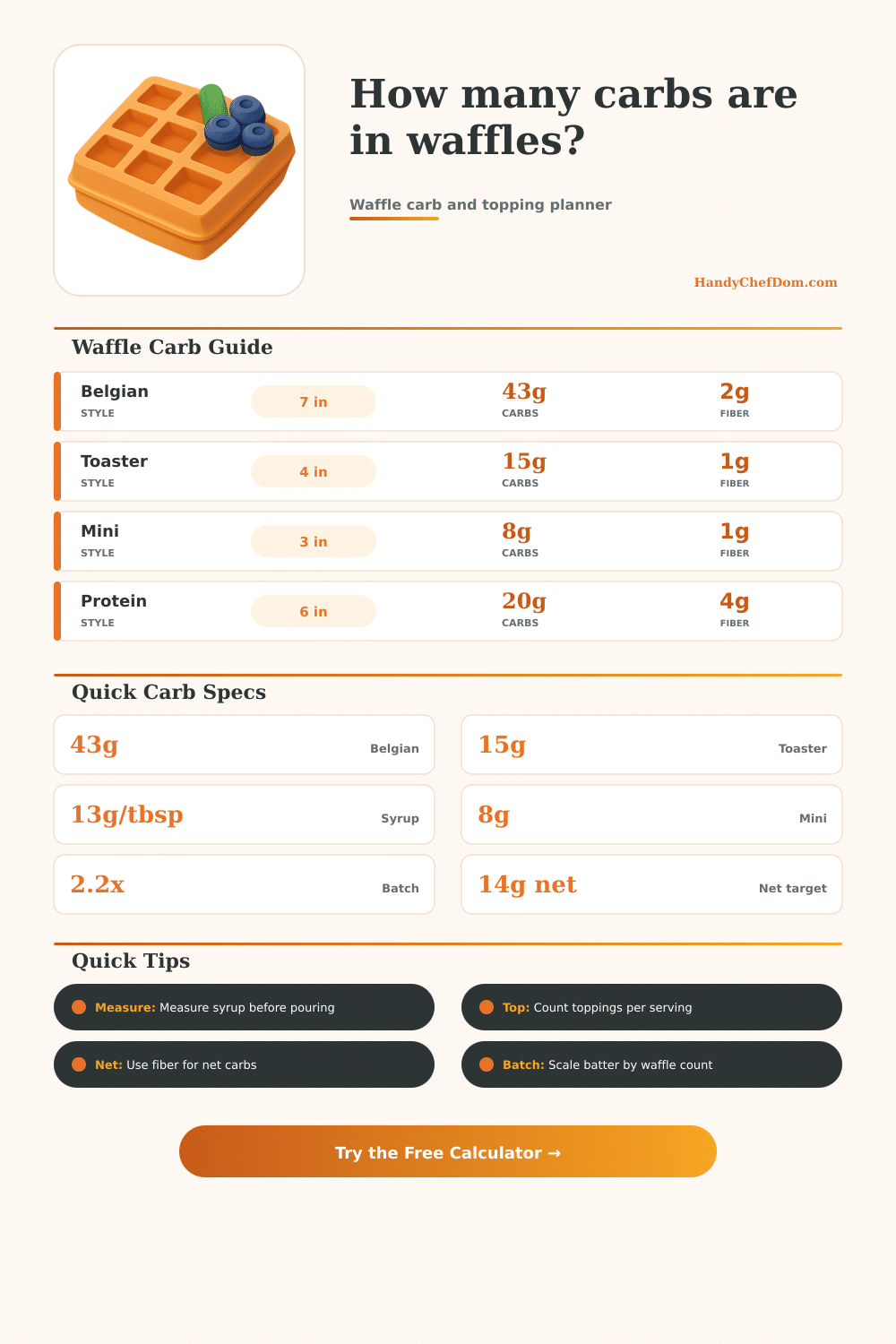
| Belgian homemade | 7 in, 3.5 oz | 43 g | 2 g | Weekend brunch plates and deep-pocket waffles |
| Classic homemade | 6 in, 2.7 oz | 30 g | 1.6 g | Standard round waffle makers and family breakfasts |
| Frozen toaster waffle | 4 in, 1.2 oz | 15 g | 1 g | Packaged toaster waffles and quick weekday servings |
| Mini waffle | 3 in, 0.8 oz | 8 g | 0.5 g | Mini stacks, kids plates, dessert boards, or sampler trays |
| Whole grain waffle | 6 in, 2.9 oz | 29 g | 4 g | Higher-fiber servings where net carbs matter |
| Protein waffle | 6 in, 2.5 oz | 20 g | 4 g | Macro-focused plates and lighter syrup portions |
🍯Syrup and topping carb comparison
| Topping | Calculator unit | Carbs per unit | Typical brunch amount | Net-carb note |
|---|---|---|---|---|
| Maple or pancake syrup | 1 tbsp | 13 g | 1 to 2 tbsp per serving | Usually no fiber, so all carbs count as net carbs |
| Fresh berries | 1 tbsp | 1.5 g | 2 to 4 tbsp per serving | Small fiber credit is included in topping estimate |
| Banana slices | 1 tbsp | 3.4 g | 2 to 3 tbsp per serving | Ripe banana raises topping carbs quickly |
| Chocolate chips | 1 tbsp | 9 g | 1 to 2 tbsp per serving | Easy to undercount when scattered over a stack |
| Fruit jam | 1 tbsp | 13 g | 1 tbsp per serving | Similar carb load to syrup unless sugar-free |
| Nut butter | 1 tbsp | 3.5 g | 1 to 2 tbsp per serving | Lower carb but heavier and more filling |
🍽Brunch batch scaling table
| Serving plan | Mini waffles | Full waffles | Belgian waffles | Suggested buffer |
|---|---|---|---|---|
| Light breakfast for 2 | 6 to 8 minis | 2 to 3 full | 2 Belgian | 0% to 5% |
| Family brunch for 4 | 12 to 16 minis | 5 to 6 full | 4 Belgian | 5% to 10% |
| Brunch table for 8 | 24 to 32 minis | 10 to 12 full | 8 to 10 Belgian | 10% to 15% |
| Waffle bar for 16 | 48 to 64 minis | 20 to 24 full | 18 to 20 Belgian | 15% to 25% |
🧮Net carb examples by serving style
| Serving style | Waffle base | Syrup | Topping | Approx net carbs |
|---|---|---|---|---|
| Plain toaster pair | 2 frozen waffles | 0 tbsp | No topping | 28 g net |
| Classic syrup plate | 1 classic waffle | 1 tbsp | Berries | 41 g net |
| Belgian sweet stack | 1 Belgian waffle | 2 tbsp | Chocolate chips | 77 g net |
| Protein berry plate | 1 protein waffle | 0.5 tbsp | Berries | 23 g net |
💪Nutrition snapshot for common waffle styles
💡Waffle carb planning tips
Nothing sounds more comforting to me than the sizzle of batter hitting a hot waffle iron, but when someone is monitoring their carbohydrate intake, that sound might be worrisome. How many carbs are in a serving of waffles? Depends on how much batter was used and what kind was cooked. How big were they? And do you use any syrup? The online calculator above figure out the details for you after you feed it your variables. There is no guesswork while you wait for breakfast.
Waffles aren’t created equal: most folks think a single serving of waffle are just about the same no matter how it looks. In practice, however, a deep-pocket Belgian waffle and a typical toaster waffle can differ significant in weight. Even when they take up the same amount of space, the former could be much heavierer. That’s where most go astray. Enter your cooked waffles’ true weight (not just the volume) into the tool. This is because many carb counts is based off weight, usually per 100 grams instead of per serving. Homemade, fluffy waffles? They’ll be heavier than frozen ones. Weight = more carbs no matter what the recipe sounds like. The diameter + weight fields helps account for this physical variation that gets ignored in generic nutritional labels.
How to Count Carbs in Waffles
Many times, people focus so much on toppings that they forget about the carb content of the actual waffle. A single small mini waffle has only 13 grams of carbs in itself. Maple syrup… Which is basically liquid sugar, have thirteen grams of carbohydrates every single tablespoon. People don’t realize this and pour generously. Without realizing it, they are eating twice as many carbohydrate as they expected. Users can enter exact measurements for toppings (like nut butter!). By allowing users to put exact measurements of toppings (nut butter! fruit!) into the calculator, you get an accurate look at the carb count for your entire meal. This also shows the carb count for your plate overall. Sounds like a small thing, but it completely changes big picture.
If you’re tracking net carbs, then fiber is what matters most. Many protein and whole-grain waffle recipes are higher in fiber than standard white flour options. Net carbs is calculated by subtracting fiber content from total carbohydrate grams. That’s the number that tends to affect blood sugar levels more immediate. If you use oat fiber or ground flax meal (or another source of added fiber) in your batter, be sure to enter that additional fiber into the calculator. It’ll knock down the net carb count a lot and make even an otherwise carby base seem quite doable on-paper. Otherwise, it’ll look like it has more net carbs then your body actualy processes.
Brunch also brings a new wrinkle: batch-scaling. Chances are, you don’t cook exactly six perfectly made waffles for a party with six friends. Some will be burnt, some will get stuck in the iron, and some will be eaten twice over. There’s a buffer feature on this calculator that lets you add a percentage to your total. Don’t worry, it’s not just for extra food, it’s to make sure your carb calculations still work if everyone’s servings is different sizes. A ten percent buffer gives you a generous fudge factor while keeping numbers from getting too out-of-control to plan by.
To make this work, there are embedded tables on the page that outline the base numbers for each kind of waffle; big ones, little snack-style ones, protein versions, etc. They allow you to see how close or far from the norm whatever recipe you’re cooking is. For example, with a mini waffle (which could easily be a four-waffler), I get just eight grams of carbs. I’d better watch myself when eating those, since four would of be like one serving to me. A protein waffle meanwhile has more fiber and less carb, tilting its nutrition away from pure calories and towards filling-you-up goodness. Knowing all this lets you pick which table to start at.
At the end of the day, carb counting is more about being aware than it is about perfecting anything. And measuring each drop of syrup and weighing every single berry in a lab isn’t necessary. All you want is a simple tool to help you have an idea of how much you’re consuming and thus be able to make smart decisions when sitting down at the table. The calculator does this for you. It packages up the weight, type, and topping all together into a nice, neat visualization. A messy breakfast pile becomes digestible information. Pour on that syrup, but maybe measure it out first. That way, you’ll know exactly what’s going into your body before it dissapears from your morning routine.