Carrot Fiber Calculator
Estimate total fiber, per-serving fiber, daily goal share, edible yield, and soluble versus insoluble fiber for raw, steamed, roasted, whole, baby, or grated carrots.
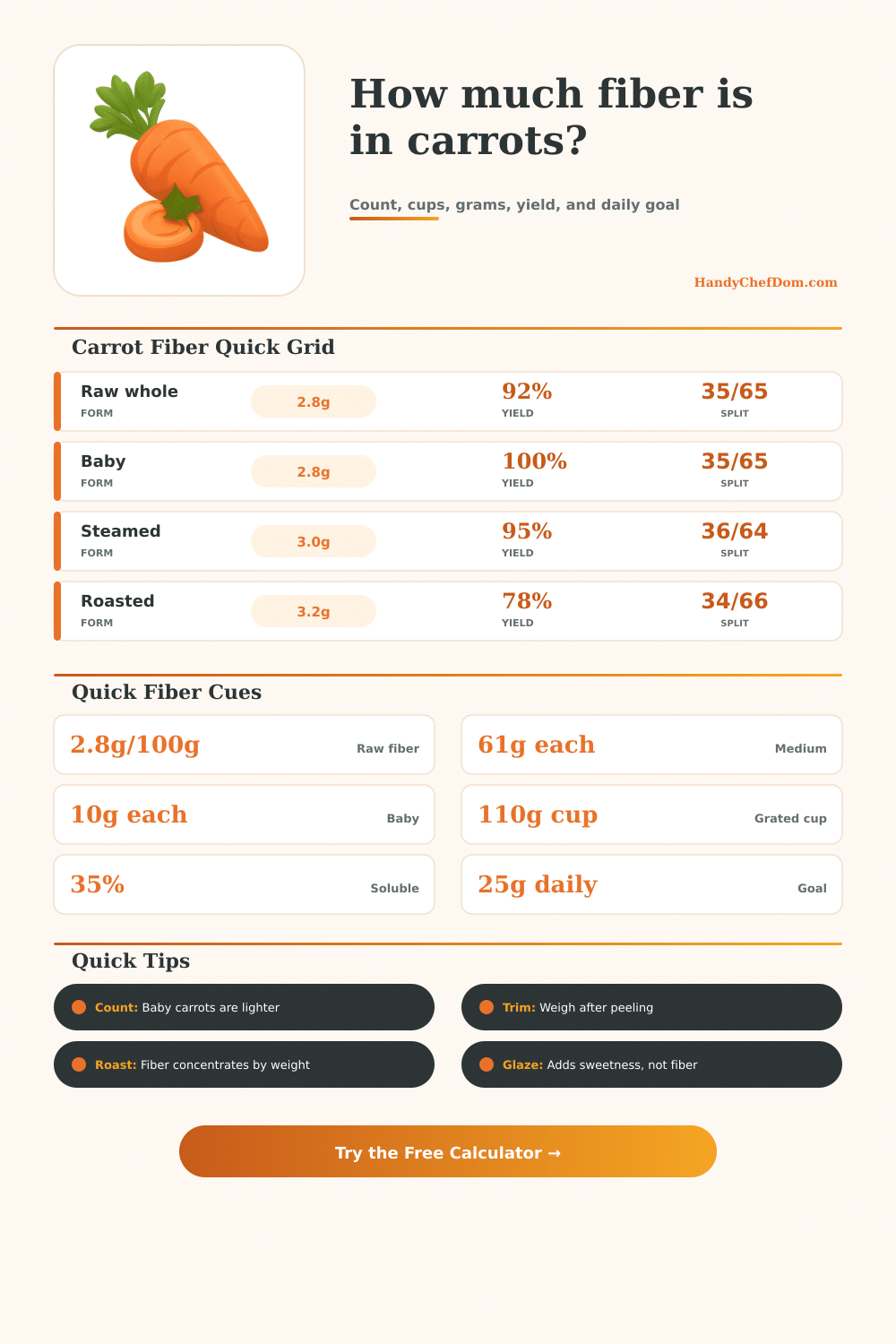
| Carrot form and method | Typical measure | Fiber per 100 g edible | Soluble estimate | Best use in calculator |
|---|---|---|---|---|
| Whole raw medium carrots | 61 g each before trimming | 2.8 g | 35% | Count or weighed snacks and sides |
| Baby carrots, raw | 10 g each, already trimmed | 2.8 g | 35% | Snack cups and platters |
| Grated raw carrots | 110 g per packed cup | 2.8 g | 35% | Salads, slaws, muffins, bowls |
| Steamed carrot slices | 156 g per cooked cup | 3.0 g | 36% | Meal prep and soft sides |
| Roasted carrot pieces | 122 g per roasted cup | 3.2 g | 34% | Sheet-pan sides after moisture loss |
| Measure | Approx grams | Approx ounces | Fiber if raw | Notes |
|---|---|---|---|---|
| 1 medium whole carrot | 61 g | 2.2 oz | 1.7 g | Before peel or top trim |
| 10 baby carrots | 100 g | 3.5 oz | 2.8 g | Usually no trim loss |
| 1 cup grated raw carrot | 110 g | 3.9 oz | 3.1 g | Lightly packed shreds |
| 1 cup chopped raw carrot | 128 g | 4.5 oz | 3.6 g | Coins or rough dice |
| 1 cup steamed slices | 156 g | 5.5 oz | 4.7 g | Cooked edible weight |
| 1 cup roasted pieces | 122 g | 4.3 oz | 3.9 g | Moisture loss concentrates fiber |
| Serving plan | Edible carrot per person | Approx fiber per person | Whole carrot count | Baby carrot count |
|---|---|---|---|---|
| Light garnish or bowl topping | 30 g | 0.8 g | 1/2 medium | 3 baby carrots |
| Snack portion | 60 g | 1.7 g | 1 medium | 6 baby carrots |
| Standard vegetable side | 85 g | 2.4 g | 1 1/2 medium | 8 to 9 baby carrots |
| Generous roasted side | 120 g | 3.4 to 3.8 g | 2 medium | 12 baby carrots |
| Meal prep vegetable base | 150 g | 4.2 to 4.8 g | 2 1/2 medium | 15 baby carrots |
| Total carrot fiber | Share of 25 g goal | Share of 30 g goal | Soluble estimate | Insoluble estimate |
|---|---|---|---|---|
| 2 g fiber | 8% | 7% | 0.7 g | 1.3 g |
| 5 g fiber | 20% | 17% | 1.8 g | 3.2 g |
| 8 g fiber | 32% | 27% | 2.8 g | 5.2 g |
| 12 g fiber | 48% | 40% | 4.2 g | 7.8 g |
Carrots has antioxidants and vitamins, which makes them healthy. When you eat one, most of us estimate how much fiber is in it. If you’re eating whole carrots, maybe added to a stir fry or just grabbing a few baby carrot for a snack, you think you’re meeting your quota. But you don’t always get as much from a carrot as you think.
Depending on the type of carrot (raw vs. Cooked, grated, roasted or steamed) will alter amount of fiber. Depending on size of your carrot (and how much of the root you peel off) alters amount of fiber as well. That’s where estimation tools comes in… Turning vague guesses into concrete numbers.
How to Calculate Fiber in Carrots
Once you enter the amount you’re preparing and which method, calculator on top does the rest. No need to guess at the yield; no need to look up density of raw carrots.
First, decide whether you are measuring by weight or count. It makes more sense to measure whole root carrots from farmer’s market by weight (one big carrot could be two or even three small). Baby carrots is standard cylinders, probably around ten grams apiece, so they tend to be best counted. Enter that into calculator and it accounts for the base fiber content.
As I said, raw carrots has roughly 2.8 grams of fiber per 100 grams of their edible portion. If you cook them (roast, for example, or steam), then you lose some water, which means all the other stuff; like fiber, is left behind and concentrated.
There’s one other variable that trips people up: Peeling. While skin of a carrot is edible (and tough), leaving it on maintains the fiber content. Stripping it off with a peeler reduce your yield by a small percentage of total weight. You give up a bit of nutrition. There’s a place to enter a “yield percentage” to adjust for it. Depending on how woody your carrots are, you can go either way here: heavy trim or light scrub. It’s a small detail but when you’re tracking your intake carefully, every little bit counts.
You’ll also see a place where you can select glaze. Adding sweeteners like honey or maple syrup boost calories and adds sweetness, but doesn’t contribute any fiber. To avoid falsely increasing your fiber count with added sugar, the tool sticks only to carrot-based estimates.
So now that we know about insoluble vs. Soluble fiber, it’s easy to see why carrots act like they do when inside you: While insoluble fiber aids food to move faster along your gut and increases stool bulk, soluble fiber absorbs water and turns to a sort of gel, this can assist keeping blood sugars stable. About 2/3 of the fiber in carrots is insoluble and the rest is soluble… Hence their gentle-yet-satiating nature.
If you’d like to get into the nitty gritty breakdown, here’s the reference table on page.
What do carrots mean when it comes to eating them? When you grate carrots into a salad, they may be a little easier to chew and have a larger surface area, but it won’t impact the fiber content more then… If we’re talking grams. If we’re talking cups though, then it’s different, grated carrot versus sliced carrot is going to weigh something different than. How tightly they pack together will change. That’s why a scale or counting might actualy be better for accuracy.
If you want to ensure you reach your 25-gram per day fiber goal OR if you like meal-prep’ing and want to know how many grams of fiber you’re getting from whatever veggies you pack in, having an accurate sense of what foods are contributing removes some of the guessing from your nutrition plan. But this is where real value comes in: consistency.
Knowing that one serving contains x amount of fiber, you can build meal plans confidently, knowing that your snack won’t be underdone and your side won’t be overdone. You’ll no longer guess that your tiny nibble isn’t so tiny after all. You’ll connect purchasing produce with understanding its effects on you.
Keep these orange roots in mind next time; your preparation is what changes what they provide for you. Using a little precision helps make sense of your daily intakes. You don’t have to become a nutritionist to get it right, you could of just used a scale. But you do need the right numbers to help guide your decisions.