🍇 Raisins Fiber Calculator
Estimate fiber in raisins by mini box, tablespoon, cup, gram weight, serving count, trail mix share, baking scale, and dried-fruit density.
Use the measure you have on hand, then adjust serving count, recipe multiplier, raisin share, and cup packing so the fiber result fits snacks, trail mix, or baked goods.
| Raisin style | Serving | Fiber | Calories | Carbs | Potassium |
|---|---|---|---|---|---|
| Thompson seedless | 40 g | 1.5 g | 120 kcal | 31.7 g | 300 mg |
| Golden seedless | 40 g | 1.5 g | 121 kcal | 31.9 g | 298 mg |
| Sultana raisins | 40 g | 1.6 g | 120 kcal | 31.6 g | 296 mg |
| Flame raisins | 40 g | 1.5 g | 120 kcal | 31.6 g | 300 mg |
| Zante currants | 40 g | 2.7 g | 113 kcal | 29.6 g | 356 mg |
| Jumbo mixed raisins | 40 g | 1.4 g | 121 kcal | 32.0 g | 296 mg |
| Baking raisins | 40 g | 1.5 g | 119 kcal | 31.2 g | 292 mg |
| Chopped raisins | 40 g | 1.5 g | 120 kcal | 31.7 g | 300 mg |
| Measure | Typical weight | Fiber, regular | Cup equivalent | Best use |
|---|---|---|---|---|
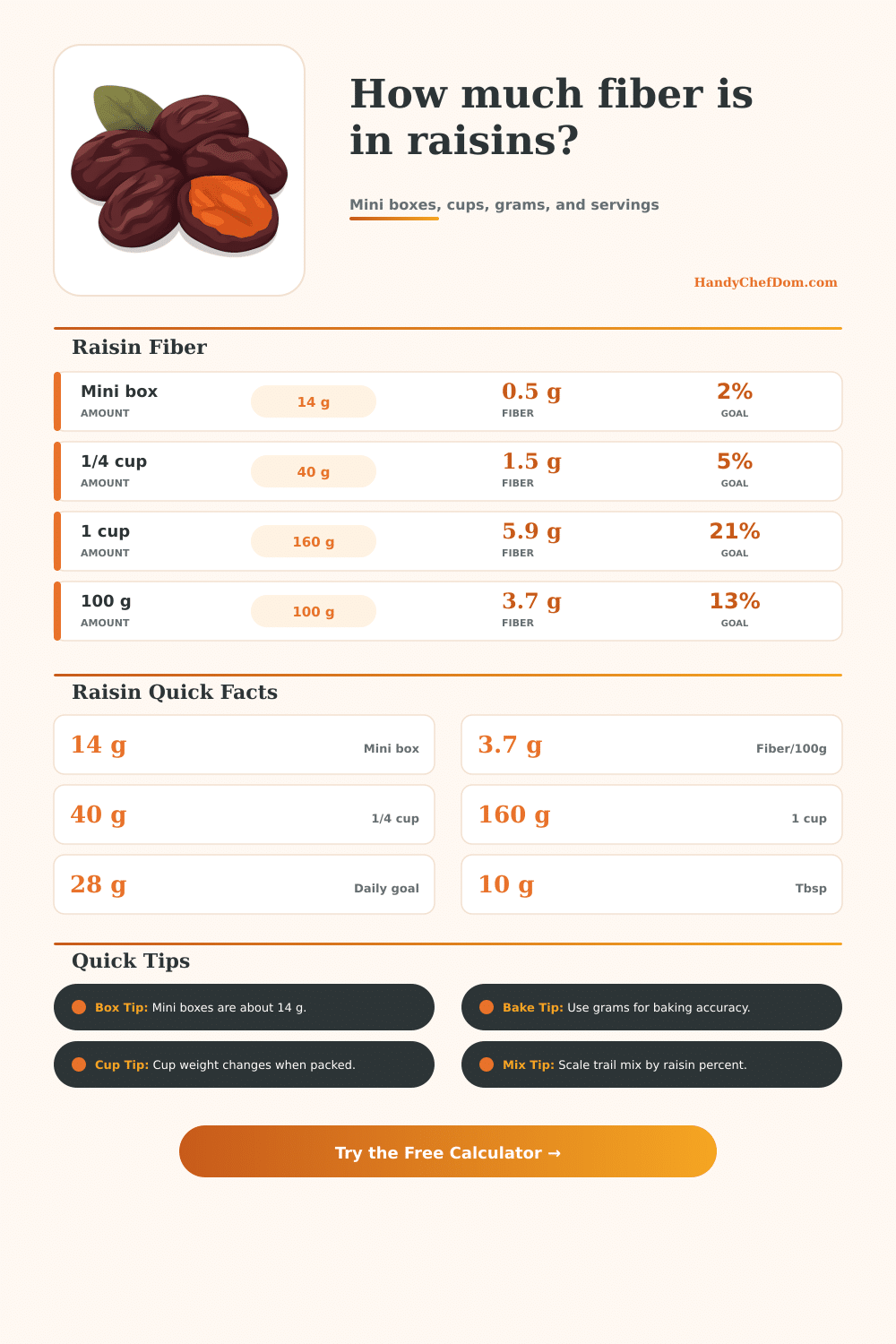
| Mini snack box | 14 g | 0.5 g | 0.09 cup | Lunchbox counting |
| Tablespoon | 10 g | 0.4 g | 0.06 cup | Oatmeal topping |
| Quarter cup | 40 g | 1.5 g | 0.25 cup | Snack serving |
| Third cup | 53 g | 2.0 g | 0.33 cup | Trail mix scoop |
| Half cup | 80 g | 3.0 g | 0.50 cup | Recipe add-in |
| One cup | 160 g | 5.9 g | 1.00 cup | Baking batches |
| One ounce | 28 g | 1.0 g | 0.18 cup | Portable snack |
| 100 grams | 100 g | 3.7 g | 0.63 cup | Metric scaling |
| Portion | Raisin grams | Fiber | % of 28 g goal | Mini box equivalent |
|---|---|---|---|---|
| 1 tablespoon | 10 g | 0.4 g | 1% | 0.7 box |
| Mini box | 14 g | 0.5 g | 2% | 1.0 box |
| Small topping | 20 g | 0.7 g | 3% | 1.4 boxes |
| Quarter cup | 40 g | 1.5 g | 5% | 2.9 boxes |
| Third cup | 53 g | 2.0 g | 7% | 3.8 boxes |
| Half cup | 80 g | 3.0 g | 11% | 5.7 boxes |
| Batch goal | Raisin share | Raisins needed | Raisin fiber | Notes |
|---|---|---|---|---|
| 400 g trail mix | 20% | 80 g | 3.0 g | Light raisin mix |
| 600 g granola mix | 25% | 150 g | 5.6 g | Breakfast batch |
| 12 muffins | 18% | 90 g | 3.3 g | 7.5 g each |
| 24 cookies | 22% | 160 g | 5.9 g | 6.7 g each |
| 1 loaf bread | 20% | 120 g | 4.4 g | 10 slices |
| 8 snack bags | 35% | 112 g | 4.1 g | 14 g each |
How much nutritional benefit is there in a raisin? I bet everyone has stared down at a tiny package of raisins, only to wonder how nutritious that bite actualy is. Even though raisins are a concentrated form of nutrient-rich grapes, they weighs very little. Our intuition about the size of a raisin isn’t good. It’s hard to gauge the volume of something so small and a serving is such a relative number compared to overall nutrition requirements.
A raisin fiber calculator can be used to make this guessing game exact. No more rough math required!
Why Use a Raisin Fiber Calculator?
Measuring cups of raisins differs because some are denser than others. This depends on the kind of raisin you use. For example, Thompson seedless raisins aren’t exactly the same as Zante currants in terms of fiber. But that’s not the biggest factor; how much a cup fits inside measuring cup differs from person to person, spoonful to spoonful. If you pack a cup with raisins, it’ll be heavier than if you used a loose handful. When you choose “loose,” “standard” or “packed” using the tool, it takes this into account.
Why does this matter? Because weight determines fiber content. Volume doesn’t. Most people assume that a cup of something weighs the same whether it is packed loosely or tightly. This means when they read the label, which gives info based off weight per hundred grams, they are off by almost thirty percent.
Little snack foods has more fiber than many realize. A small box has ~14g of fruit (or 0.5g of fiber). It sounds like not much but then two boxes = a noticeable fraction of the day’s recommended intake. It’s easy to forget how little each serving is until you see total amount using our fruit box calculator. It translates boxes into total fiber, shows what percentage of your daily goal it represents, and adjusts based on number of cups, tablespoons, or boxes you enter.
This is good if you’re making trail mix with raisins or serving kids a snack. Weight matters more then volume when baking: “One cup” isn’t clear, as home cooks vary in how tightly they pack a cup. Pro bakers measures by grams instead, so how tightly they pack the ingredients doesn’t matter. Grams makes it easy to scale a recipe up or down, too, just set your multiplier and the calculator will recalculate all of the fiber for that entire batch. That way, when you double the cookie batch, you’ll remember to only add half again as much fruit (or sugar).
Raisins also has fiber, iron, and potassium. They can be stirred into yogurt bowls, oatmeal, and even savory pilaf dishes. No one said anything about it having to look perfect. If you know the general proportions, don’t worry about measuring out each gram. For example, a quarter-cup serving have roughly one and a half grams of fiber… Not bad for just one serving, right? It’s all about regular inclusion, not perfect optimization in every single bite.
You can get different kinds of raisins with different flavors and textures. For example, dark raisins tend to be more chewy than golden ones (which have a sweeter flavor and a softer texture). This makes a difference if you plan on baking with them versus just using them as a topping. The calculator works with all kinds: chopped currants, sultanas, whatever kind you happen to have in the pantry, it will still give you an estimate.
So by tracking fiber you build a habit around tracking things that is aligned with your lifestyle. Whether you’re making lunches for your kids’ school boxes or whipping up holiday treats, having an idea of what little tweaks add up takes the guessing out of healthy food choices. Stop wondering if that dried fruit is really worth it. Know what goes in your body and how exactly that adds up to the rest. Seeing all those tiny boxes added together made one mini box not seem so insignificant. The same applies to learning about what you eat, it starts with understanding each item alone and then adds up to the whole picture. You should of checked this sooner!