Onion Sugar Calculator
Estimate natural onion sugar, trimmed yield, chopped cups, fiber balance, and scaled recipe amounts from count, grams, prep style, and servings.
✨Onion Scenario Presets
🧅Onion Inputs
Onion Sugar Results
📊Live Recipe Scale Snapshot
🌱Nutrition Per Serving Snapshot
📘Onion Type, Prep, and Sugar Grid
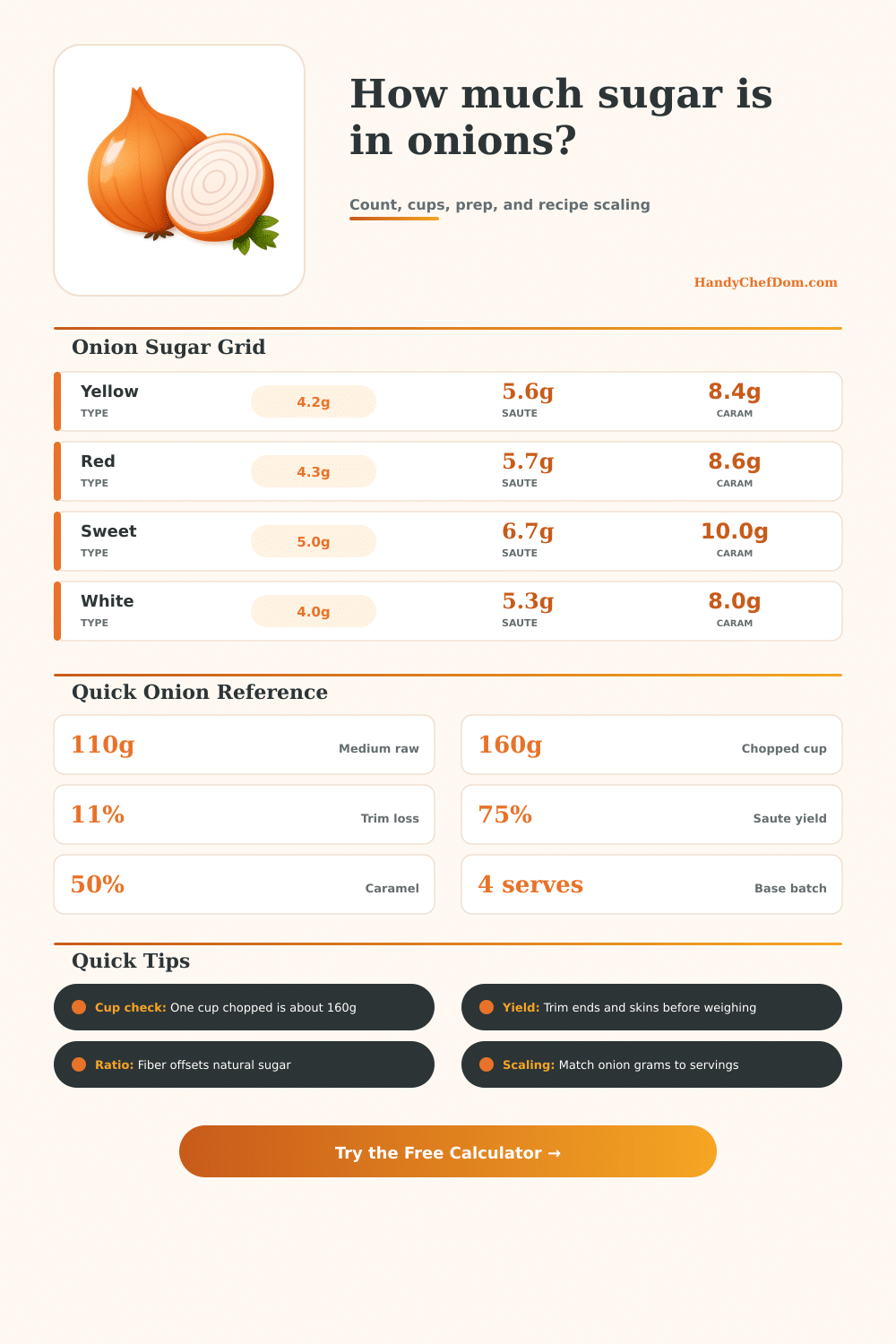
| Onion type | Sugar per 100g raw | Fiber per 100g raw | Best calculator use |
|---|---|---|---|
| Yellow onion | 4.2 g | 1.7 g | Balanced soups, burgers, sauces |
| Red onion | 4.3 g | 1.8 g | Raw garnish, salsa, salads |
| Sweet onion | 5.0 g | 1.5 g | Onion-forward dishes and fajitas |
| White onion | 4.0 g | 1.6 g | Bright raw crunch and quick saute |
| Shallot | 7.9 g | 3.2 g | Small aromatic bases with more sweetness |
| Green onion | 2.3 g | 2.6 g | Scallion garnish and light toppings |
🥣Chopped Cup and Trimmed Yield Conversions
| Cut or measure | Approx grams per cup | Approx ounces per cup | Calculator note |
|---|---|---|---|
| Fine diced onion | 165 g | 5.8 oz | Packs tightly in measuring cups |
| Medium chopped onion | 160 g | 5.6 oz | Good default for recipe cups |
| Sliced onion | 115 g | 4.1 oz | Air pockets make cups lighter |
| Minced onion | 180 g | 6.3 oz | Dense volume for relishes and fillings |
| One medium onion | 110 g edible | 3.9 oz | After typical peel and end trim |
| One large onion | 150 g edible | 5.3 oz | Use count mode for rough prep planning |
🔥Prep Concentration and Cooked Yield
| Prep stage | Typical yield from raw | Sugar concentration effect | Use when |
|---|---|---|---|
| Raw or tossed | 100% | No concentration | Salsa, salad, burger topping |
| Sweated low | 85% | Mildly concentrated | Soup base, rice, stuffing |
| Sauteed soft | 75% | Moderately concentrated | Omelets, gravy, pasta base |
| Caramelized | 50% | Strongly concentrated | Pizza topping, jammy onions, tart filling |
🍽Serving and Recipe Base Scaling Table
| Recipe role | Raw onion per serving | Chopped cups for 4 servings | Natural sugar estimate |
|---|---|---|---|
| Light raw garnish | 20 g | 0.5 cup | About 0.8 to 1.0 g each |
| Balanced aromatic base | 45 g | 1.1 cups | About 1.8 to 2.3 g each |
| Onion-forward skillet | 75 g | 1.9 cups | About 3.0 to 3.8 g each |
| Caramelized topping | 100 g | 2.5 cups raw | About 4.0 to 5.0 g each |
💡Onion Sugar Calculator Notes
Why does making a basic soup feel like a math equation? Why is there a cup of this and a cup of that and now I’m looking at my yellow onions on the counter wondering how many I should chop? And what if I caramelize them, would that raise their sugar level more high? It’s a familiar kitchen problem: part measuring, part cooking sense. A lot of recipes tells you to, for example, “chop until it looks right,” or “use one large onion.”
They’re good enough for informal meals, but when you’re keeping tabs on nutritional information, or planning to make several batch of something, those tips don’t help much. The calculator above translates your raw ingredients into specific data points that you can recall without memorizing complex density numbers.
Cooking with Onions Made Easy
Then there’s the actual work: you must realize that an onion isn’t a typical geometric shape. Trimming it out of equation results in weight loss; how much depends on its size (root plate or skin thickness). Also, wasting some inedible parts of plant. Either root plate or skin, increases your numbers. Since all the fiber and sugar is found in the edible flesh, enter trimmed grams, rather then overall bulb weight, into calculator to get accurate numbers. More than many might think, this makes a difference when counting macros or when you want to scale up a recipe for a dinner party. Override the default trim loss if you’re working with especially dirty field onions (this keeps the final yield realistic).
The act of cooking also transforms your ingredients’ density and texture. Raw onions is bulky; caramelizing them draws out their liquid and concentrates their flavor, but it also shrinks them down into a denser state. You can’t fit one cup of cooked onion in the space occupied by one cup of diced raw onion. To reflect this physical reality, you’re able to choose from different stages of onion prep. This helps you know how far along the dish is. It also helps you predict how much food will be left in pan compared to what the book expects.
When onions caramelize, they shrinks significantly, requiring more raw onion to reach the same saucy state. Knowing this ratio can save you the disappointment of doubling a recipe blindfolded, then opening up half-empty pots.
Each type of onion (or shallot) has its own unique qualities on the table: sweet onions offer higher natural sugars that brown faster, while yellow onions provides a reliable baseline for everyday cooking. And with those variations come subtle flavors, understand which to substitute for which by consulting the handy-dandy reference grid built into tool. Need a recipe calling for red onion, but all you’ve got on hand is white? You’ll know what to expect when it comes to color contribution and sweetness level. Think of it as matching the vegetable up to its role in the dish, not reading off labels.
But there’s a whole other side to making bigger batches: It gets tricky when you’re scaling up a recipe to feed more people. Simply multiplying all ingredients by 3 doesn’t work because volume doesn’t change at the same rate than weight or flavor concentration. To solve this, we added an easy slider that adjusts number of servings and helps you dial-in how many onions to use per dish compared to overall meal size. So you can avoid making something super-fragrant but also too weak-tasting when feeding a family. Locking down the amount of servings let the system automatically figure out how much raw material to use to reach your flavor goal (precisely). Get full control over what it tastes like without having to guess about how sweet/heat/etc to make things at the last minute.
You could of just used an estimate. When I know what’s going on in my veggies, I don’t have to guess anymore when I cook. Instead of worrying that I’ve added too much (or not enough), I measure confidently. The numbers are a tool instead of a rule. After I understand the relationship between cooking reduction and trim loss, it’s easy to handle any bulb. That heap of onions on your counter turns from an undefined ingredient into a specific part of your meal plan. Chopping them up? You’ll do so confidently knowing which layers will be contributing to whatever ends up on your plate.