Carrot Vitamin C Calculator
Estimate vitamin C from carrot weight, cups, pieces, juice volume, prep style, trimming, and daily intake target
Food values are based on USDA FoodData Central and USDA nutrient reference entries for vitamin C, total ascorbic acid. Carrot vitamin C varies with cultivar, age, processing, and storage, so use these as planning estimates.
| Carrot Form | Vitamin C | Cup Basis | Estimated mg/Cup |
|---|---|---|---|
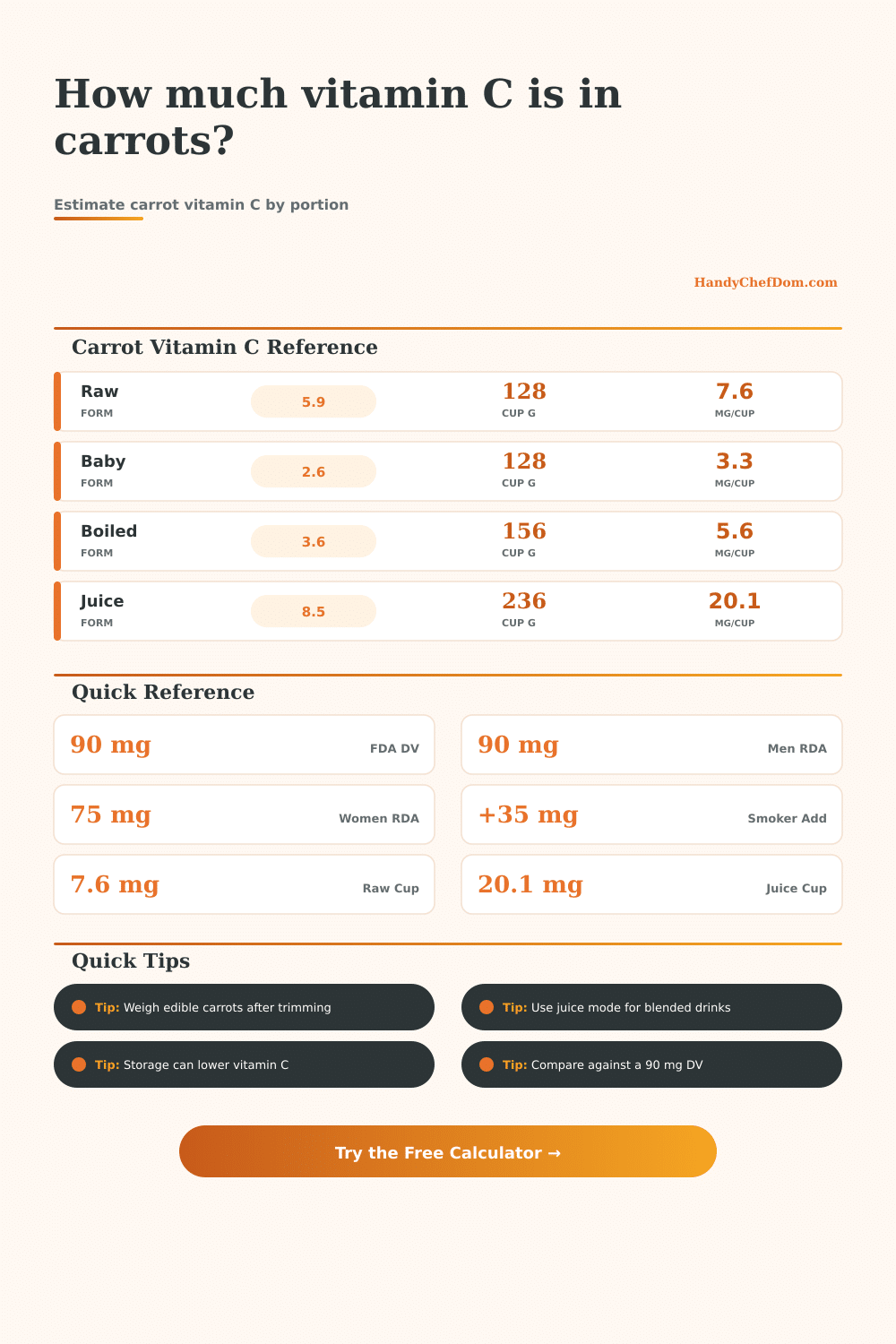
| Raw whole carrots | 5.9 mg/100 g | 128 g chopped cup | 7.6 mg |
| Raw chopped carrots | 5.9 mg/100 g | 128 g cup | 7.6 mg |
| Raw shredded carrots | 5.9 mg/100 g | 110 g packed cup | 6.5 mg |
| Raw baby carrots | 2.6 mg/100 g | 128 g cup | 3.3 mg |
| Cooked boiled carrots | 3.6 mg/100 g | 156 g sliced cup | 5.6 mg |
| Roasted carrots estimate | 4.4 mg/100 g | 130 g cup | 5.7 mg |
| Canned carrots drained | 2.0 mg/100 g | 123 g half-cup | 4.9 mg per cup |
| Carrot juice | 8.5 mg/100 g | 236 g cup | 20.1 mg |
| Reference Target | Vitamin C | Source Basis | Calculator Use |
|---|---|---|---|
| FDA Daily Value | 90 mg | Nutrition Facts label DV | Default percent DV |
| NIH adult men RDA | 90 mg | Recommended Dietary Allowance | Adult male target |
| NIH adult women RDA | 75 mg | Recommended Dietary Allowance | Adult female target |
| NIH pregnancy RDA | 85 mg | Pregnant adult target | Pregnancy setting |
| NIH breastfeeding RDA | 120 mg | Lactating adult target | Higher target setting |
| NIH smoker addition | +35 mg | Added to selected target | Optional adjustment |
| Portion | Approx Weight | Best Input Mode | Notes |
|---|---|---|---|
| 1 medium raw carrot | 61 g | Carrot pieces | Good for snack counts |
| 1 large raw carrot | 72 g | Carrot pieces | Use large size setting |
| 1 baby carrot | 10 g | Carrot pieces | Use baby size setting |
| 1 cup chopped raw | 128 g | Cups | Raw salads and bowls |
| 1 cup shredded | 110 g | Cups | Packed but not compressed |
| 1 cup cooked sliced | 156 g | Cups | Boiled side dish |
| 1/2 cup canned | 123 g | Servings | Drained solids basis |
| 1 cup carrot juice | 236 g | Juice volume | Use mL or fl oz |
| Adjustment | Factor | When To Use | Effect |
|---|---|---|---|
| Fresh or just prepared | 1.00x | Recently cut, cooked, or poured | Uses listed value |
| Peeled and rinsed | 0.96x | Trimmed raw carrots | Small reduction |
| Cut and held overnight | 0.90x | Prepped raw sticks or shreds | Storage estimate |
| Cooked then reheated | 0.85x | Leftover cooked carrots | Extra handling loss |
| Stored several days | 0.78x | Older prepped portions | Conservative estimate |
| Trim or peeling loss | User % | Ends, peels, waste | Reduces edible grams |
| Form | mg/100 g | Cup Weight | mg/Cup | Cups For 25% DV | Cups For 100% DV |
|---|---|---|---|---|---|
| Raw whole carrots | 5.9 | 128 g | 7.6 mg | 2.98 | 11.92 |
| Raw chopped carrots | 5.9 | 128 g | 7.6 mg | 2.98 | 11.92 |
| Raw shredded carrots | 5.9 | 110 g | 6.5 mg | 3.47 | 13.87 |
| Raw baby carrots | 2.6 | 128 g | 3.3 mg | 6.76 | 27.04 |
| Cooked boiled carrots | 3.6 | 156 g | 5.6 mg | 4.01 | 16.03 |
| Roasted carrots estimate | 4.4 | 130 g | 5.7 mg | 3.93 | 15.73 |
| Canned carrots drained | 2.0 | 246 g | 4.9 mg | 4.57 | 18.29 |
| Carrot juice | 8.5 | 236 g | 20.1 mg | 1.12 | 4.49 |
Beta carotene: That’s what comes to mind when you think of carrots. It make sense, after all, that bright orange color scream vision health and skin glow. But there is another nutrient hiding in that carrot that often gets overlooked when people rush toward an orange for they vitamin C fix.
While carrots won’t blow kale out of the water, it still add up over time. If you’re aiming to hit your daily target (without having to take pills), there’s a big difference between starting your day with a large glass of fresh-squeezed carrot juice vs. A handful of baby carrot at lunchtime.
How Carrot Prep Changes Vitamin C Levels
The common wisdom says that when we cook our veggies, we destroy all their vitamin content right away. While the heat will break down some of the vitamin C, it won’t take it all. For example, boiled carrots contains approximately three or four milligrams per hundred grams of carrot. That may sound like small potatoes in comparison to a raw carrot, but if you consider that this is a typical side dish, there’s plenty to go around.
You can use the calculator above to plug in your preferences for preparation; then it’ll do the math for you so you don’t have to guess about whether that steamed serving counts towards your day’s quota. If you’re looking at raw carrots, they’ll land closer to the top of the chart with almost six milligrams per hundred grams. What makes the difference? It is the form. A stick of whole carrots pack quite differently than shredded carrots. And if you juice them, you get all the concentrate (without the fiber that tends to slow down absorption).
Freshness matters Vitamin levels decreases as storage time increases. Exposure to light and air cause vitamin C to break down. For example, chopping up a bag of carrots on Sunday to use during the rest of the week will cause the vitamin C content to drop by Tuesday. To account for this decrease, the tool has adjustable settings so you can select how your food was prepared (freshly), how long it’s been sitting out (overnight) or how long it’s been stored (a few days). Each setting includes a reduction factor based off real world degradation instead of ideal lab conditions. It makes abstract nutritional information useful planning advice.
The weight you enter into the calculator must be the part you’re going to eat. For many fruits and vegetables, this won’t match the raw weight you purchased. You might peel them first, even though peels contain valuable nutrients, or cut off the tops and ends which have no nutritional value. This wasted food have weight, but doesn’t add anything to what you consume. The trim loss field allows you to subtract out this waste prior to calculating. It makes you account for what you will eat, not just what came home from the store. This helps ensure you track accurately.
This is especially important if you are on a diet for medical reasons like pregnancy or breastfeeding, which raises your target much higher than average person’s daily value. There’s one more tweak: Smokers’ bodies needs something different. Because nicotine speeds up the rate at which vitamin C breaks down, health guidelines suggest adding another 35 milligrams to their daily intake. (This is an optional toggle on the calculator.)
That doesn’t mean tacking on one more digit. It means recalculating all your coverage percentages from a new, higher level. This prevents you from thinking you’ve hit some kind of “baseline” when you haven’t even made it high enough for your own lifestyle.
Carrot juice wins the density contest. By taking out the fiber, you can eat more carrot material than if you were required to chew it. Compared with an equal amount of solid carrots (by weight), one cup of juice has about three times as much Vitamin C (about 20 mg). Of course, there’s a tradeoff: satiety and glycemic impact. The nutrient comes in but not the fullness, so it doesn’t count toward meal satisfaction like chowing down does.
Knowing that will help you know when to juice, when to steam, when to chop, and all for the sake of your overall health goals. These differences are broken out in detail on the page in reference tables. For example, they explain why whole organic carrots have higher numbers than baby ones due to blanching and other pre-packaging processes. And also how different preparations, like juicing or steaming, can change the nutrient density.
It is a little thing but it makes a difference if you want to be as efficient as possible with what you eat on a restricted diet. You don’t have to remember all of the coefficients, though; the tool does the math for you, converting from cups to milligrams or ounces to grams as needed. All you have to do is be honest about what you’re actualy consuming, and when you last put it in the fridge. Accurate data in = accurate insight out, and that’s where the real value here lies.