Kale Vitamin K Calculator
Estimate vitamin K from kale cups, grams, ounces, servings, and preparation style using USDA-style nutrient values
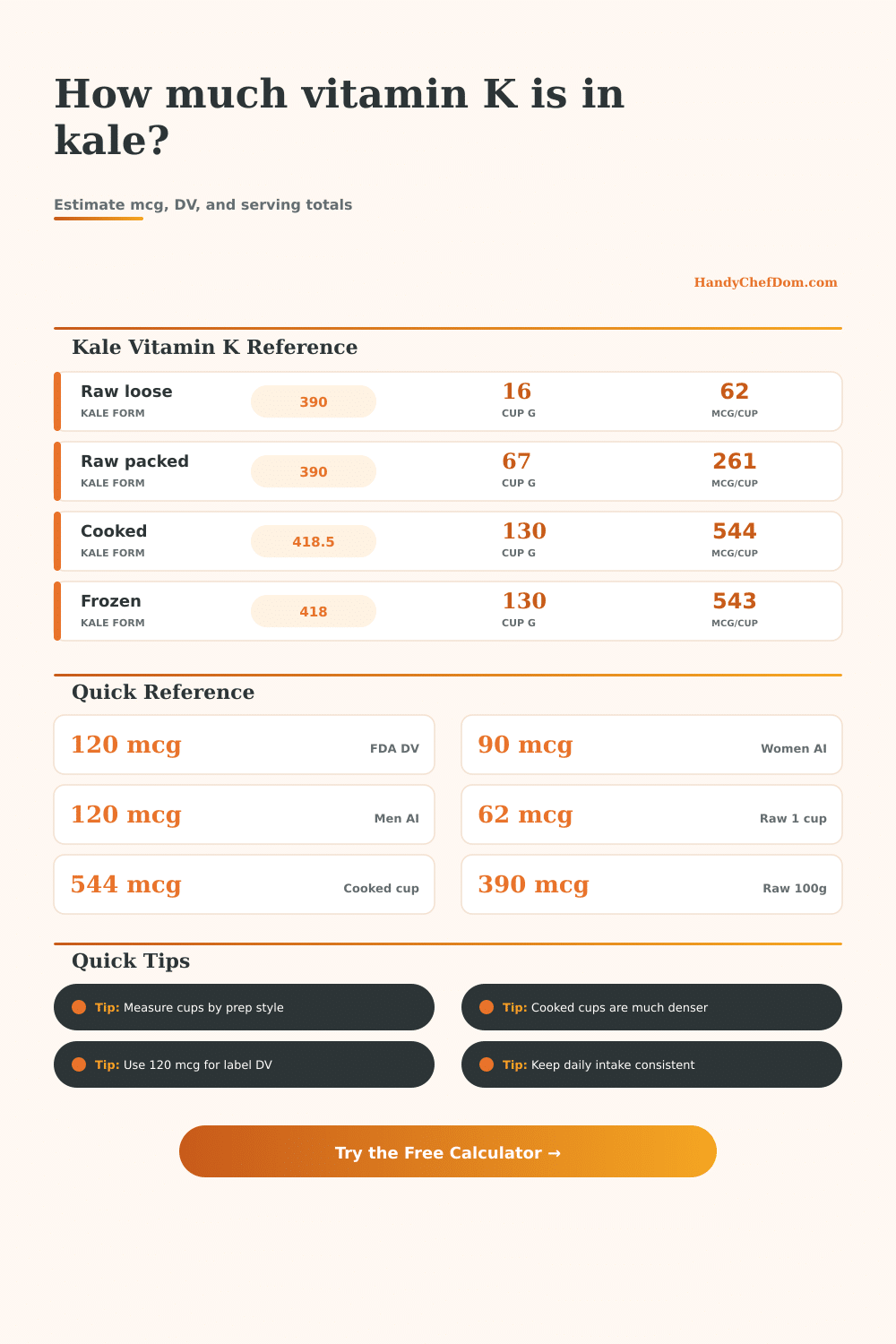
| Kale Form | Vitamin K | Cup Weight | Approx per Cup |
|---|---|---|---|
| Raw kale, loose cup | 390 mcg/100 g | 16 g | 62 mcg |
| Raw kale, shredded estimate | 390 mcg/100 g | 25 g | 98 mcg |
| Raw kale, packed estimate | 390 mcg/100 g | 67 g | 261 mcg |
| Baby kale, raw estimate | 390 mcg/100 g | 20 g | 78 mcg |
| Lacinato kale, raw estimate | 390 mcg/100 g | 21 g | 82 mcg |
| Cooked boiled kale | 418.5 mcg/100 g | 130 g | 544 mcg |
| Cooked packed kale | 418.5 mcg/100 g | 160 g | 670 mcg |
| Frozen cooked kale | 418 mcg/100 g | 130 g | 543 mcg |
| Reference | Amount | Used For | Calculator Use |
|---|---|---|---|
| FDA Daily Value | 120 mcg | Nutrition labels | Percent DV card |
| NIH adult men AI | 120 mcg | Daily intake target | Target option |
| NIH adult women AI | 90 mcg | Daily intake target | Target option |
| NIH teen AI | 75 mcg | Age 14 to 18 target | Target option |
| Custom target | User set | Meal planning | Custom option |
| Scenario | Kale Form | Amount | Vitamin K |
|---|---|---|---|
| Smoothie handful | Raw loose | 1 cup | 62 mcg |
| Side salad base | Raw loose | 2 cups | 125 mcg |
| Meal prep packed greens | Raw packed | 1 cup | 261 mcg |
| Cooked side portion | Cooked boiled | 0.5 cup | 272 mcg |
| Hearty cooked bowl | Cooked packed | 1 cup | 670 mcg |
| Frozen cooked serving | Frozen cooked | 0.5 cup | 272 mcg |
| Measurement | Raw Loose | Raw Packed | Cooked |
|---|---|---|---|
| 0.5 cup | 8 g | 34 g | 65 g |
| 1 cup | 16 g | 67 g | 130 g |
| 2 cups | 32 g | 134 g | 260 g |
| 100 g | 6.3 cups | 1.5 cups | 0.8 cup |
| 1 oz | 1.8 cups | 0.4 cup | 0.2 cup |
| Portion | Form | Weight | Vitamin K | % DV | Women AI |
|---|
That’s why “a cup of kale” isn’t always so simple. There’s more going on than meets the eye: How you pack (or don’t) that kale will change what’s in your body today. Depending upon how tightly packed those leaves have been compressed in order to make your next meal, the volume required for “a cup” can vary a lot.
Toss a handful of fresh, raw curly kale atop your salad and you might meet half your recommended vitamin K levels for the day; a scoopful of wilted, cooked greens from your pot could mean you’re at quadruple your vitamin K allotment. Yes, there’s such a thing as eating too much of this nutrient. The point is, details matter, particularly when one is trying to maintain nutritional balance, particularly if you’re on medication known to interfere with vitamin K.
Why Packing Kale Matters for Your Health
It begins with the problem of volume: A loose-packed cup of raw kale contain about 16 grams of food. Compress that cup, however, and it will hold more then four times as much (about sixty-seven grams) of leafy mass. It’s a more than fourfold difference in weight for exactly the same-sized cup. Because vitamin K content per gram stays fairly steady for any particular style of preparation, this means that greater volume equal a higher amount of nutrients.
For accuracy’s sake, that’s why weighing your greens is better than counting cups when precision matters. You don’t have to worry about how tightly packed your blender cup might be… Simply input your chosen amount and form into the calculator above, and let it do the math for you.
And then there’s the cooking equation: which is maybe not what you’d think. When you cook kale, it shrink in volume dramatically because it wilts and loses water. So while a cup of kale is obviously less volume when it’s cooked, it’s actualy a lot more actual leafy substance. And since vitamin K holds up pretty well under low heat, that heavy mass of cooked leaves bring a much greater dose of those nutrients to your plate. In other words, you’re noshing on super-concentrated greens. That’s why it works: you get more of the plant material per bite. (The chart on the page spells it out nicely; note that each of the served cooked versions has a greater micronutrient load per serving than its raw counterpart.)
But for those who want to eat healthily and meet their goals: it’s more about tracking your consistency every day. The recommended daily intake is ninety micrograms for adult women and one hundred twenty for men. You get sixty-two micrograms from one cup of raw kale. Not bad! But that’s not the full picture. Replace that with a packed lunch box filled with raw kale? It is easy to knock out the entire day’s allotment in a single meal.
Here’s the key: knowing exactly what’s going into that number. What you’re after isn’t just maximum quantity, it’s consistency. It also takes into account variety: Different types of kale, like Lacinato kale, and baby kale, is denser and have slightly different textures, which will make them differently heavy on your scale, or fill up a measuring cup differently. When you choose those varieties, it will adjust its estimate accordingly. So it factors in some realistic aspects of packing, or the loss from cutting off the stems, that flat charts can’t factor in.
And no nutrition degree required. Simply an idea of if this is going to be a large batch for the week, a side dish, a smoothie, etc. But that’s really just half the story: The magic happens when you know how many servings are in each meal beforehand… When you can predict your totals before you eat.
Want to track your vitamin K intake because you have a medical issue that makes it important for you to keep blood levels steady? Knowing that one cooked serving has about five-hundred micrograms is useful information. It lets you make decisions about the rest of the day (eat more, eat less, balance it out with other low-K items, etc.) and stick to what feels safe to you. It makes vague goals measurable.
Kale’s a powerhouse, but you have to treat a powerhouse with respect. That means knowing what kind of preparation will increase your results, and then using that information to control those results instead of being surprised by them. For some reason (whether to manage nutrients for medications’ side effects or to maximize nutrients for bone health), you want to know exactly what you’re getting.
A cup of loose kale weighs less than a cup of tightly packed kale. It’s still kale, same as before; the only thing different is the air inside. But in terms of your diet, that matters. You should of known how much was in there!