Espresso Caffeine Calculator
Estimate caffeine from shot count, ristretto-to-lungo style, bean blend, decaf share, body weight, and drinking window
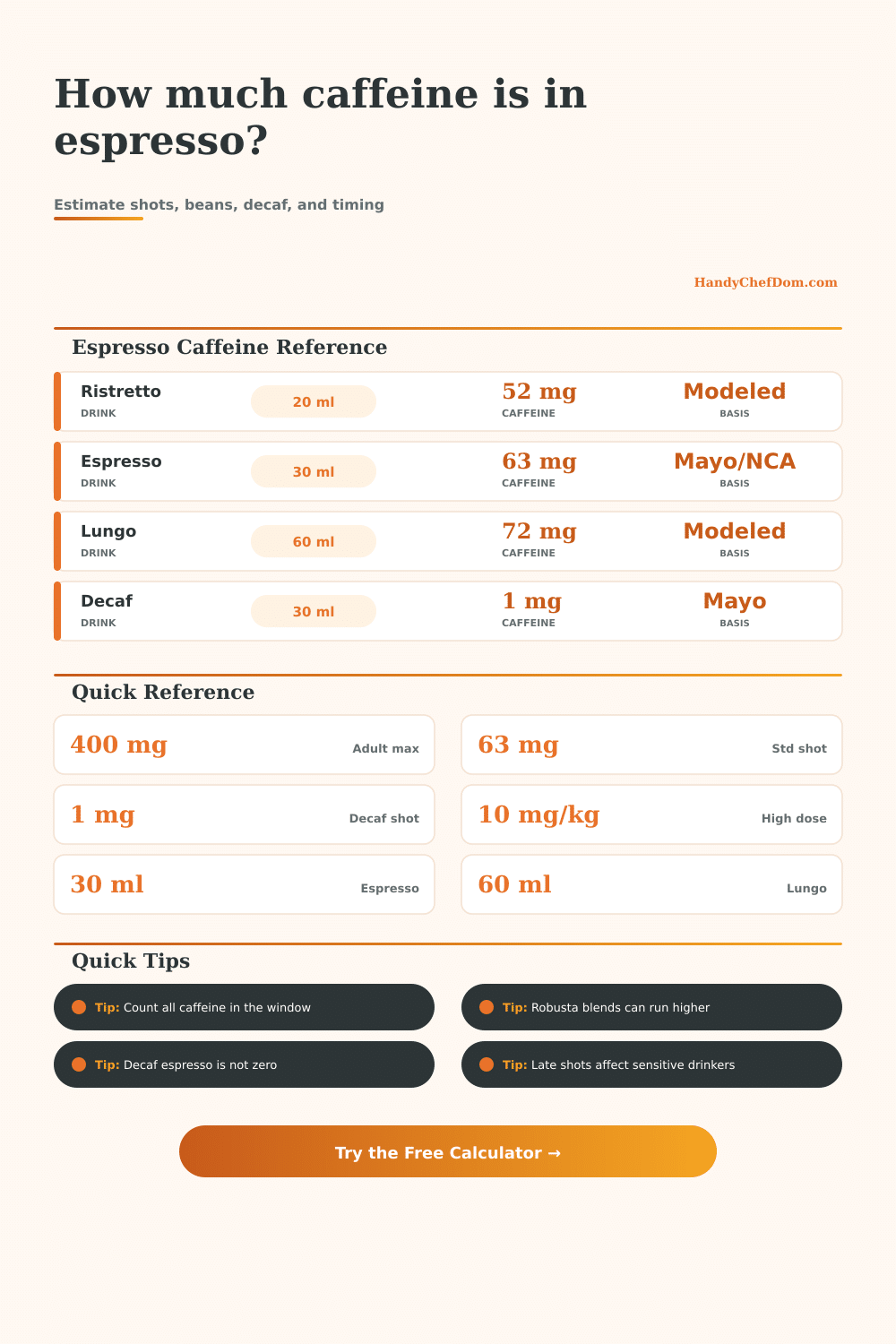
| Style | Typical Yield | Modeled Caffeine | Use In Calculator |
|---|---|---|---|
| Ristretto | 15-20 ml | About 52 mg | Shorter extraction, lower total |
| Classic espresso | 30 ml / 1 fl oz | About 63 mg | Mayo and NCA reference value |
| Lungo | 50-60 ml | About 72 mg | More extraction, less concentrated |
| Decaf espresso | 30 ml / 1 fl oz | About 1 mg | Mayo reference value |
| Profile | Multiplier | Best For | Notes |
|---|---|---|---|
| Mostly Arabica | 1.00x | Standard estimate | Default baseline |
| Light Arabica | 1.06x | Light roast shots | Slightly higher by dose |
| Dark Arabica | 0.95x | Darker espresso | Slightly lower by dose |
| 20% Robusta blend | 1.18x | Italian-style blend | Robusta raises caffeine |
| 50% Robusta blend | 1.38x | Strong cafe blend | Higher caffeine estimate |
| High-Robusta blend | 1.65x | Very strong espresso | Use when blend is known |
| Espresso capsule | 0.92x | Small capsule dose | Lower coffee dose common |
| Decaf base | 0.02x | Decaf-only drinks | Decaf is not caffeine-free |
| Reference | Amount | Calculator Use | Practical Reading |
|---|---|---|---|
| FDA adult guide | 400 mg/day | Daily remaining card | Common healthy adult benchmark |
| Mayo adult guide | 400 mg/day | Default daily limit | Lower if sensitive or advised |
| Very high dose marker | 10 mg/kg/day | Body-weight warning | Used as a high-dose flag |
| Typical half-life | About 5 hours | Bedtime note | Varies widely by person |
| Personal limit option | 300 mg/day | Sensitivity dropdown | Conservative planning level |
| Order | Shot Count | Style | Approx Caffeine |
|---|---|---|---|
| Single espresso | 1 | Classic | 63 mg |
| Double espresso | 2 | Classic | 126 mg |
| Flat white | 2 | Classic | 126 mg |
| Triple latte | 3 | Classic | 189 mg |
| Two ristrettos | 2 | Ristretto | 104 mg |
| Double lungo | 2 | Lungo | 144 mg |
Your morning double shot isn’t always the same. It’s a variable outcome determined by beans place of origin, the grinder setting, the patience level of barista, and; yes, even the humidity of room. Like most, you probably think there’s a set quantity of caffeine in every shot of espresso, as if it were like getting exactly 12 ounces of something out of a soda can. When energy crash hits earlier then expected, it comes as a surprise.
The device above aims to eliminate this guessing game in favor of model that includes the actual variables within your power. Adjust type of pull (tight ristretto vs long lungo), switch up robusta mixes and consider your body weight to calculate how much of that dose will affect your particular physiology.
How to Control Your Caffeine Intake
The biggest mistake most users will make is forgetting what kind of bean it’s made out of. Most espressos in the world use Arabica beans, because they’re generally considered to taste better, but Arabica also has far less caffeine than its cousin bean, Robusta. Many Italian-style espresso blends contains so much Robusta not only for body and crema, but also because there are more milligrams of stimulant in each gram. Order a dark roast from an establishment whose house blend is half Robusta? You’ll have quite a bit more caffeine then if you had drunk a similar amount from one brewed entirely of Arabica.
Once you choose your bean profile, the calculator will do math for you. You won’t have to worry about balancing species differences and extraction efficiency in your head. Why? Flavor intensity doesn’t always mean caffeine strength. That bold-tasting dark, bitter coffee could end up being decaf or even light-roast Arabica, giving you a false sense of strength without actualy providing the caffeine you think you got.
Here’s where extraction comes into play, changing the game even more. Typically, an espresso shot produce around an ounce of liquid within twenty-five to thirty seconds. Running that same dose longer results in a lungo. Stopping the flow earlier will produce a ristretto. This drink has more concentrated flavor (and therefore is also sweeter) per unit of volume, but contains less overall caffeine since less water extracted it from ground. Chemistry prefers volume over concentration when measuring milligrams total, so it makes sense that the less tasty drink actualy has more of the drug. Knowing whether your barista pulled a quick shot or let it drip for forty seconds to create a lungo can make all the difference.
And finally, there’s the whole time thing, something that all but the most attentive drinkers ignore entirely. Most people have a five-hour half-life of caffeine in their bodies, i.e., they’ve got 100 mg coursing through their veins an hour after waking up and still 50 mg doing laps around heart and bloodstreams six hours later. So when you’re trying to go to bed at 10 pm, that lingering caffeine might be able to throw off those deeper cycles of sleep, even though you’re otherwise relaxed and tired enough to fall into dreamland.
That’s why the calculator lets you plug in both your bedtime and a time window, so you can see how much of your morning coffee is still circulating when it’s time for lights out. It’s especially handy if you’re nursing a cup of decaf after your switch-off at 3pm and are still livig awake with the lights on. While decaf coffee isn’t actualy zero caffeine, it’s close enough that most people won’t notice difference, unless they’re sensitive to one or two milligrams of caffeine.
But more importantly, it puts that number into a context for you, it converts it from an abstract number to something that represents your own individual dose given your body weight. The top end they say is 400 mg for healthy adults; but again that’s a one-size-fits-all number that doesn’t take size into account. Someone who weighs less could feel jittery on doses that someone twice their size hardly even feel. So entering in your weight gives you a milligram-per-kilogram reading which provide a better sense of how much in the context of your own physiology. Does this represent a normal stimulant response? Or has it crossed some threshold towards anxiety/heart palpitations?
Caffeine isn’t something to be feared, just controlled. Knowing what’s in the cup is only half of the equation. To know its impact on your body, you have to look beyond the cup. When you pay attention to the clock, the blend, and the extraction, the haze fades away and you’ll begin drinking intentionaly instead of impulsively. The energy will arrive at the appropriate time and depart before bedtime. It becomes a reliable tool instead of a guessing game.