Steak Grilling Time Calculator
Estimate steak grill time from cut, thickness, grill heat, doneness, sear style, starting temperature, rest time, and carryover.
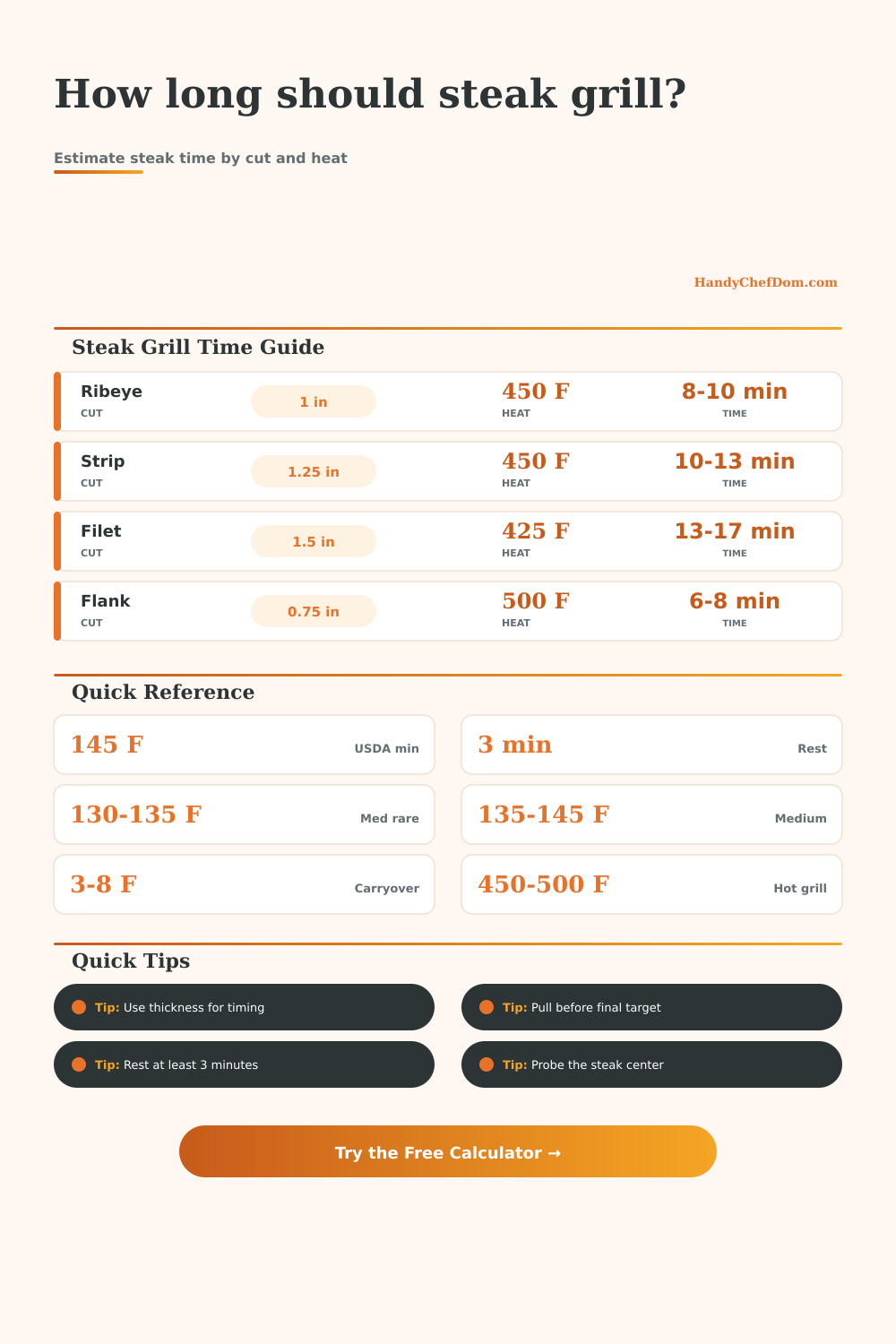
| Cut | Typical Thickness | Good Grill Heat | Estimated Time to Medium Rare |
|---|---|---|---|
| Ribeye | 1.0 to 1.5 in | 425 to 500 F | 8 to 13 minutes |
| New York strip | 1.0 to 1.5 in | 425 to 500 F | 8 to 14 minutes |
| Filet mignon | 1.25 to 2.0 in | 400 to 475 F | 12 to 19 minutes |
| Flank or skirt | 0.5 to 1.0 in | 475 to 550 F | 5 to 9 minutes |
| Porterhouse or T-bone | 1.25 to 2.0 in | 400 to 475 F | 12 to 20 minutes |
| Doneness | Final Target | Typical Pull Range | Safety Context |
|---|---|---|---|
| Rare preference | 120 to 130 F | 115 to 127 F | Below USDA whole-cut minimum |
| Medium rare preference | 130 to 135 F | 125 to 132 F | Below USDA whole-cut minimum |
| Medium preference | 135 to 145 F | 130 to 142 F | Upper end reaches USDA minimum |
| USDA whole-cut minimum | 145 F | 137 to 143 F | Rest at least 3 minutes |
| Medium well to well done | 150 to 160 F | 142 to 157 F | Above USDA whole-cut minimum |
| Method | Best Thickness | Heat Pattern | Calculator Effect |
|---|---|---|---|
| Direct grate sear | 0.75 to 1.5 in | Medium-high direct heat | Baseline time |
| Two-zone sear and finish | 1.25 to 2.0 in | Hot side plus cooler side | Adds gentle finish time |
| Reverse sear finish | 1.5 in and thicker | Indirect first, hot finish | Longer, more even cook |
| Cast iron on grill | 1.0 to 1.75 in | Hard contact heat | Slightly faster browning |
| Thin cut fast sear | 0.5 to 1.0 in | Very hot, short timing | Shortens active time |
| Factor | Typical Range | Time Effect | Planning Note |
|---|---|---|---|
| Fridge-cold start | About 38 F | Baseline | Most steak timing charts assume this |
| Room-temperature start | About 68 F | About 8 percent faster | Thick cuts still need center checks |
| Frozen or partly frozen | 32 F center | About 45 percent longer | Use lower heat to avoid burning |
| Carryover cooking | 2 to 10 F | Lowers pull temperature | More rise with thick hot steaks |
| Rest time | 3 to 10 minutes | Adds ready time | USDA minimum is 3 minutes |
The sound of meat meeting the grate. Satisfying until it becomes the sound of burning charcoal. Why? Because you’ve forgotten how thick it is. That’s where most folks go wrong. You treat every cut of steak as though it were the same thing. You use exact same timer for your two inch tomahawk ribeye as you did with thin piece of skirt steak. The end result is rare meat or rubbery leather. It is well done on the outside and icy cold in the middle.
The secret is understanding what you’re measuring. It is not just time, it is heat transfer through mass. The first variable is most critical: thickness. Thickness are the single most important variable here, yet it’s often ignored in favor of weight. It’s possible to have a tall steak that’s light and a flat steak with density. How does heat move? From outside to inside. Whether you’re cooking over gas or charcoal makes no difference. The heat will move predictably. You don’t need to guess at how deep it should goes into the meat.
Why Thickness and Temperature Matter for Grilling
Plug in your measurements, and let the calculator do the math. It knows that a thicker steak take longer, adjusting accordingly. The thicker piece has more distance to travel to cook through without burning outer layer (the “crust”). That is why tool asks for separate input for both thickness and cut type.
The first thing to realize: What was its initial temperature? Before putting the meat on the fire, you need to think about where the meat came from. A steak fresh out of the fridge is roughly thirty-eight degrees. There’s quite a gap in temperatures that needs closing. Leaving it on counter for a half hour doesn’t get it completely up to room temperature, but it helps to reduce some of the thermal shock. The tool considers the initial condition of the meat. Will it be cold or has it been sitting out on the counter at room temperature? If so, it will adjust the estimate accordingly. Then there’s a frozen steak. That’s an entire category unto itself. It needs much more time on heat. You have to both cook the meat and defrost it. You must do this all without burning outside.
Another reason even seasoned grilling veterans get tripped up is carryover cooking. Once you remove the meat from the heat, it will continue cooking. Not only that, but its interior are far cooler than its exterior layer of meat. We call that thermal gradient. Because of it, heat continues to move inward, and that causes the internal temperature to increase. By a few degrees. For something like thick-cut steak cooked at high temperatures, that could be upwards of eight degrees. If you don’t account for it, you’ll have overcooked meat on your hands.
The expected rise in internal temperature is accounted for in the calculator. It recommends removing the steak a few degrees shy of your final goal, so that when you let it rest, it lands right where you intended. It is a small detail but it makes a big difference. Resting isn’t just about letting the juices redistribute, but that is an important part of it too. But so does resting because resting is when the leftover carryover heat works. According to USDA guidelines, which are really the bare minimum for food safety, a whole cut of meat need at least three minutes of rest. Five to ten minutes allows the meat to stabilize and gives it some time to relax those fibers. The internal temperature evens out. Usually when you rush this part you lose moisture on the cutting board. And you don’t want to lose that moisture in your steak.
Not all cuts of beef are equal. Each cut has its own muscle structure and fat content. That dictates their performance in the pan. Marbled cuts like a ribeye will take longer to cook than a leaner cut, such as a filet mignon. Less insulating fat means it cooks faster. Those time comparisons between types of cuts are laid out in reference tables. Keep in mind, those are baselines.
Grill temperature also plays a huge role. High heat sears the exterior fast. If meat is thick enough, that can result in a harsh difference between the outside and inside. Low heat allows things to cook more evenly but runs the risk of drying out the outside before the inside gets done. That’s where the real skill comes into play. Being able to have a planned starting point makes adjusting on the fly much easier. You have an instant-read thermometer in your hand. These are averages; they’re estimations. The weather, the grill itself, even the kind of steak you use can affect it all by a little bit. Take the estimation as a plan. Take the thermometer as proof.
Once you get the hang of the relationship between temperature, thickness, and carry-over, you don’t guess anymore… You cook intentionally. That satisfying “thunk” off the grate will still be there. But this time, instead of char, you get a perfectly sliced medium-rare piece of meat.