🍔 Turkey Burger Protein Calculator
Estimate protein, calories, fat, raw patty weight, cooked yield, and optional bun add-ins for turkey burger servings.
Use raw patty weight for the most reliable nutrition math. Cooked yield changes the plated weight, while the bun add-in is optional and can be left at no bun.
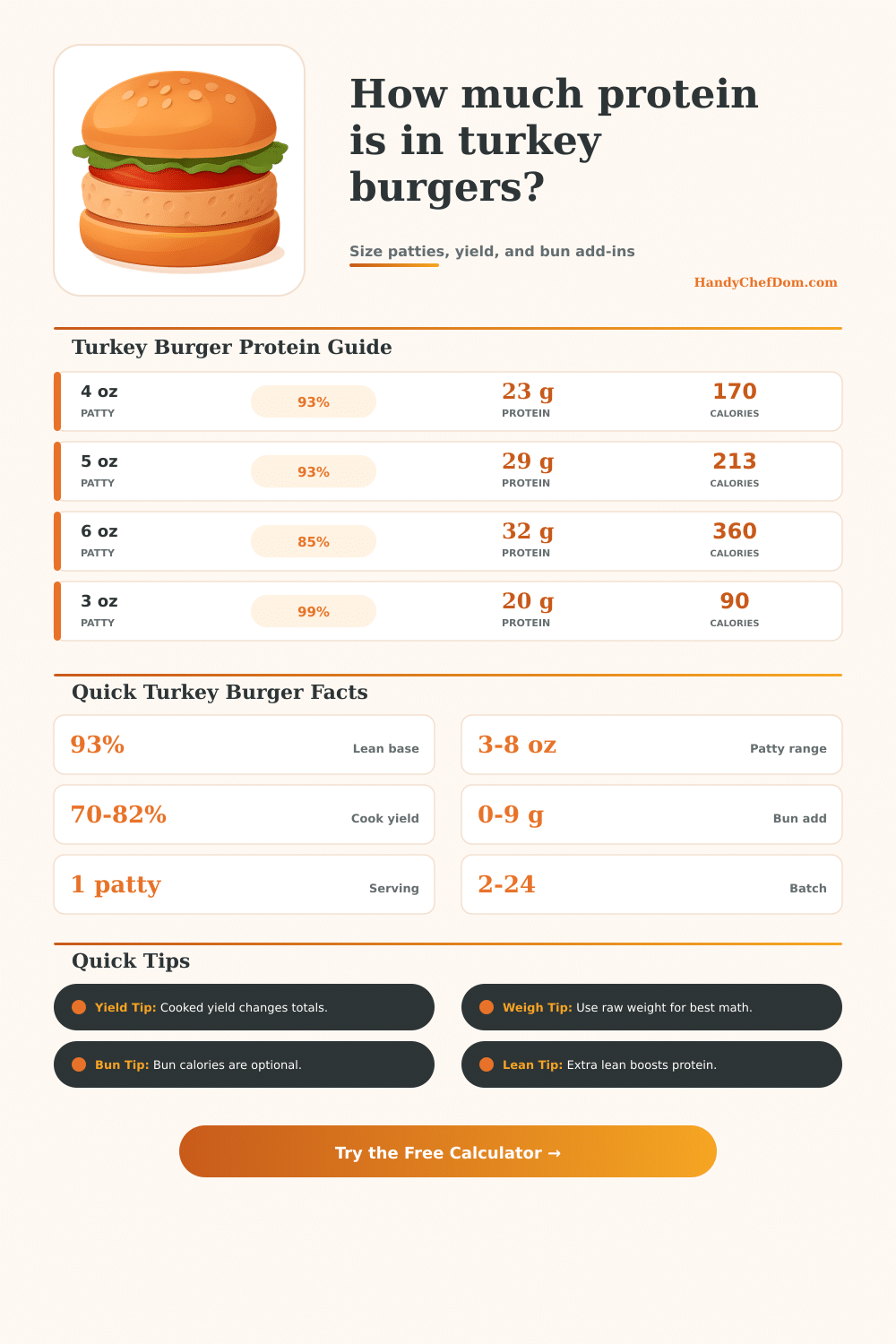
| Lean turkey | Protein per 4 oz | Calories per 4 oz | Fat per 4 oz |
|---|---|---|---|
| 99% extra lean | 26 g | 120 kcal | 1.5 g |
| 97% lean | 25 g | 150 kcal | 3 g |
| 93% lean | 23 g | 170 kcal | 8 g |
| 90% lean | 22 g | 200 kcal | 11 g |
| 85% lean | 21.5 g | 240 kcal | 17 g |
| 80% lean | 19 g | 280 kcal | 22 g |
| Seasoned blend | 22 g | 210 kcal | 13 g |
| Raw patty size | At 76% yield | Cooked grams | Best use |
|---|---|---|---|
| 2.5 oz slider | 1.9 oz cooked | 54 g | Party trays |
| 3 oz small | 2.3 oz cooked | 65 g | Kids plates |
| 4 oz classic | 3.0 oz cooked | 86 g | Standard burger |
| 5 oz hearty | 3.8 oz cooked | 108 g | Meal prep |
| 6 oz pub | 4.6 oz cooked | 129 g | Large burger |
| 8 oz double | 6.1 oz cooked | 172 g | Big appetite |
| Bun add-in | Protein | Calories | Fat |
|---|---|---|---|
| No bun | 0 g | 0 kcal | 0 g |
| Regular bun | 4 g | 140 kcal | 2 g |
| Whole wheat bun | 6 g | 150 kcal | 2 g |
| Brioche bun | 6 g | 190 kcal | 6 g |
| Thin sandwich bun | 4 g | 100 kcal | 1.5 g |
| Slider bun | 3 g | 90 kcal | 1.5 g |
| Lettuce wrap | 0 g | 5 kcal | 0 g |
| Gluten free bun | 3 g | 160 kcal | 4 g |
| Servings | 4 oz patties | Raw turkey | Cooked yield |
|---|---|---|---|
| 2 burgers | 8 oz | 0.5 lb | 6.1 oz |
| 4 burgers | 16 oz | 1 lb | 12.2 oz |
| 6 burgers | 24 oz | 1.5 lb | 18.2 oz |
| 8 burgers | 32 oz | 2 lb | 24.3 oz |
| 12 burgers | 48 oz | 3 lb | 36.5 oz |
| 24 burgers | 96 oz | 6 lb | 73 oz |
How much protein is in a turkey burger? Most people think they know how much protein is in a turkey burger until the scale says otherwise and the label on the package contradicts their memory. But difference between what we imagine, and what the real world reflects, is typically about as simple as cooked weight vs. Raw weight, which tend to be far greater than you’d think.
You purchase a package of 93 percent-lean ground turkey and you’re getting a product that are clinging to both fat and moisture before ever seeing the heat. It’s the former, not the latter, from which your nutritional calculations ought to come. If you want to know how much turkey burger you should eat per serving, simply enter your desired servings along with your raw patty size into the tool above.
How to Calculate Protein in Turkey Burgers
You’ll notice it asks for your cooked yield percentage; this is because turkey burgers (like most ground meat) shrinks while they’re cooking. Depending on your preparation style, you might expect them to reduce anywhere from eighteen to thirty percent of their raw weight when fat renders and moisture evaporates. If you imagine that each four-ounce raw patty is now four ounces when it reaches your plate, you’ll be wildly off base.
That’s why we apply a yield factor (typically about seventy-six percent for conventional preparations). This factor adjusts based on our actual experience of where weight goes. It helps you make an informed decision about how much to put in your container. The difference between a meal with the correct lean percentage and one that’s not is huge.
A hundred grams of 99% extra lean turkey might sound great on paper, but it’ll likely be dry, crumbly and fall off the grill. Anything lower than 93% is harder to cook and mix well; the fat helps bind things together and also carries flavors! Eighty-five percent lean is far juicier, though it comes at the expense of more calories and saturated fat. So which do you value most: your precise macronutrients or actualy enjoying what you eat?
As you can see from the table above, fat levels changes a lot depending on the lean grade, while protein stays about the same. Finally there’s buns… Something most folks don’t consider until they look at the final caloric count. An average white bun will bump up your burger by about 140 calories and four grams of protein, which doesn’t sound like much unless you’re counting macros closely for some health purpose (like a competition).
You have options, such as whole wheat for fiber or swapping out buns entirely for lettuce wraps to reduce carbs. You can toggle those add-ons in the calculator, getting a sense for the compounding impact without having to do any math in your head. Turning off the bun toggle isolates just the meat, which is handy when you’re not eating burgers on buns but rather serving them alongside quinoa or rice.
In that sense, batch cooking is a bit of a change-of-pace compared with typical weeknight dinners. It’s easy to under- or overestimate by just a few burger when you’re preparing 24 for your meal prep routine. That ten percent cushion will help account for second helpings (or a few extra mouths at the table) while also avoiding the need to whip up some extras from scratch.
While the presets it includes address familiar situations such as high-protein meal preps and backyard barbecues, you don’t necessarily have to enter everything manually; unless you find yourself outside those use cases. You don’t always have to be exact; instead, having something decent to fall back on can prevent you from feeling lost in the moment when hunger pangs hit on day four of the work week.
People also forget about burger yield. That’s how much they shrink (and lose their juices) when you make patties that is packed too loosely. They help hold the patty together when you press them tightly, but if there’s a lot of flavorful fat in there, you’ll squeeze some out before you’ve even started cooking. Balance matters, not just to the flavor, but also to weight at the end.
Using the calculator, you can enter your desired yield as a percentage between 70 and 82. This gives you a range to work with depending on what kind of grill master you are. Overcook? Bump it down. Like ’em juicy? Go up a few points. This isn’t about worrying over grams; this is about taking the guessing out of making meals, whether you’re feeding yourself or a family of four.
Knowing exactly where your calories and protein will be coming from allows you to make more informed decisions at the checkout stand and in the kitchen. If you’ve got a heavy day ahead you can adjust accordingly by swapping some bread carbs for extra turkey meat. Or, you can choose a lighter bun instead of a brioche bun depending on your numbers for the day.
Once you realize that raw weight is starting line, the rest is easy math. How do you want your burger cooked? What else do you plan on having with it? Adjust as needed. Know that when you use consistent inputs, you get reliable outputs each and every time. Trust the process and keep the scale handy.