🌮 Taco Seasoning per Packet Calculator
Convert taco seasoning packets into tablespoons, teaspoons, grams, meat coverage, sodium, serving strength, and taco-count portions for store packets or homemade blends.
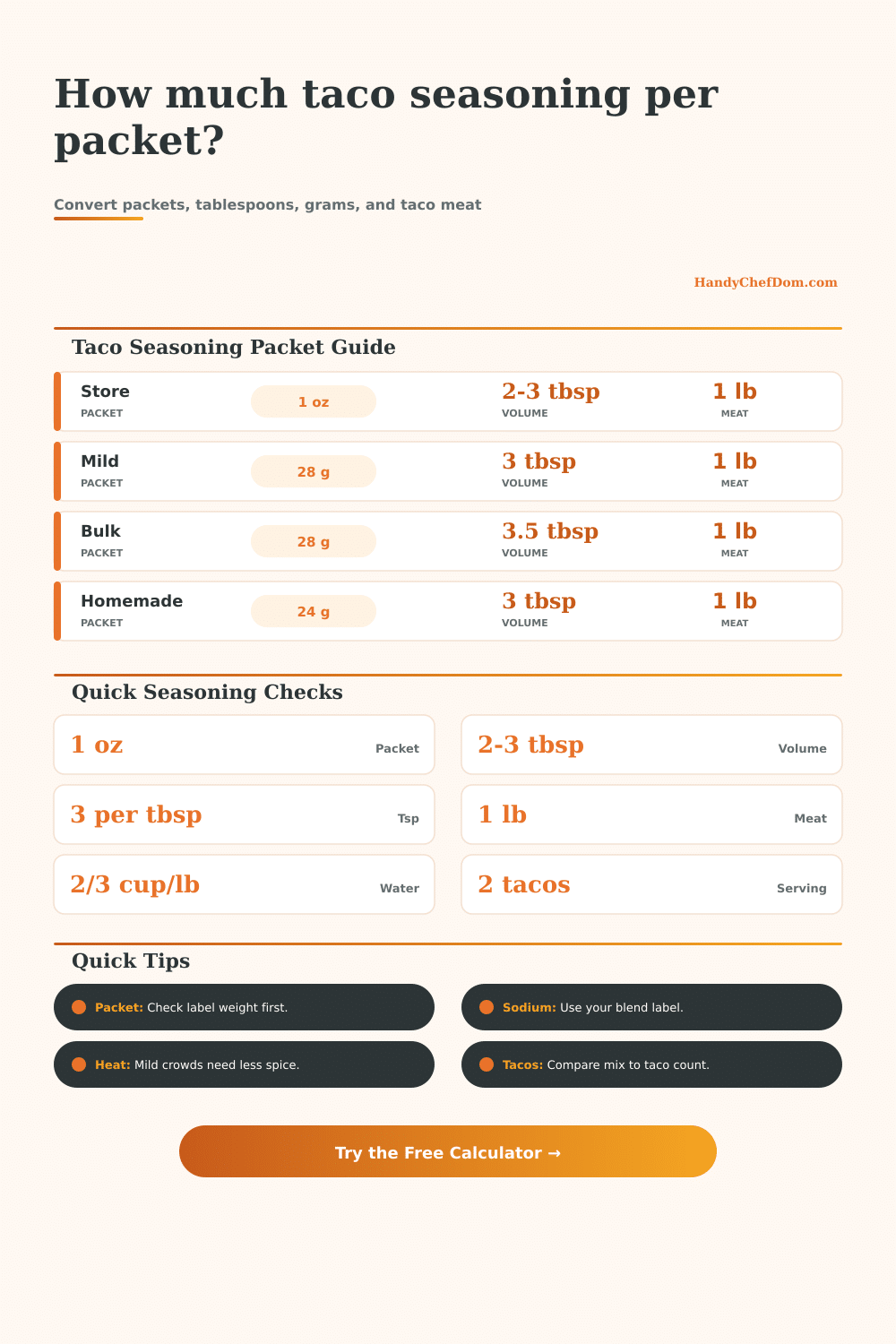
Most packets are close to 1 oz and season about 1 lb of ground meat. Many labels and homemade substitutions equal roughly 2 to 3 tablespoons per packet, so the calculator lets the blend profile drive both tablespoon and gram math.
Seasoning results will appear here.
About 7.5 teaspoons.
Packet weight divided by volume.
Adjusted by strength setting.
Useful for taco trays.
Family-style amount for the same meat weight.
Classic packet strength for taco meat.
Heavier chile-cumin flavor for party trays.
Per serving at standard strength.
| Seasoning format | Typical packet weight | Approx volume | Meat coverage | Calculator use |
|---|---|---|---|---|
| Standard store packet | 1 oz or 28 g | About 2 to 3 tbsp | 1 lb ground meat | Default profile for most packet-style taco meat directions. |
| Mild packet | 1 oz or 28 g | About 3 tbsp | 1 lb ground meat | Uses a slightly gentler heat score and similar volume. |
| Hot packet | 1 oz or 28 g | About 2.5 tbsp | 1 lb ground meat | Uses higher spice strength so less may taste bold. |
| Lower-sodium packet | 1 oz or 28 g | About 2.5 tbsp | 1 lb ground meat | Keeps packet math while lowering sodium estimates. |
| Homemade blend | 24 to 28 g | About 3 tbsp | 1 lb ground meat | Useful when chili powder, cumin, paprika, and oregano replace a packet. |
| Kitchen measure | Teaspoon equivalent | Packet fraction | Approx grams | Best use |
|---|---|---|---|---|
| 1 teaspoon | 1 tsp | About 1/7 packet | 3 to 4 g | Single serving bowls, dips, or sodium checks. |
| 1 tablespoon | 3 tsp | About 1/3 to 1/2 packet | 8 to 12 g | Small skillets or adjusting bland taco meat. |
| 2 tablespoons | 6 tsp | Often near 1 packet | 18 to 24 g | Dense commercial blends or lighter packet substitutions. |
| 2.5 tablespoons | 7.5 tsp | 1 standard profile packet | 28 g | Default setting for this calculator. |
| 3 tablespoons | 9 tsp | 1 larger-volume packet | 24 to 30 g | Common homemade packet replacement rule. |
| Meat weight | Standard seasoning | Typical servings | Regular tacos | Water or broth guide |
|---|---|---|---|---|
| 1 lb taco meat | 1 packet or 2 to 3 tbsp | 4 servings | 8 tacos | About 2/3 cup liquid. |
| 1.5 lb taco meat | 1.5 packets or 3.75 tbsp | 6 servings | 12 tacos | About 1 cup liquid. |
| 2 lb taco meat | 2 packets or 5 tbsp | 8 servings | 16 tacos | About 1 1/3 cups liquid. |
| 5 lb taco meat | 5 packets or 12.5 tbsp | 20 servings | 40 tacos | About 3 1/3 cups liquid. |
| 10 lb taco meat | 10 packets or 25 tbsp | 40 servings | 80 tacos | About 6 2/3 cups liquid. |
| Blend choice | Sodium style | Strength note | Packet equivalent | Planning note |
|---|---|---|---|---|
| Regular packet | High label sodium | Salt and starch round the flavor. | 1 oz, 2 to 3 tbsp | Use label sodium for the most accurate serving estimate. |
| Lower-sodium packet | Moderate sodium | May need a little more acid or broth. | 1 oz, 2.5 tbsp | Good default when guests watch sodium. |
| Homemade balanced blend | Adjustable sodium | Usually more chili powder and cumin by volume. | 3 tbsp | Enter your own sodium if salt was added. |
| Salt-free homemade blend | Very low sodium | Needs enough spice volume for flavor. | 3 tbsp | Lets each serving add salt separately. |
| No-starch spice blend | Depends on salt | Tastes stronger because there is less filler. | 2.25 tbsp | Start lighter, then add more after simmering. |
When taco night rolls around, well-meaning intentions begin… Then the question arises: how much seasoning should I use? There’s a seasoning packet, but how much meat is there? One pound? Two? What if I have kids who can’t handle spicy food? Oops, no more packets, now we’ll have to concoct our own mix using leftover spices. How much of each do we add? How many tacos are you making? It gets complicated fast.
A converter help because it offers precise amounts that keep dinner from being too salty, or totally bland.
Use a Converter for Better Seasoning
Packets aren’t made equal One ounce is roughly what a normal-sized store brand packet holds, although since packets comes in different densities that volume isn’t necessarily the same as weight. For instance, some mixes has salt and/or starch, which makes them heavier for each tablespoon. Others are light and fluffy, appearing like a large portion but weighing far less. To get consistent results, go with measuring in grams instead of a heaping tablespoon. Using a converter on your phone’s calculator will take away the eyeballing guesswork. No longer do you need to rely on appearance of the pile in your palm. Now you can rely on actual mass, and it’ll scale up just right no matter if you’re cooking for two or twenty.
Home cooks rarely consider another factor until they taste their meal: sodium. Low-sodium vs. Standard salt; different manufacturers even has differing levels of sodium in their packets, and lower-sodium blends can taste weaker because they lack that immediate punch of sodium chloride. Seasoning strength becomes a combination of your desired level of flavor vs. Concern for your health. The app lets you enter your packet’s sodium per serving and visualizes the tradeoff, so if you want to be more lenient with your seasoning, you can see how much less healthy you’re being per serving. That way you don’t over-salt a party tray by thinking all packets are created equal, or under season a leaner turkey mix.
Most people screw up when they scale it up. Doubling the meat doesn’t mean you need twice the seasoning. If you’re adjusting the heat, this isn’t true. Cumin and capsaicin is stronger than most other things on the palate, so you may need less of a spicy mix to get the same effect as a milder one. The calculator takes into account these changes in strength, ensuring that no matter how big or small you go, it will have the same flavor profile. It even takes into consideration something many forget about: the right ratio of liquid to meat. Too much water and you dilute the spice; too little and you end up with dry clumps of meat. Having an idea of how much broth to add per pound ensures that you get a moist texture without washing away flavor.
Homemade works better (cheaper, too) but does require faith in your own proportions. It also won’t have the thickeners as commercial packets do; it doesn’t go on the meat exactly the same. Sometimes it will be about the same weight, but require a little extra volume to stick as well. Knowing how the texture differs helps you manage what you expect. Because you’re not replicating a recipe, you’re creating a flavour experience for your house based off what they like.
Cooking should of be about enjoying the food, not worrying if what’s being served tastes good or bad. The key is to take the anxiety out of the recipe by getting the portions correct. Once you know how many packets are in each tablespoon of your unique blend, you’ll approach cooking with confidence, not caution. You’ll turn a possible kitchen nightmare into a surefire hit and be able to concentrate more on making that salsa taste great, instead of trying to get the skillet right. You could of turned it into a moddern success if you used a converter.