🥞 Baking Powder per Pancakes Calculator
Estimate teaspoons and grams of baking powder for pancake batter using flour amount, pancake count, diameter, batter thickness, buttermilk acidity, baking soda share, altitude, powder age, and batch scaling.
Use flour amount when you already have a recipe base, or choose target pancakes to estimate flour from count and diameter before applying the leavening adjustments.
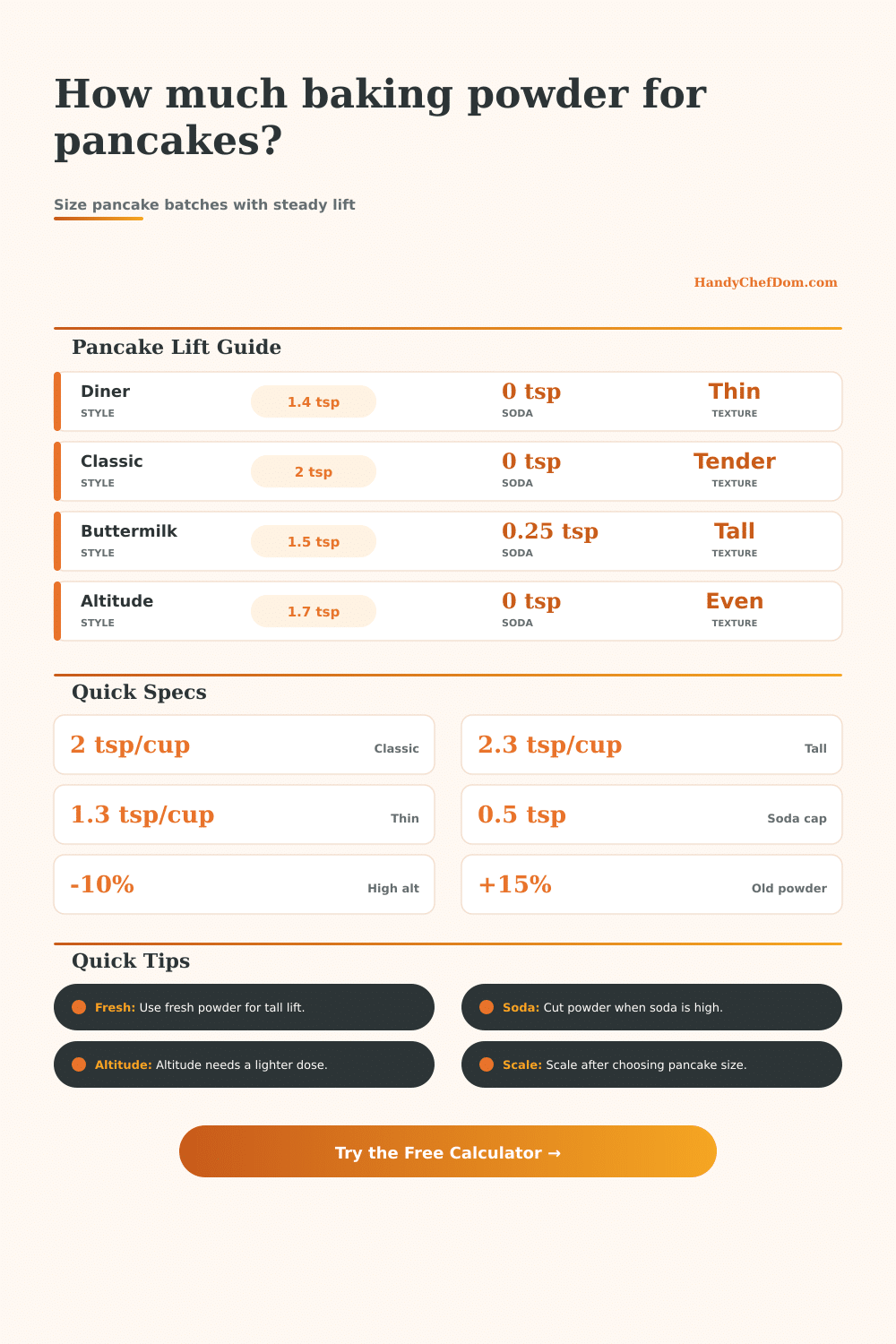
| Batter style | Powder per cup | Soda per cup | Best texture |
|---|---|---|---|
| Thin diner | 1.25 to 1.50 tsp | 0 tsp | Flat and tender |
| Classic pancakes | 1.75 to 2.00 tsp | 0 to 0.125 tsp | Soft middle |
| Fluffy weekend | 2.00 to 2.25 tsp | 0 to 0.25 tsp | Tall lift |
| Buttermilk stack | 1.50 to 1.85 tsp | 0.25 to 0.50 tsp | Springy crumb |
| Gluten-free batter | 2.15 to 2.45 tsp | 0 to 0.25 tsp | Extra support |
| Protein mix | 1.70 to 2.00 tsp | 0 to 0.20 tsp | Controlled rise |
| Pancake size | Diameter | Flour each | Typical yield |
|---|---|---|---|
| Mini kid | 3 in | 0.10 cup | 10 per cup |
| Small stack | 4 in | 0.14 cup | 7 per cup |
| Classic plate | 4.5 in | 0.18 cup | 5 to 6 per cup |
| Diner wide | 5.5 in | 0.27 cup | 3 to 4 per cup |
| Griddle cake | 6 in | 0.32 cup | 3 per cup |
| Oversized | 7 in | 0.43 cup | 2 per cup |
| Acid level | Examples | Soda share | Powder move |
|---|---|---|---|
| None | Milk, water | 0 tsp per cup | Use full powder |
| Light acid | Lemon milk, yogurt | 0.125 tsp per cup | Small reduction |
| Buttermilk | Cultured milk | 0.25 tsp per cup | Reduce modestly |
| Strong acid | Kefir, sour cream | 0.375 tsp per cup | Reduce more |
| Too much soda | Over 0.50 tsp | Per cup flour | May taste soapy |
| No soda | Neutral batter | 0 tsp per cup | Powder carries lift |
| Altitude | Powder change | Batter cue | Why it helps |
|---|---|---|---|
| 0 to 2,999 ft | No change | Normal bubbles | Standard pressure |
| 3,000 to 4,999 ft | Reduce 5% | Slightly thicker | Slows over-rise |
| 5,000 to 6,999 ft | Reduce 10% | Rest briefly | Prevents collapse |
| 7,000 to 8,999 ft | Reduce 15% | Watch spread | Balances lift |
| 9,000 ft plus | Reduce 20% | Cook smaller | Limits tunneling |
| Old powder | Add 10% to 25% | Fizz test first | Offsets weak gas |
When you flip your pancakes, they sinks down and become these heavy rubbery discs. The issue is typicaly about leavening (not how you cook pancake itself).
Think of the baking powder as engine of the pancake: It needs an exact mix of fuel to operate properly. Too little and your stack will be flat; too much and you’ll end up with something bitter and spongy.
How to Use Baking Powder Calculator
Since your environment and ingredients change, you don’t follow a recipe very often. Baking powder is straightforward chemistry, but there’s still room for human error.
Baking powder are double-acting. This means it release its carbon dioxide first when it gets wet, and then again as it heats up during baking. This results in a tender crumb and high pancakes.
But here’s where things get tricky: How much should I adds? That depends not just on the volume of batter, but also how acidic it is. For example, buttermilk reacts with the baking soda so you should of used less baking powder. Many recipes fails to account for this.
My recipes won’t fail because the calculator takes out the guesswork, and yours won’t either if you use it. It’ll adjust to fit flour quantity, as well as the kind of milk/acid you’re incorporating in the mix.
Gluten free flours aren’t as structurally sound than wheat; they want just a bit extra oomph to keep them from getting gummy. And because whole wheat batters weighs more then white, they call for an entirely different strategy.
Then there’s altitude. This is something most home cooks neglect until their breakfast goes awry. As altitude increase, atmospheric pressure drops, meaning gases expands more quickly. Put your sea-level quantity of baking powder into the mix in Salt Lake City or Denver, and your pancakes will puff up too quickly and then fall apart before they set.
The tool on this page takes your kitchen’s altitude into account, and reduces the dose accordingly to ensure controlled rise. When you’re making breakfast, you may not think about barometric pressure, but the batter react instantly to its environment. Altitude adjustment matter; it’s the difference between a good stack and a failed experiment.
While it’s important how many ingredients you’re using, it’s also critical to remember that freshness counts, too. Baking powder expire; when its shelf life is up, it goes inactive. That means if you’ve had a can sitting around the pantry since last winter, even though it may appear perfect, it could be useless.
You have the option of plugging in how old your baking powder is on the calculator, which then adjust for a possible decrease in potency and recommends a bit more lift. Better to err on the side of slightly too much than not enough.
Too much powder leads to a metallic taste (that maple syrup won’t mask) while a little bit extra can help produce a nice tall stack.
A good pancake is about mastery of chemistry, moisture, and heat. It’s about knowing how to balance leaveners and acids. It is also about how flour weight impact texture and how bowl ingredients has an influence. Knowing how each one affects the other lets you dial in your ratio with confidence and avoid any meltdowns.
Over-mix? You will get tough pancakes. Under-leavened? Flat stack. Old powder? Check expiration date on the box.
With these ratios at hand, you get a sense for what makes up a stack by looking at the numbers… From light and fluffy to heavy and doughy. Then you know exactly where to tinker when it’s not working out right.
You’re no longer winging it, you’re engineering. Bubbles turn out to be the magic ingredient after all, your stack stands tall, stays tender, and now you can prove it.