🫙 Pectin per Package Calculator
Estimate pectin packages, spoon measures, sugar-adjusted set strength, fruit batch size, added liquid, and finished jar yield for jam or jelly.
Choose fruit amount by cups or weight, then adjust pectin type, package size, sugar level, batch multiplier, set strength, natural fruit pectin, added liquid, and jar size.
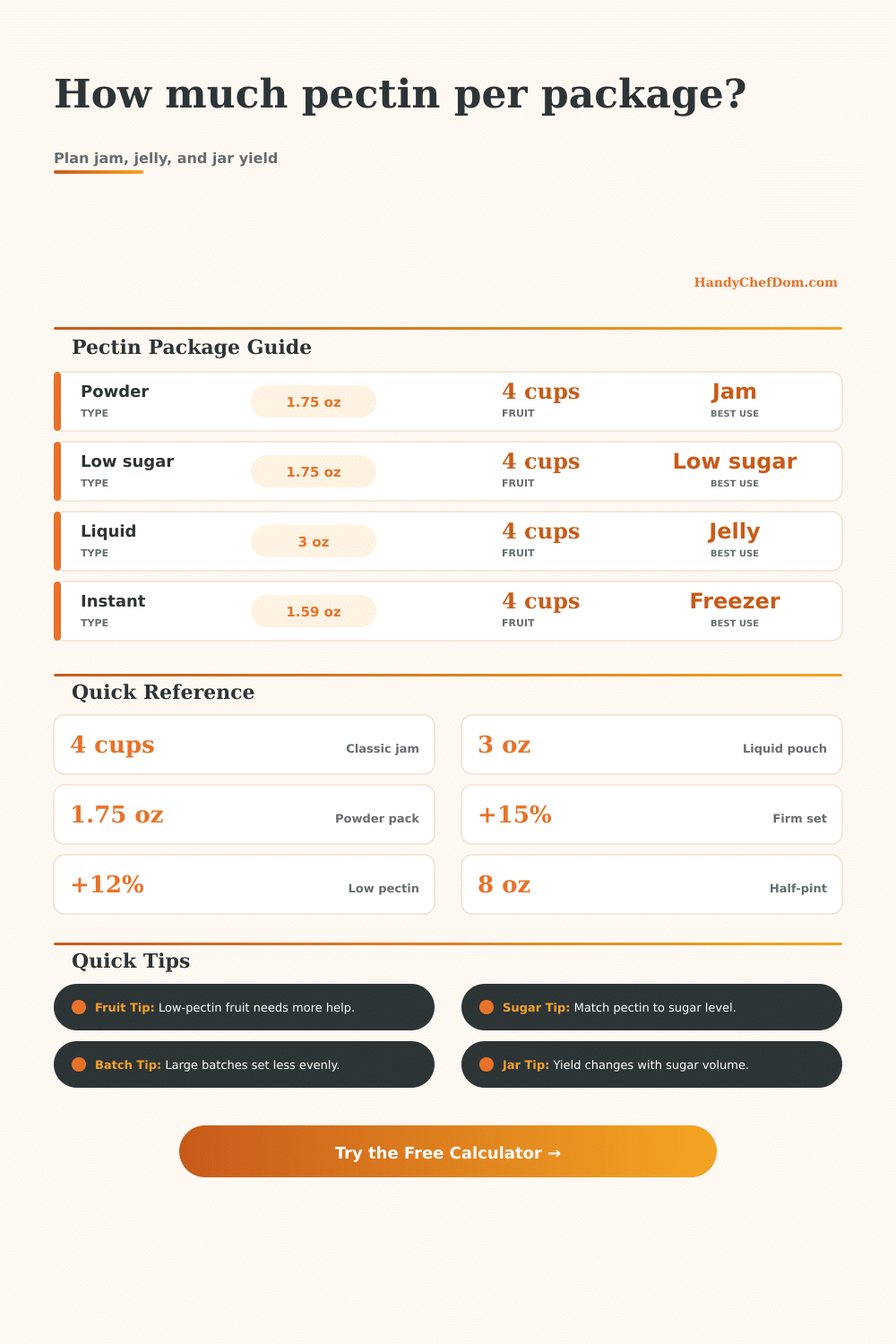
| Pectin Type | Typical Package | Fruit Base per Package | Best Match |
|---|---|---|---|
| Regular powdered pectin | 1.75 oz packet | About 4 cups prepared fruit | Classic full-sugar jam and jelly |
| Low or no sugar powdered pectin | 1.75 oz packet | About 4 to 4.25 cups prepared fruit | Reduced, low, or no added sugar batches |
| Liquid pectin pouch | 3 oz pouch | About 4 cups juice or fruit base | Jelly, grape juice, apple juice, and smooth berry bases |
| Instant freezer-jam pectin | 1.59 oz packet | About 4 cups crushed fruit | No-cook freezer jam with fresh fruit texture |
| Classic high-methoxyl pectin | 1.75 oz packet | About 4 cups prepared fruit | Full-sugar cooked preserves |
| Citrus pectin powder | 1.75 oz packet | About 4.5 cups citrus base | Marmalade and high-acid fruit mixtures |
| Fruit or Juice | Natural Pectin | Approx Cup Weight | Package Planning Note |
|---|---|---|---|
| Strawberries, crushed | Low to medium | 8.0 oz per cup | Needs dependable commercial pectin for a clear set. |
| Raspberries, crushed | Medium | 7.5 oz per cup | Works with regular or low-sugar pectin. |
| Blackberries, crushed | Medium | 7.6 oz per cup | Seed-heavy batches may finish slightly thicker. |
| Blueberries, crushed | Low | 7.0 oz per cup | Use a firm-set adjustment for tidy spooning. |
| Peaches, chopped | Low | 7.2 oz per cup | Low natural pectin benefits from a stronger set target. |
| Apple juice for jelly | High | 8.6 oz per cup | High pectin and acidity usually need less adjustment. |
| Grape juice for jelly | Medium to high | 8.5 oz per cup | Liquid pectin is a common fit for smooth grape jelly. |
| Mango, chopped | Very low | 6.9 oz per cup | Needs low-pectin fruit adjustment and careful sugar matching. |
| Sugar Level | Best Pectin Choice | Pectin Adjustment | Yield Effect |
|---|---|---|---|
| Classic full sugar | Regular powder or liquid pectin | Standard dose | Higher finished jar volume |
| Classic jelly sugar | Liquid or regular pectin | Slightly stronger dose | Clear jelly volume with more dissolved sugar |
| Reduced sugar | Low-sugar powdered pectin | Small increase if using regular pectin | Moderate jar yield |
| Low sugar | Low or no sugar powdered pectin | Use sugar-flexible pectin | Lower jar yield than classic jam |
| No added sugar | No-sugar powdered pectin | Needs calcium or low-sugar style pectin | Lowest jar yield |
| Fruit-heavy spread | Low-sugar powdered pectin | Firm set may need extra pectin | Dense fruit texture |
| Conversion | Imperial Amount | Metric Amount | Use In Calculator |
|---|---|---|---|
| Volume cup | 1 cup | 236.6 ml | Fruit volume and added liquid |
| Half-pint jar | 8 fl oz | 237 ml | Common jam and jelly jar yield |
| Quarter-pint jar | 4 fl oz | 118 ml | Sampler jars and small batches |
| Powder packet | 1.75 oz | 49.6 g | Common powdered pectin size |
| Liquid pouch | 3 oz | 85 g | Common liquid pectin pouch size |
| Tablespoon powder | 1 tbsp | About 8.3 g | Approximate spoon measure for powdered pectin |
Pectin: What separates jam from slide-off-the-spoon jam (or jelly, which typically has no solids) is most often pectin: It’s the structure in preserves, and transforms fruit syrup into a gelled substance. Home cooks tend to get this wrong. If following a recipe, you might measure perfectly, but if doing it yourself, how much should you add?
One answer is to use a pectin calculator; unlike guessing with conversion charts, all you need to know is what kind and how many cups of fruit, plus your desired sweetness level. Knowing what variables are will make for better results. The kind of pectin matters. There is no one thing called “pectin.” It’s different depending on what it came from, and how much else is in your pot.
How to Make Perfect Jam
The normal stuff, the powdered pectin. Demands lots of sugar in order to thicken into a gel. Go too low in sugar (to cut the calories) and the jelly doesn’t set: The gel structure breaks down. That’s why there are such things as no- or low-sugar pectins, which has been specially made to set up even without extra-high amounts of sugar. A chart tells you which pectin to use with which amount of sugar.
Runny jam? Most often that means someone used the incorrect combination. Easy error, but an oops! right there that destroys the batch.
The last component that affects texture is the fruit. Many fruits are naturaly high in pectin. Citrus and apples, for example, are heavy-hitters because their cores and skins is rich in the stuff. In general, the less commercial pectin you need, the more natural pectin present. Conversely, other fruits, like overripe berries, cherries, and peaches, are pectin poor. They provide flavor and color but little structure. They will contribute to the color and flavor, but not the structure of your jam.
When working with low-pectin fruits, you’ll need to add additional commercial pectin. The calculator determines how much extra to add based on the amount of natural pectin in your fruit. This is an input to the calculation, so just like before, you can’t assume that a peach batch behaves exactly like apple one.
There’s one additional wrinkle: Batch size. You might think doubling a recipe would be simple, but that isn’t exactly true. The evaporation rate is different, and so is surface area. A bigger pot retains heat better, but it has less surface area compared to the amount of food inside. That results in a slower path toward the gel point. These conditions are especially critical with liquid pectin, which is formulated for use after cooking but can breaks down when exposed to a big enough batch at too high a temperature. Maintaining a reasonable-sized batch allows the pectin to do its job properly. The calculator includes multipliers for batch size, though there are still physical constraints in the kitchen.
Arithmetic isn’t all that’s needed; you also need to pay attention to a steady set. Sugar is not just a sweetener; it’s also a structural partner for pectin and, in fact, a preservative. With traditional full-sugar jams, the sugar fight with water for available spots on the pectin molecules. The competition forces the pectin chains to hook up and form a gel. If you back off on the sugar, you’re taking away the competition, and the pectin remains unhooked. That’s why there’s low-sugar pectin out there. It’s changed to make use of calcium ions, rather than depending only on sugar, to help it gel.
Why does it work? It works for a reason, and you could of simply cut the sugar and expect the same result without changing the chemistry.
The last practical consideration is how much fruit I get back. It’s a ballpark figure. The calculator predicts jar yield (in half-pints). But that’s just an average, and there’s no one-size-fits-all for anything in cooking. When you cook the fruit down, it shrivels. Sugar dissolves, which changes the volume. And some fruits are naturaly denser than others. A cup of crushed strawberries doesn’t weigh as much than a cup of chopped peaches. So use the standard averages provided by the tool; what comes out of your kitchen may differ a bit. That’s fine, feel is part of preserving, too.
Consistency. That’s what you’re after. When you grab a jar off the shelf, you want to get the same thing each time: that familiar combination of flavors, with no wild guesses about how much sugar or which kind of pectin to use. Once you understand the connection among sugar, fruit and pectin varieties, you begin to make educated choices. And then you have perfect jam. You know the reason for the rules. You’ve built a structure that stands up. If you do it right, it’ll hold.