🍎 Apple Carb Calculator
Estimate total carbs, net carbs, fiber, and serving carbs from apple variety, size, peel choice, prep style, edible portion, and recipe use.
Use edible apple weight whenever you have it. If you choose a whole apple size, the calculator estimates edible grams after core, peel, prep, and recipe-use adjustments.
Reference values are practical kitchen estimates based on USDA FoodData Central-style entries for raw apples with skin, raw apples without skin, unsweetened applesauce, and dried apples. Variety values are rounded per 100 g for calculator planning.
| Variety | Total carbs per 100 g | Fiber per 100 g | Best calculator use |
|---|---|---|---|
| Generic raw apple | 13.8 g | 2.4 g | Default USDA-style apple estimate |
| Granny Smith | 13.3 g | 2.8 g | Tart snack, salad slices, lower-carb estimate |
| Gala | 13.7 g | 2.1 g | Lunchbox apples and fresh snacks |
| Fuji | 15.2 g | 2.1 g | Sweet apple portions and dessert plating |
| Honeycrisp | 14.1 g | 2.3 g | Crisp whole apples and thick wedges |
| Pink Lady | 13.9 g | 2.5 g | Salads, snack boxes, tart-sweet slices |
| Red Delicious | 14.1 g | 2.3 g | Whole apples and chopped lunch sides |
| Golden Delicious | 13.6 g | 2.4 g | Soft fresh pieces and filling prep |
| McIntosh | 13.4 g | 2.4 g | Soft apple portions and saucy prep |
| Apple size or cut | Reference weight | Total carbs | Fiber |
|---|---|---|---|
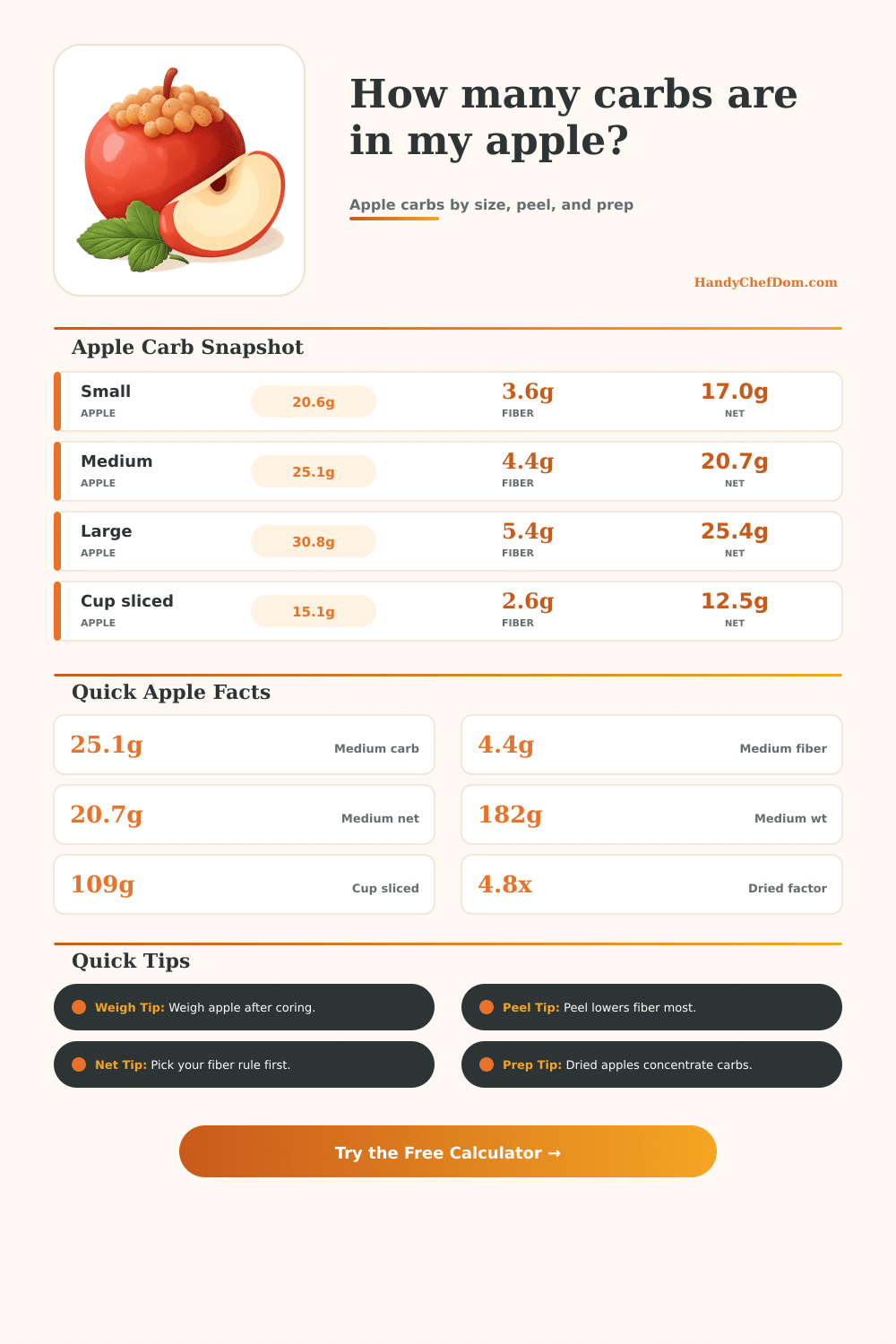
| Small apple | 149 g | 20.6 g | 3.6 g |
| Medium apple | 182 g | 25.1 g | 4.4 g |
| Large apple | 223 g | 30.8 g | 5.4 g |
| Extra-large apple | 242 g | 33.4 g | 5.8 g |
| 1 cup sliced | 109 g | 15.1 g | 2.6 g |
| 1 cup chopped | 125 g | 17.3 g | 3.0 g |
| 1/2 cup pieces | 62 g | 8.6 g | 1.5 g |
| Prep or peel choice | Carb effect | Fiber effect | When to use it |
|---|---|---|---|
| With peel | 1.00x | 1.00x | Whole apples, wedges, peel-on snacks |
| Partly peeled | 0.98x | 0.77x | Mixed peel pieces or decorative trimming |
| Peeled | 0.96x | 0.54x | Peeled slices, fillings, soft apple pieces |
| Unsweetened applesauce | 11.3 g/100 g | 1.2 g/100 g | Sauce cups, bowls, and blended portions |
| Baked, no sugar | 14.4 g/100 g | 2.2 g/100 g | Moisture-reduced apple halves or wedges |
| Dried apple rings | 65.9 g/100 g | 8.7 g/100 g | Trail mix and dehydrated snack portions |
| Recipe use | Typical portion | Net carb focus | Calculator note |
|---|---|---|---|
| Fresh snack | 1 medium | 20.7 g | Use size and peel choice directly |
| Oatmeal topping | 1/2 cup | 7.1 g | Diced apple portions are easiest to weigh |
| Salad garnish | 1/3 cup | 4.7 g | Small serving counts matter in batch salads |
| Smoothie blend | 1 cup | 12.5 g | Track total edible apple going into the blender |
| Pie or crisp filling | 1 slice share | 18-26 g | Use servings to divide the prepared apple weight |
| Meal prep container | 80-120 g | 9-14 g | Custom weight gives the cleanest portion estimate |
Standing in front of the fridge, you hold an apple: a Honeycrisp. Will it raise your blood-sugar level? Can you count it in your day’s allotment? How can one apple be one serving? That isnt obvious. Botany doesn’t agree with biology about what’s edible. Half the fruit’s fiber are on the peel. The core takes up space.
Most shoppers don’t know how much variety they choose matters. To get it right, go beyond the skin and see inside to understand how much weight equals how many carb. After you plug in what kind of apples you’ll be using and how you plan to prepare them, the calculator above will do the math for you.
How to Count Carbs in Apples
You don’t have to guess anymore if a sliced apple with its peel on is higher or lower in carb then one without. Contrary to popular belief, taking off the peel doesn’t make the apple “lower in sugar.” In fact, it almost never does. Here’s why. The majority of dietary fiber are in the skin. Most of the naturally sugars are in the flesh. Removing the peel give up the fibrous structure while providing softer eating. That might be great for enjoyment, but it doesn’t mean you’re ingesting significantly fewer grams of glucose. If you lose some fiber, your digestive system digests whatever sugar remain a little more quickly. It may not matter much, but it can affect how you feel an hour later.
Another common trip-up is size. You can fit a little Granny Smith apple in one hand with room to spare. A big Fuji appears to be enough for two, but its carb count don’t increase at the same rate. From variety to variety, apples also vary in their density and water content as they grow bigger. To account for this variation, the tool will adjust the base carb count per hundred grams of edible weight.
Why does this matter? This matters because tracking by piece rather than by gram introduce too much error. A typical medium apple ends up being roughly one hundred eighty-two grams (uncored). This number varies depending off growing conditions and water content.
Now let’s stray from the raw slice. Preparation changes the math. Water is removed by drying apples, concentrating their carbohydrate load significantally. If you believe a single fresh apple is equivalent to five dried rings, you’ll consume five times the amount of carbs (by weight) and under-estimate your consumption. To avoid such an underestimation, the calculator accounts for this carb concentration when munching on trail mix. Baked apples similarly lose some water (but not as much as dehydrated), further highlighting the apple’s sweet side with each minute in the oven.
You can select either “total” or “net” carbs for calculating; both have their use cases and it’s up to you which one best fits your tracking style. For instance, some people track everything as carbs because it takes work by the body to digest even fiber. Other people exclude it entirely, since they’re only interested in digestible sugar. You can flip these flags back-and-forth and see the calculator won’t update what you typed in. Instead, it will re-calculate based on the new rule, showing just how sensitive your daily budget is with respect to this choice. A compromise would of subtracting half of the fiber, recognizing that some types of starch are resistant to digestion.
That puts the carbs in context, too, which recipe uses them? You don’t eat an apple just by itself. Sliced onto oatmeal it’s different. It combines with protein and fat, which slows absorption. How many carbs does it add up to per serving? That’s what the tool will estimate, helping you understand the part every ingredient play in the meal overall. (A major pitfall people fall into is underestimating the carbs in something that’s mixed into a bigger dish, such as sauce or pie.)
In the end, it’s not so much about getting exact measurements when you track the carb count of apples, it’s about seeing trends in what you eat. There’s no need to weigh everything on a lab scale; just be consistent with your portion estimates. If you’re having a snack of sliced apples in the morning, or dry apple rings during your afternoon hike, knowing how heavy that fruit is will help turn guessing into a habit you can manage. And that sense of clarity is the key to going from being frustrated by the lack of detail in food labeling to mastering your daily nutrient intake.
Begin with weighing them. Adjust for peeling. Let the figures guide your next chew.