🧇 Batter per Waffle Iron Calculator
Estimate batter per waffle from iron type, plate size, grid depth, fill percentage, batter density, overflow headroom, servings, and batch multiplier.
Choose a preset or enter the cooking plate dimensions. Round irons use the width field as the diameter; rectangular and square irons use both width and height.
| Iron Type | Typical Plate Size | Grid Depth | Starting Pour |
|---|---|---|---|
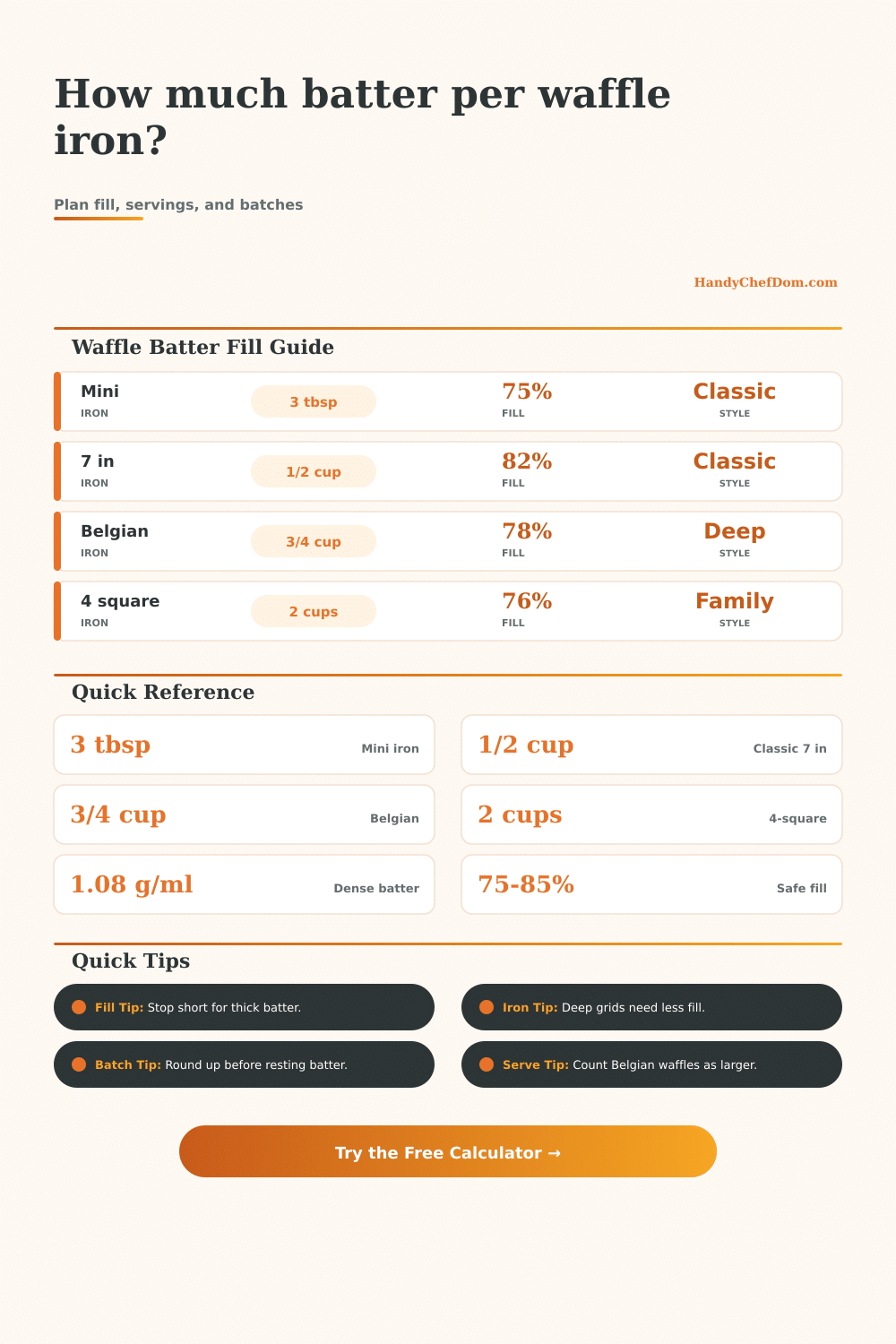
| Mini round classic | 4 in diameter | 0.18 to 0.25 in | 2.5 to 3.5 tbsp |
| Classic round | 7 in diameter | 0.22 to 0.35 in | 1/2 to 2/3 cup |
| Classic square | 7 in by 7 in | 0.22 to 0.35 in | 2/3 to 3/4 cup |
| Belgian round | 7 in diameter | 0.45 to 0.70 in | 2/3 to 1 cup |
| Belgian square | 7 in by 7 in | 0.45 to 0.75 in | 3/4 to 1 cup |
| Four-square Belgian | 8.5 in by 8.5 in | 0.45 to 0.65 in | 1.5 to 2.25 cups |
| Waffle Style | Pocket Factor | Fill Range | Planning Note |
|---|---|---|---|
| Thin crisp waffle | 38% to 46% | 78% to 88% | Use less batter because shallow grids spread quickly. |
| Classic American | 48% to 56% | 78% to 86% | Good baseline for everyday round or square irons. |
| Belgian deep-grid | 58% to 68% | 72% to 82% | Leave more headroom because the waffle rises taller. |
| Flip Belgian | 60% to 70% | 72% to 80% | Even spreading makes the pour more forgiving. |
| Stuffed pocket | 65% to 78% | 62% to 72% | Lower the batter amount when fillings add volume. |
| Mini chaffle | 46% to 55% | 70% to 80% | Cheese batters expand unevenly, so use a buffer. |
| Batter Type | Density | Per Cup Weight | Fill Adjustment |
|---|---|---|---|
| Standard waffle batter | 1.02 to 1.04 g/ml | 241 to 246 g | Use the default fill setting. |
| Thin buttermilk batter | 0.98 to 1.02 g/ml | 232 to 241 g | Add 2% to 4% fill if it spreads slowly. |
| Whole-grain batter | 1.05 to 1.10 g/ml | 248 to 260 g | Use more rest allowance as flour hydrates. |
| Yeasted batter | 0.94 to 1.00 g/ml | 222 to 237 g | Use a larger overflow buffer for lift. |
| Protein waffle batter | 1.06 to 1.14 g/ml | 251 to 270 g | Lower fill if it foams or swells quickly. |
| Chaffle mixture | 1.00 to 1.12 g/ml | 237 to 265 g | Start low because cheese melts outward. |
| Total Waffles | Classic Batter | Belgian Batter | Servings Estimate |
|---|---|---|---|
| 4 waffles | 2 to 2.5 cups | 3 to 4 cups | 4 light servings |
| 8 waffles | 4 to 5 cups | 6 to 8 cups | 6 to 8 servings |
| 12 waffles | 6 to 7.5 cups | 9 to 12 cups | 10 to 12 servings |
| 20 waffles | 10 to 13 cups | 15 to 20 cups | 16 to 20 servings |
| Half batch | Multiply by 0.5 | Multiply by 0.5 | Small breakfast |
| Double batch | Multiply by 2 | Multiply by 2 | Brunch group |
It’s all about volume when calculating waffle batter. You start with a fixed set of dimensions (the container), and then you add liquid. Miss your calculation? Crispness goes out the window. Let this tool take care of the calculations for you while you focus on the cooking.
First, the hardware is important because not all waffle irons is alike. The classic American-style iron features shallow pockets and needs less batter. The classic Belgian iron features deep trenches. More to hold but different heat-trapping properties. To adjust for the effect, you can choose your type of iron from the calculator, which will calculate your pocket factor for you.
How to Calculate Waffle Batter
Deep pockets (a.k.a. “deep grid”) require both more headroom and a higher fill percentage to hit the top of their walls, since the batter expand as it cooks. Stuffing a deep iron to overflowing means the expanding starches has no place to go, and they’ll spill over into the overflow channel. To account for that, the tool let you set an overflow buffer. Start at eight percent. That’s generous enough to let the waffle puff up without leaving its prison cell.
But then there’s the density of the batter itself. Maybe you’re assuming that all batter is wet flour with some eggs in it. Nope. And the denser it is, the more slow it sits down. Thick, protein-rich, or whole-grain batters tends to be heavy. Meanwhile, a thinner batter made of buttermilk, for instance, which flows easily, is less dense; it’s nearer a gram of batter per milliliter. When you pour same amount as for something thicker, the thin batter will appear an underdone puck. Enter the density of the batter into the calculator. For a thick mix, raise that number slightly. That’ll increase the weight of the batter so it fills the entire space instead of just sitting on top and covering the surface.
And don’t forget: there’s a thing called resting time. Letting good waffle batter rest gives the flour time to absorb liquid, and allows the gluten to relax. But that also means the mix will get thicker while its sitting. There’s an option in the calculator called “resting allowance.” It will add a tiny percent of additional batter on top of what you need. That way, when you’re down to three waffles and you run out of batter, you haven’t totally screwed yourself. You’ve anticipated the thickness, you’ve got the buffer. It is the difference between a seamless brunch and a frantic scramble to whip up another batch with milk and water.
This is your batch multiplier. How many people will it feed? One? A crowd? The tool can scale up (or down) based off that. It maintains the ratio. You won’t need to do the mental math of halving some things and doubling others. Just type in how many waffles you need. And then go.
Stop guessing how much batter goes into a single waffle and stop wasting batter. Get consistent results every time. But this takes away all of the worry out of it. It’s not a blind pour. It’s an intentional pour. I know how much space there needs to be for that rise, and I know how much that iron can holds. You should of used this sooner.
The math is complete. All that remains is when. And if you get the geometry down, everything else is simply rhythm. Pour. Cook. Serve. No guessing. No spilling.