🥩 Boneless Rib Roast Cooking Time Calculator
Estimate boneless rib roast timing from roast weight, center diameter, oven temperature, reverse-sear or sear-first style, target doneness, rest time, slice plan, and guest count.
This calculator is built for boneless rib roast and boneless ribeye roast shapes. Enter the center diameter because a thick compact roast usually cooks slower than a long narrow roast of the same weight.
Boneless rib roasts heat from the outside in, so center diameter can matter more than weight alone.
Low oven timing is longer, but the final sear can be separated from the main cook.
Early surface heat trims a small amount from oven time and adds active minutes upfront.
Thin slices make the same boneless roast cover more plates, buffets, or sandwiches.
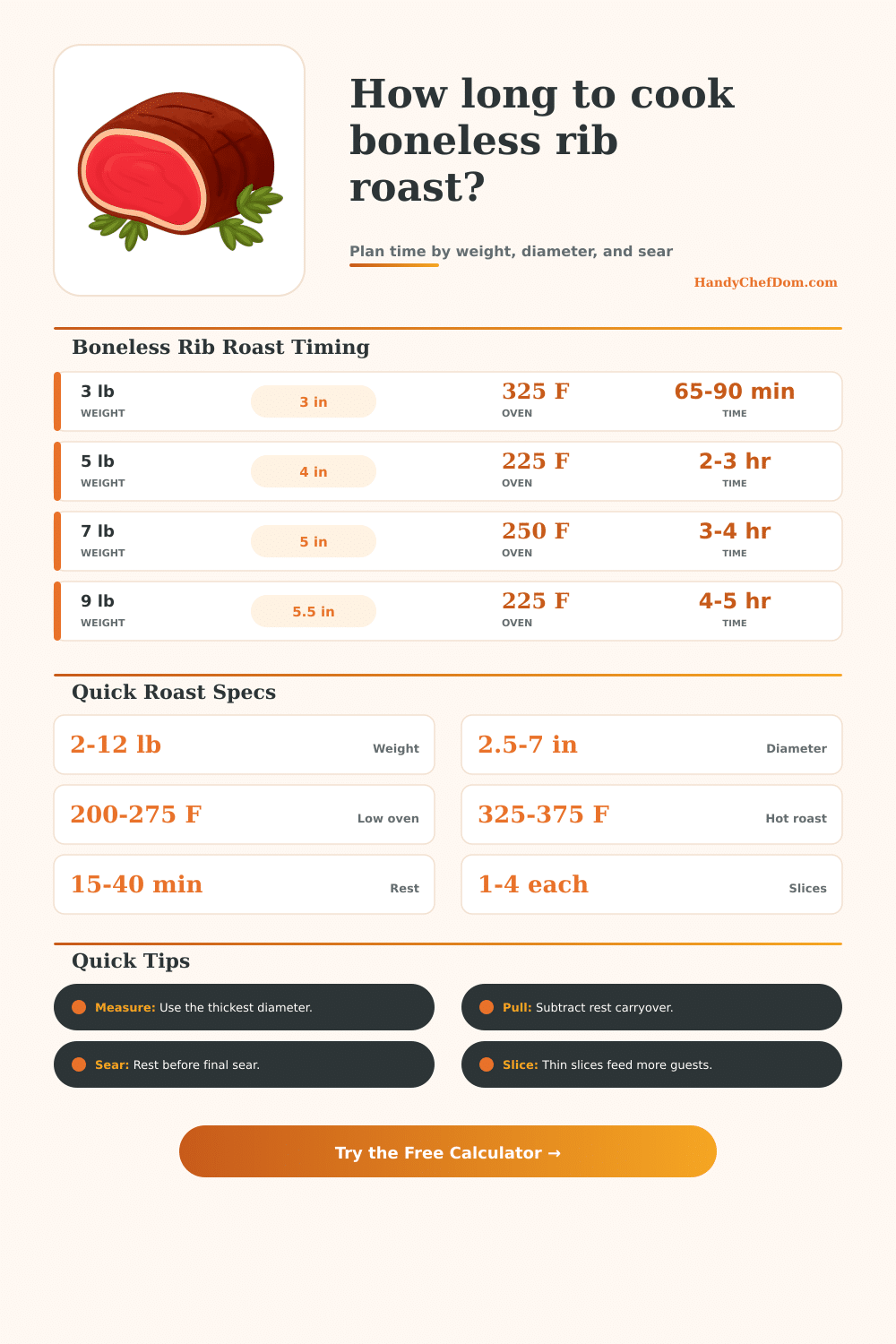
| Boneless weight | Typical diameter | 225 F reverse sear window | 325 F steady roast window | Best use |
|---|---|---|---|---|
| 2 to 3 lb | 2.5 to 3.3 in | 75 to 120 minutes | 50 to 80 minutes | Small dinner or two couples |
| 4 to 5 lb | 3.5 to 4.3 in | 2 to 3 hours | 80 to 125 minutes | Family rib roast dinner |
| 6 to 7 lb | 4.3 to 5.1 in | 3 to 4 hours | 120 to 175 minutes | Holiday table |
| 8 to 9 lb | 4.8 to 5.8 in | 4 to 5 hours | 160 to 230 minutes | Large platter slicing |
| 10 to 12 lb | 5.3 to 6.5 in | 5 to 6.5 hours | 210 to 300 minutes | Large gathering or buffet |
| Target doneness | Finish goal | Common pull range | Carryover planning | Slice result |
|---|---|---|---|---|
| Rare | 125 F | 115 to 119 F | 6 to 10 F | Deep rosy center |
| Medium rare | 132 F | 120 to 125 F | 7 to 11 F | Warm red center |
| Medium | 140 F | 129 to 134 F | 6 to 10 F | Pink center slices |
| Medium well | 150 F | 140 to 145 F | 5 to 9 F | Faint pink center |
| Well | 160 F | 151 to 156 F | 4 to 8 F | Fully cooked slices |
| Reverse/sear style | Timing effect | Typical sear time | Roast shape match | Calculator treatment |
|---|---|---|---|---|
| Reverse sear after rest | Gentle main cook | 6 to 12 minutes | Medium to large cylinders | Adds sear after low oven and rest |
| Low roast, no separate sear | Slowest total oven stage | 0 minutes | Even tied roasts | No added sear heat credit |
| Sear first, then roast | Small oven-time reduction | 8 to 12 minutes | Small and medium roasts | Adds active sear, credits surface heat |
| High heat start, then lower | Faster early heat | 12 to 18 minutes | Wide or cold roasts | Adds hot-start time and carryover |
| Steady 325 F style roast | Shorter but less gentle | Optional | Small dinner roasts | Uses faster oven factor |
| Guests | Light buffet roast | Standard dinner roast | Hearty dinner roast | Slice plan note |
|---|---|---|---|---|
| 4 guests | 2.0 to 2.5 lb | 2.5 to 3.25 lb | 3.25 to 4 lb | 1 to 2 slices each |
| 6 guests | 3 to 3.75 lb | 4 to 4.75 lb | 5 to 6 lb | 2 slices works well |
| 8 guests | 4 to 5 lb | 5.5 to 6.5 lb | 7 to 8 lb | Slice before platter service |
| 12 guests | 6 to 7.5 lb | 8 to 9.5 lb | 10 to 12 lb | Thin slices improve coverage |
| 18 guests | 9 to 11 lb | 12 to 14 lb | 15 to 18 lb | Consider two smaller roasts |
Calculator timing is an estimate for planning boneless rib roast schedules. Oven behavior, roast shape, starting temperature, pan style, and thermometer placement can change the final window.
Cooking a boneless rib roasts requires an understanding of the factors that will impact teh cooking process. Although many individual may believe that the weight of the boneless rib roast is the only important factor in the cooking process, the shape of the boneless rib roast are also critical. It is possible for two boneless rib roasts of the same weight to cook differently based on whether the boneless rib roast is thick and barrel shaped or thin and long.
The thick portion of the roast will impact how the heat move through the roast, meaning you must measure the thickness of the boneless rib roast at the thickest point. The oven temperature will also impact how the boneless roast cook. Using a low cooking temperature will allow the heat to slowly move from an edge of the roast to the center.
How to Cook a Boneless Rib Roast
Using a higher temperature will shorten the cooking time for the boneless roast but will cook the outer edge of the roast more then the middle portion of the roast. Finally, the method used to cook the boneless roast will also impact the carryover cooking of the roast. The target doneness for the boneless roast will impact when the roast are removed from the oven.
Because of carryover cooking, the cook must remove the roast from the oven below the target cooking temperature. For instance, if the target doneness is a medium-rare roast that reaches 132 degrees, removing the roast from the oven at 122 or 124 degrees will allow the roast to finish cook. Resting the roast is necessary for two specific function.
First, resting allows the juice to redistribute throughout the roast so they do not spill out of the roast when slice. Second, resting allows the carryover cooking to continue and finish cooking the roast to the target temperature. Depending on the size of the roast, the resting time may range from a few minutes for a smaller roast to twenty-five or thirty minutes for a larger roast.
The thickness of the slice of the roast will determine how many servings of the roast will be prepared. Thinly sliced roasts will allow a single roast to serve more individual than thicker sliced roasts. Additionally, the appetite of the individuals who will be served the roast will impact the thickness of the slices.
If the appetite for the roast is greater, the roast should be sliced into thicker portion to allow the individuals to consume more of the roast. Many individuals tend to make mistake when roasting boneless roasts by only considering the weight of the roast. Using only the weight of the roast to set a timer for roasting may lead to the center portion of the roast being undercook or the outer edge of the roast being overcook.
Additionally, the starting temperature of the roast may impact the cooking time. A roast that started at room temperature will take less time to cook than one that started at refrigerated temperature. Finally, cooking two smaller roasts instead of one large roast will impact the cooking time because there is more surface areas for the heat to reach the edge of the roasts.