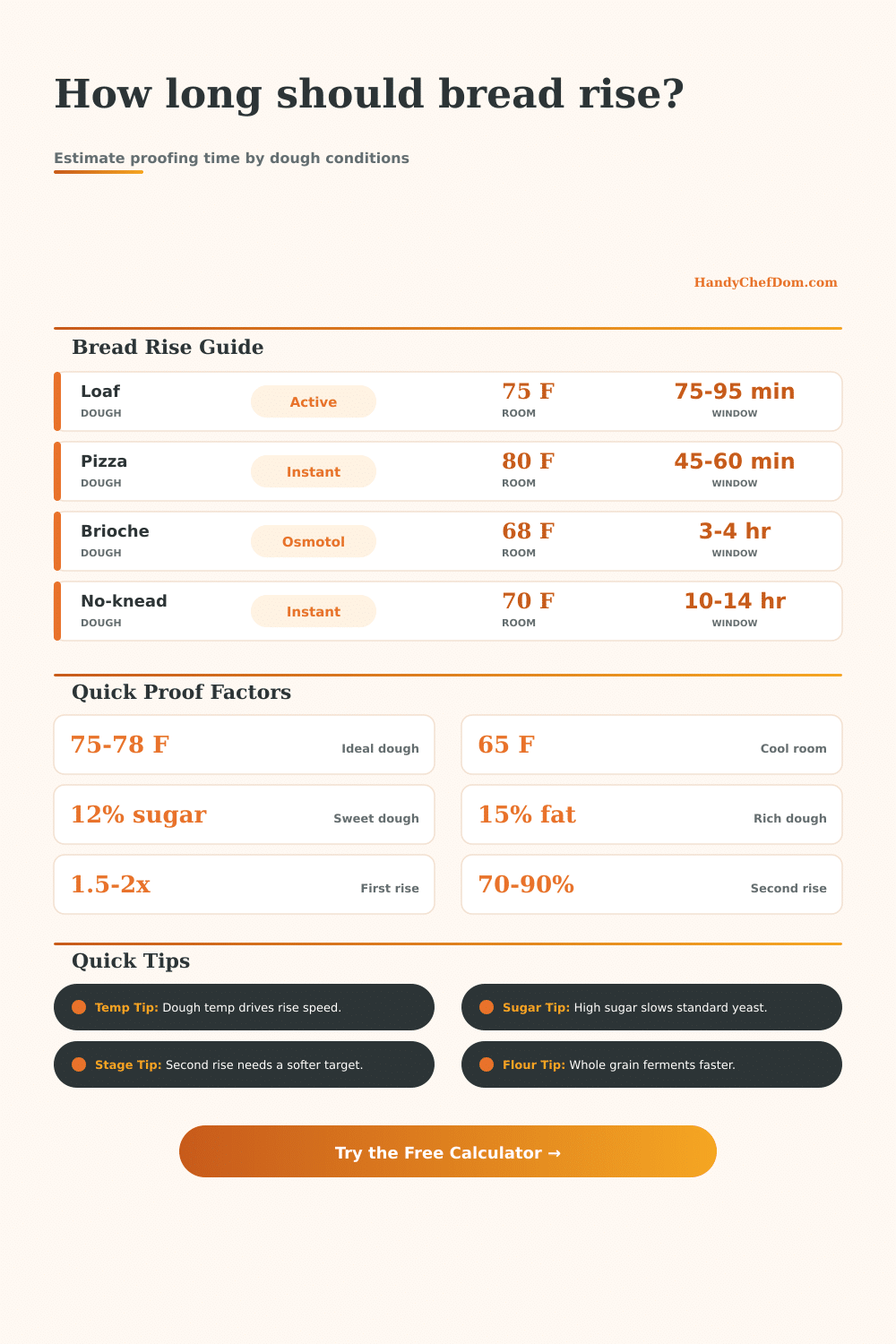
🍞 Bread Rising Time Calculator
Estimate first rise, second proof, or overnight counter rise time from yeast type, dough temperature, room temperature, enrichment, flour, hydration, and target volume.
Use baker percentages for sugar, fat, and hydration. Dough and room temperatures can differ because mixed dough often starts warmer or cooler than the kitchen.
| Yeast Type | Typical Flour % | Relative Speed | Best Dough Style |
|---|---|---|---|
| Active dry yeast | 1.0-1.8% | Standard | Pan loaves and rolls |
| Instant yeast | 0.8-1.5% | 10-15% faster | Pizza, rolls, sandwich bread |
| Fresh compressed yeast | 2.0-3.5% | Fast start | Soft bakery doughs |
| Osmotolerant yeast | 1.0-2.0% | Stable in sugar | Brioche and cinnamon dough |
| Wild sourdough starter | 15-30% | Slow and steady | Levain loaves |
| Poolish preferment | 20-40% | Moderate | Lean crusty breads |
| Dough Temperature | Room Temperature | Rise Behavior | Adjustment Cue |
|---|---|---|---|
| 65F / 18C | 60-65F | Slow fermentation | Add patience, not yeast |
| 70F / 21C | 68-70F | Gentle rise | Use longer window |
| 76F / 24C | 72-75F | Balanced proof | Check near midpoint |
| 82F / 28C | 78-80F | Quick rise | Watch volume closely |
| 88F / 31C | 82-85F | Very fast proof | Shorten final proof |
| Below 55F | Cool room | Retarded pace | Expect several hours |
| Dough Formula | Sugar % | Fat % | Rise Effect |
|---|---|---|---|
| Lean country loaf | 0-2% | 0-2% | Clean fermentation |
| Sandwich loaf | 3-7% | 3-8% | Slightly slower |
| Dinner rolls | 5-10% | 5-10% | Moderate drag |
| Cinnamon dough | 10-16% | 8-14% | Slow unless warm |
| Brioche | 8-15% | 20-35% | Long enriched rise |
| No-knead lean dough | 0-2% | 0-2% | Slow by low yeast |
| Flour And Hydration | Hydration Range | Fermentation Note | Volume Cue |
|---|---|---|---|
| Bread flour | 60-70% | Predictable gluten strength | Domed and springy |
| All-purpose flour | 58-68% | Soft but steady rise | Puffy edges |
| Whole wheat flour | 70-85% | More minerals, faster activity | Use smaller volume target |
| Rye blend | 75-90% | Fast acids and low gluten | Look for cracks |
| Spelt flour | 62-75% | Extensible dough relaxes fast | Avoid overproofing |
| High-gluten flour | 62-78% | Strong hold for big rises | Firm but airy |
Burning the loaf isn’t the worst part of home baking. That would be realizing the dough has collapsed because you was distracted by a phone call, or a sudden craving for coffee. This is called overproofing. You trusted the clock, not your eyes. But it’s also not all about your anxiety. It’s about biology.
Yeast is a living organism that ferments. It builds gluten network as it consumes sugar and exhales carbon dioxide along the way. If you know what’s driving this process, you’re no longer guessing, you’re in control of the rise. And that’s why we has a calculator for you (above) to handle the complicated variables, so you can focus on how the dough feels.
Why Your Bread Rises
There’s one variable that realy impacts how quickly your bread will rise: Temperature. In general, hotter dough rises faster because yeast activity speed up at higher temperatures. Cooler dough doesn’t rise as fast but this gives flavor compounds more time to develop, so it’s not necessarily a bad thing. Because of this, the tool actualy wants to know what your room temperature is in addition to the temperature of your dough. Rarely does it stay the same. Kneading dough warms it up from friction if you’re mixing in a warm kitchen. Storing it in the fridge slows its growth, giving yeast a lot less pep in its step. Going from sixty-five degrees in your kitchen to a mere seventy-five could add an additional hour to your waiting time. This is where people make mistakes. They think that all that matter is ambient air temperature.
Add enrichment, however, and everything changes. Fat and sugar aren’t just flavor enhancers. Instead, they’re physical hindrances to yeast action. High amounts of sugar exert an osmotic pressure that pulls water out of the yeast cell, starving it. That’s where osmotolerant yeasts comes into play. Twelve percent sugar doesn’t work well with standard active dry yeast, even if you’re making a cinnamon roll. Yes, it’ll still get up and go… But it’ll do so in fits and starts, at its own pace. Fat coats gluten strands and other flour proteins, weakening dough structure and making it harder to hold gas. This creates a longer rise window. Brioche can’t be rushed like a baguette; no sir. The calculator takes all this drag into account, factoring in your fat and sugar percentages in figuring time.
The other factor is a quieter one: flour type. Bran particles in whole wheat flour are like little razors slicing up the growing network of gluten. There’s also more food for the yeast to eat. Typically, this results in faster fermentation but less structure. Rye flour lacks nearly any gluten whatsoever. Structure is achieved via starch gelatinization and action of enzymes. If you treat rye dough like bread flour, it will flatten out in the oven. This is where the reference tables on the page come in handy; they detail how various flours behave when put under pressure. With this knowledge, you can adjust your expectations to match. Even if two loaves use the same amount of yeast, the one made with whole wheat may rise to its desired volume sooner then the white bread.
And then there’s hydration. More hydrated dough is easier to mix, but harder to handle. Artisan bread dough is very high hydration. That type of dough will stretch, but not be stiff enough to push up aggressively. It tends to lay out flat instead of rising. So you may want to adjust your target volume change downward. With a wet ciabatta you aren’t hoping for a double rise. You’re looking for openness and some lift. To do this, the tool considers both flour strength (a low gluten content would suggest a gentler proof) and your hydration percentage. This connects a longer, gentler proof to a wetter, slack dough.
And finally: The numbers aren’t hard-and-fast. They’re a guideline. Every kitchen has its own microclimate, and the window might open and close by twenty minutes or more depending on your altitude, humidity level, strain of yeast in the jar, etc.
Take the ballpark estimate as your starting point, then check your dough. Start the timer on the low side. Shake the bowl. Does the dough quiver, jiggling like Jell-O? That is good. Is there some bounce left, but overall the dough look full of bubbles and smooth? Yes. Time to go. If not… Not yet. You’re looking for the sweet spot.
It is not the minute. The minute is irrelevant. You want the dough at its best, right on the cusp of tiredness, when the gluten starts to let go. Get to know that instant. And the clock should of mattered anymore.