Brewhouse Efficiency Calculator
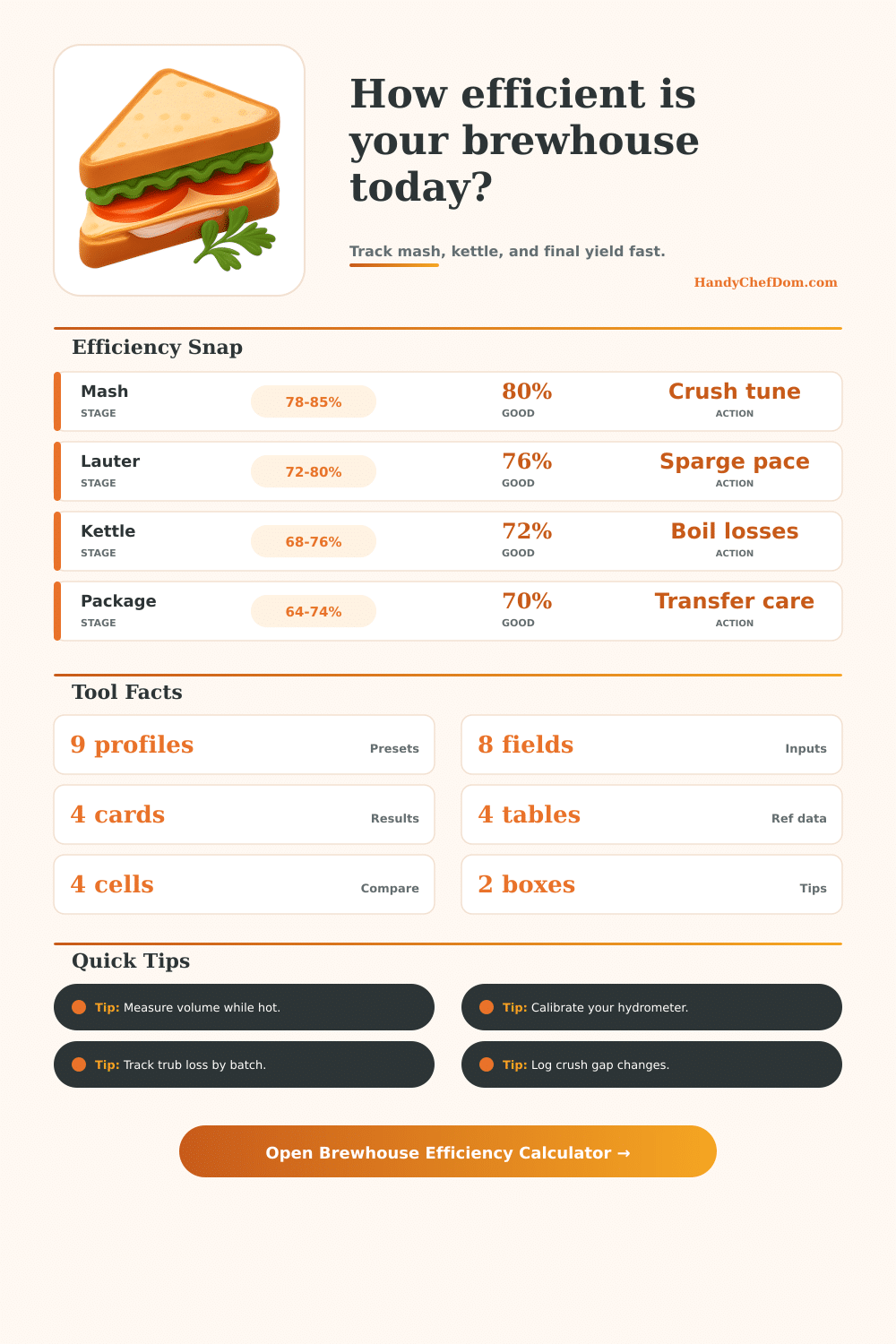
Estimate mash-to-package yield from gravity points and volume, then compare each stage to practical homebrew targets so you can tighten process losses and improve recipe accuracy.
📌 Batch Presets
🏷 Process Labels
⚙ Efficiency Inputs
Method: Potential gravity points from malt are compared to actual points into package. Stage checks estimate where efficiency is being lost.
Efficiency Breakdown
📊 Efficiency Comparison Grid
📑 Reference Tables
| Stage | Formula | Good range | What it means |
|---|---|---|---|
| Mash points | Potential x mash % | 78-90% | Conversion quality |
| Pre-boil points | (SG-1)x1000 x vol | 72-84% | Lauter capture |
| Post-boil points | OG points x vol | 68-78% | Kettle retention |
| Packaged points | OG points x pack vol | 64-74% | Final brewhouse |
| Brewhouse % | Planning effect | Recipe impact | Action |
|---|---|---|---|
| 60-63% | Needs more grain | Higher cost | Reduce losses |
| 64-69% | Standard baseline | Predictable OG | Track trends |
| 70-74% | Efficient setup | Lean grain bill | Hold process |
| 75-80% | Very high yield | Fast payback | Verify readings |
| Loss source | Typical amount | Symptom | Fix idea |
|---|---|---|---|
| Mash dead space | 0.1-0.3 gal | Low pre-boil points | Drain tilt |
| Grain absorption | 0.08-0.12 gal/lb | Short runoff | Adjust liquor |
| Kettle trub | 0.2-0.6 gal | Good OG, low pack vol | Whirlpool cone |
| Transfer hold-up | 0.1-0.4 gal | Missing package volume | Short tubing |
| Hydrometer temp | Correction | At SG 1.050 | Use case |
|---|---|---|---|
| 60 F (calibrated) | +0.000 | 1.050 | Reference point |
| 70 F | +0.001 | 1.051 | Warm sample |
| 80 F | +0.002 | 1.052 | No chill reading |
| 90 F | +0.003 | 1.053 | Hot-side estimate |
💡 Two Practical Tips
Brewhouse efficiency are a number that helps to indicate the amount of sugar that can be extracted from the grain during the brewing process. Brewhouse efficiency can be relatively low due to the loss of that sugar during several stage of the brewing process, such as the grain crush, the mash, the lauter, the kettle boil, and during the packaging of the beers. If the brewhouse efficiency is low, the resulting beer may taste thin relative to the recipe that was constructed to create that particular beer, and the recipe may need to be adjusted to include more grains to compensate for the loss of sugars.
One of the main stage at which brewhouse efficiency can be lost is during the mash conversion of the grains to soluble sugar. If the grains do not contain enough soluble sugars due to incorrect mash temperatures, incorrect mash length, or incorrect mash pH, the resulting beer will have a low pre-boil gravity. Adjusting these factor can increase the amount of soluble sugars in the mash, which will subsequentally increase the brewhouse efficiency.
How to Measure and Improve Brewhouse Efficiency
Another of the main stages at which brewhouse efficiency can be lost is during the lauter stage of brewing. The sugars can become stuck to the grains and not be boiled, or the run-off of the wort can lose sugars if there is dead space under the false bottom. Furthermore, the grains may absorb much of the liquid that is forced through the grains, and that liquid contains the sugars.
If the brewer does not measure the brewhouse efficiency at this point in brewing, these loss of sugars can be accepted. However, if the brewer measures the brewhouse efficiency at this point, then the brewer can make necessary adjustment to the brewing process. The losses at the kettle involve both the volume and gravity of the liquid in the kettle.
Losses of volume can result from evaporation of the liquid during the boil, or from the amount of liquid that remains at the kettle after the wort is separated from the spent grains (trub). If the boil is particularly vigorous, more of the liquid will be lost to evaporation. Additionally, if more of the liquid evaporates during the boil, the gravity of the remaining liquid will be higher.
Thus, brewhouse efficiency must be calculated at each of these stage to determine the actual brewhouse efficiency of the brewing operation. Losses during the packaging of the beer are generally lost to the amount of liquid that remains in the hoses, pump chamber, or the walls of the fermentor. While these losses are generally small for each batch of beer, they can become significant if many batch of beer are brewed.
Brewhouse efficiency should not be reviewed as a single number without also reviewing the efficiency at each of these individual stages. For example, 68% brewhouse efficiency may be normal for certain brewing equipment, but it may be an issue for another type of brewing equipment. In reviewing the brewhouse efficiency at each of the individual stages, reference tables can help the brewer to identify whether or not the brewhouse efficiency for each type of equipment is within the normal range for that equipment.
Additionally, temperature must be accounted for in the brewhouse efficiency calculation. Hot liquids will expand, so a gallon of liquid at brewing temperatures will not contain the same volume of liquid as a gallon of cold liquid. Furthermore, the gravity of the liquid will change with temperature.
By tracking the brewhouse efficiency for each batch of beer, a brewer can make adjustments to they’re recipes. For example, if the brewer knows the percentage of extract that is lost during the mash, as well as the percentage of extract that is lost during the lauter and kettle stages, then the brewer can create recipes that contain sufficient extract to account for those losses. Additionally, if the brewhouse efficiency drops to a lower percentage than normal, the brewer will be able to recognize potential issue with the brewing process.
Finally, if the measurements are recorded for each batch, the brewhouse efficiency can become a baseline for that brewery. Establishing this brewhouse efficiency baseline will allow the brewer to use a brewhouse efficiency calculator to ensure that the brewhouse efficiency remains the same throughout the brewing process.