🥩 Brisket Servings Calculator
Plan raw brisket weight, trimming loss, cooked yield, sandwich or plated portions, guest appetite, and leftovers in one serving estimate.
Use plan mode when buying brisket for a guest count. Use check mode when you already know the raw brisket weight and want estimated servings.
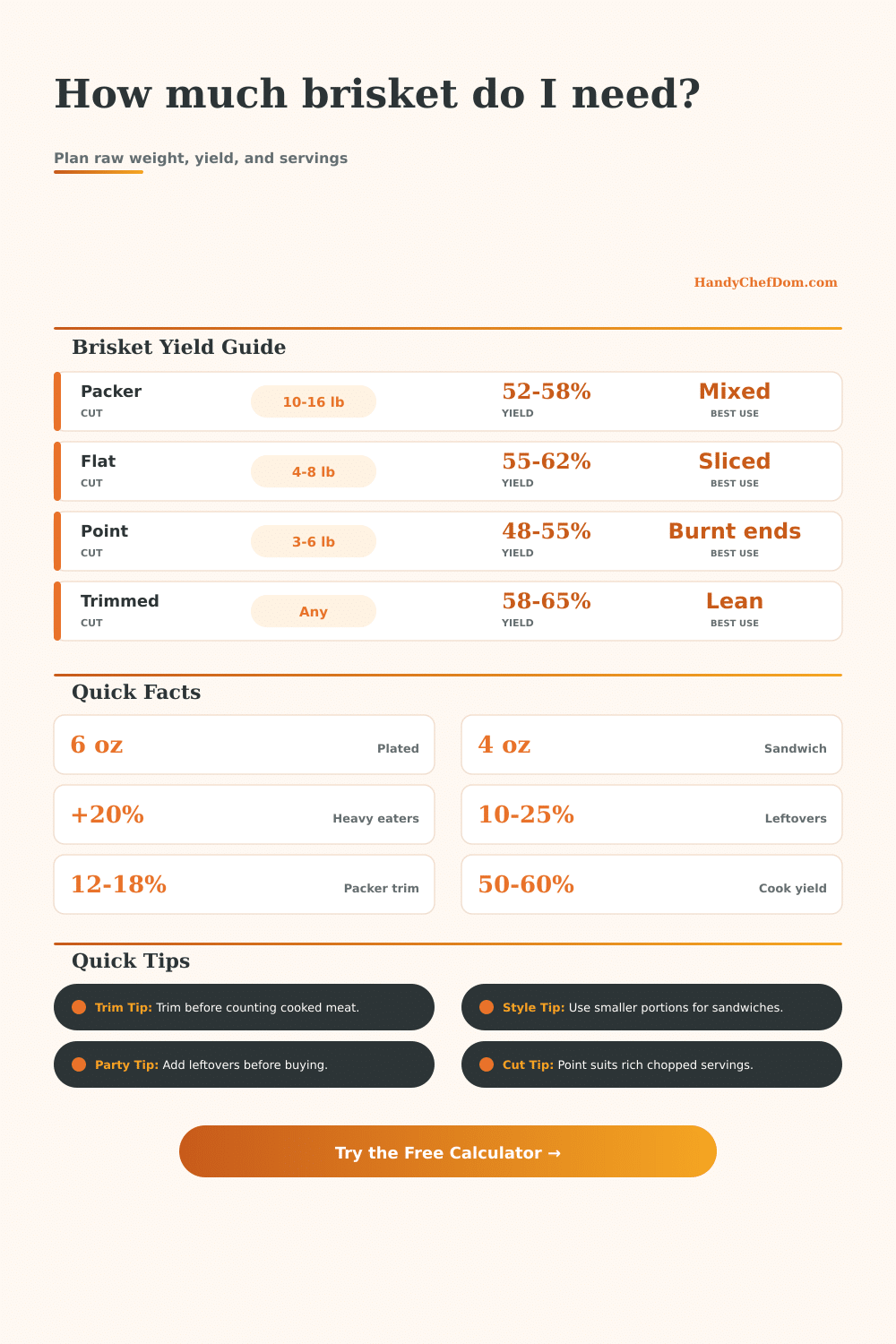
| Brisket Cut | Typical Raw Size | Trim Loss | Cooked Yield |
|---|---|---|---|
| Whole packer brisket | 10 to 16 lb | 12% to 18% | 52% to 58% |
| Flat only | 4 to 8 lb | 8% to 14% | 55% to 62% |
| Point only | 3 to 6 lb | 10% to 18% | 48% to 55% |
| Pre-trimmed brisket | Any weight | 3% to 8% | 58% to 65% |
| Lean trimmed flat | 3 to 7 lb | 5% to 10% | 58% to 64% |
| Point for burnt ends | 3 to 6 lb | 12% to 20% | 45% to 52% |
| Serving Style | Cooked Portion | Works Best For | Planning Note |
|---|---|---|---|
| Sandwich tray | 4 oz per guest | Buns and sides | Plan extra if sandwiches are overfilled. |
| Plated dinner | 6 oz per guest | Holiday meals | Use average appetite unless sides are light. |
| BBQ buffet line | 5 oz per guest | Mixed meats | Reduce if ribs or sausage are also served. |
| Tacos or sliders | 3 oz per guest | Small portions | Count two small portions as one guest serving. |
| Burnt ends portion | 5 oz per guest | Point meat | Yield runs lower because the point renders heavily. |
| Meal prep containers | 5.5 oz each | Leftover boxes | Use the leftover target as planned extra meals. |
| Guests | Sandwich Raw | Plated Raw | Packer Count |
|---|---|---|---|
| 8 guests | 5 to 6 lb | 7 to 8 lb | 1 small flat |
| 12 guests | 7 to 8 lb | 10 to 11 lb | 1 small packer |
| 20 guests | 12 to 14 lb | 17 to 19 lb | 1 large packer |
| 35 guests | 21 to 24 lb | 30 to 33 lb | 2 to 3 packers |
| 50 guests | 30 to 34 lb | 42 to 47 lb | 3 to 4 packers |
| 75 guests | 45 to 51 lb | 64 to 70 lb | 5 to 6 packers |
| Leftover Target | Extra Raw Brisket | Best Use | Serving Effect |
|---|---|---|---|
| 0% | No planned extra | Tight event count | Little margin for seconds |
| 10% | About 1 lb per 10 lb | Small cushion | Covers a few heavier plates |
| 15% | About 1.5 lb per 10 lb | Family gatherings | Good for next-day sandwiches |
| 25% | About 2.5 lb per 10 lb | Meal prep | Creates planned extra portions |
| 40% | About 4 lb per 10 lb | Freezer meals | Buy another small flat if close |
| 60% | About 6 lb per 10 lb | Large prep batch | Often needs another packer |
Two days prior to your bbq you’re freaking out. The smoker’s all set up, the rub is blended, and the side dishes is prepared, but now what? What size brisket should I purchase?
Briskets are tricky at the grill. They appear huge when placed on the scale, shrink during the smoke, and will frequently leave you overfull or underfed at the table. The cause of this split generaly comes down to a single variable; how much does raw brisket become cooked brisket? A lot of folks makes an educated guess. They see the “party size” 12 pound packer on sale and figure that’s plenty of meat for a bunch of friend. Then they find themself with a massive amount of unexpected leftovers or just enough for four people.
How Much Brisket to Buy
The problem is, however, that brisket shrinks, a lot. Look at any raw brisket and you’ll notice lots of connective tissue, water, and fat. That’s going to dissapear as it spends hours and hours in the smoker. But how much? What is it realy going to shrink by? That’s where the calculator comes in (above). It figures the math out for you when you enter number of guests and how you plan to serve the meat. This way, you don’t have to stand in line at the butchering counter trying to do mental math with percentages.
Brisket require a bit of know-how: First, there’s trimming. And no, you don’t go into it hoping to find enough. You trim based off what the meat appears to be. If there’s a big deckle of firm fat across one end or if the whole thing have a layer of fat so thick you can barely see through it, get rid of it. Before you start thinking about cooking time, you need to trim. If not, you won’t get an accurate sense of yield, since that fat will render out and slip away from the meat. Most home cook fail to make that difference between trimming loss and cooking loss in their mental math. But the tool does, and it matters, because a fattier piece of brisket called the “point” differ from a trimmed-down flat.
Next up: the cook. As it smokes, the meat lose additional weight. Water evaporates, collagen breaks down. And here’s where we get into yield percentage. In general, a typical piece of brisket will retain half its original weight. Maybe a little more if it’s on the lean side, maybe a little less if it’s fatty. Not a penalty, it’s part of the process. What emerges are tender. The catch: plan accordingly for half.
For plated dinners, that means serving 6-ounce portions of cooked meat. That’s a standard plate. But for sandwiches? Four ounces will do, since the pickles, slaw and bun holds up the remainder of the meal. This makes a huge difference in terms of the amount of raw meat required. To make it easy, I built the calculator so that it automatically adjusts for this variable. You select your preference (plate versus sandwich), and it scales back the size of the portion accordingly. Sounds like a small toggle, but it shifts the amount of raw meat you must purchase by 25-percent. This is the distinction between having just enough for one smoker…or two.
The other variable that seems subjective but can be quantified is appetite. Is your guest digging into an elaborate meal of sausage, chicken, and ribs? That reduces his brisket appetite. He isn’t going to eat a lot; he’s sampling. On the other hand, perhaps the main course are all brisket or maybe the sides is light. Either way, you’ll want to cater to the heavy eater. Using the tool you can up the portion for your hungry audience. You can even tack on a service buffer.
Your buffer accounts for seconds, for end pieces that appear to be smaller, for uneven slices, etc. Adding just a little bit of meat protects you from the embarrassing question of being asked for more and having none left. Better to have too much then not enough.
The other thing is the leftovers. Brisket tastes even better the second day. The texture improve and the flavors meld. Want to take it as a sandwich (or put in some meal prep containers) for the week? Plan for that ahead of time. Plan for leftovers upfront. Plan out how much you’d like, and account for this additional raw amount. Now it’s not a waste management problem, it’s a feature! You’re already cooking dinner for next week.
This is clearly laid out in the reference tables on the page. A whole packer is versatile. Rich meat from the point and slices from the flat. Flat alone is more consistent and lean. The point is best for chopped meat or burnt ends. If you know what cut you have, that will change your yield and trim expectations. The calculator defaults to a standard packer, but you can switch those around. That’s what makes it work for both a large party and a backyard dinner.
You won’t have to guess anymore. You’re buying exactly what you need. Brisket smoking is all in the precision and patience. You wouldn’t of been able to rush it along with the low and slow cook. However, you can shop for your items beforehand. Ensure that you get the weights correct before firing up the smoker. Let the meat do the work.