🍗 Chicken Average Weight Calculator
Estimate average raw chicken weight by bird or cut type, bone-in or boneless style, package count, piece count, servings, cooked yield, skin, trim, and leftovers.
Use plan mode to estimate raw weight and average pieces from servings. Use check mode when you already have package weights and want cooked edible yield and serving coverage.
| Bird or Cut Type | Average Raw Weight | Typical Edible Yield | Package Planning Note |
|---|---|---|---|
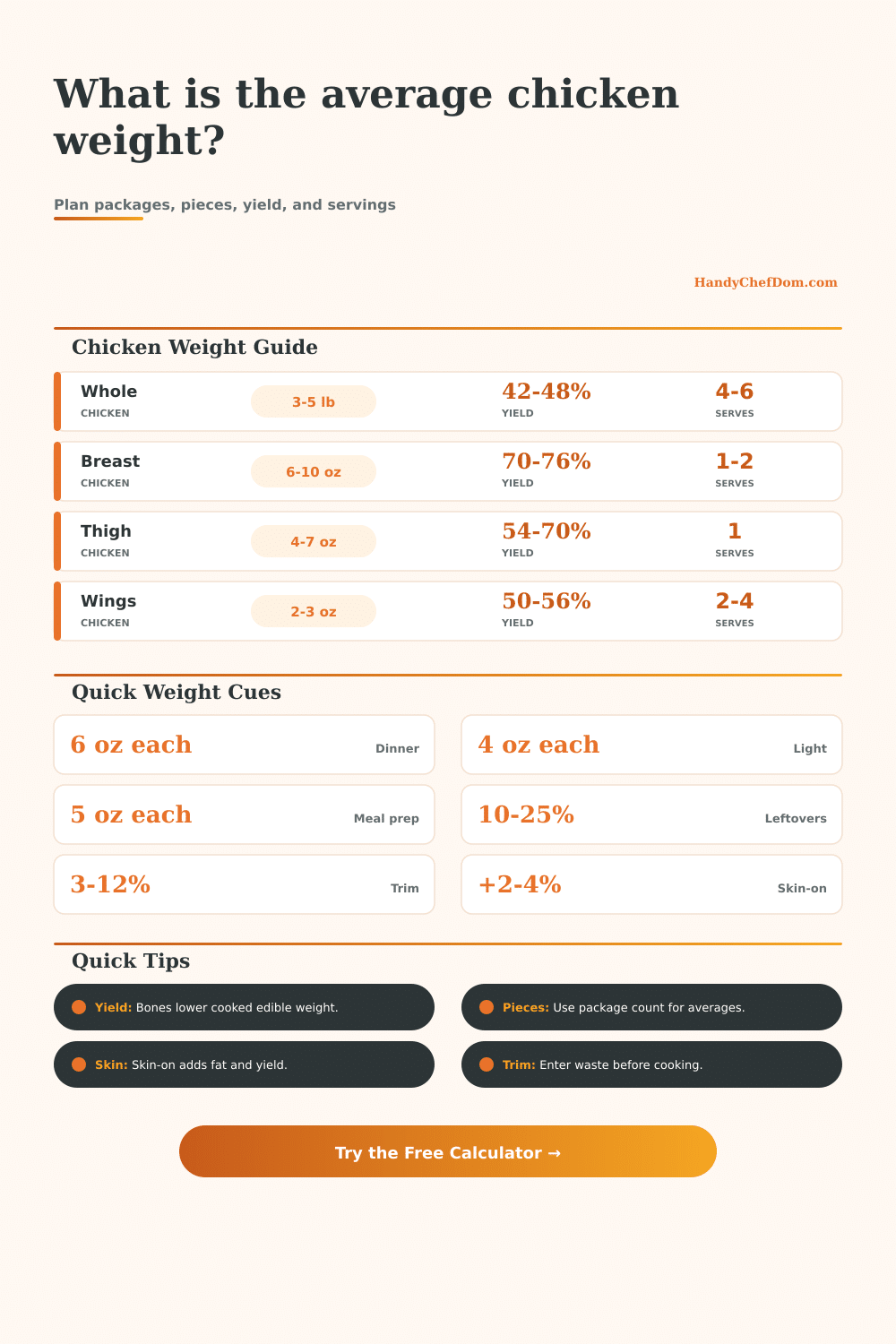
| Whole broiler chicken | 3 to 5 lb per bird | 42% to 48% | Use one piece count per bird; carcass lowers edible cooked meat. |
| Cornish hen | 18 to 28 oz per bird | 42% to 48% | Often planned as one small bird for one large serving or two light servings. |
| Boneless chicken breast | 6 to 10 oz per piece | 70% to 76% | Divide package weight by breast count for average piece weight. |
| Bone-in split breast | 10 to 16 oz per piece | 52% to 60% | Raw piece looks large because rib bone and skin are included. |
| Boneless chicken thighs | 3 to 5 oz per piece | 66% to 72% | Small uneven pieces average well across the whole package. |
| Bone-in chicken thighs | 5 to 8 oz per piece | 54% to 60% | Skin-on pieces carry more raw weight than edible meat. |
| Drumsticks | 4 to 6 oz per piece | 48% to 56% | Useful for count-based party portions. |
| Chicken wings | 2 to 3 oz per wing | 50% to 56% | Count pieces first when planning appetizers. |
| Serving Plan | Cooked Portion | Boneless Raw Rule | Bone-In Raw Rule |
|---|---|---|---|
| Light lunch or salad | 4 oz each | 0.35 to 0.45 lb per serving | 0.55 to 0.75 lb per serving |
| Standard dinner plate | 6 oz each | 0.55 to 0.65 lb per serving | 0.8 to 1.0 lb per serving |
| Hearty chicken meal | 8 oz each | 0.7 to 0.85 lb per serving | 1.1 to 1.35 lb per serving |
| Meal prep bowl | 5 oz each | 0.45 to 0.55 lb per container | 0.7 to 0.9 lb per container |
| Mixed mains at table | 4.5 oz each | 0.4 to 0.5 lb per serving | 0.6 to 0.8 lb per serving |
| Appetizer wings | 3 to 4 oz edible | Not typical | 0.5 to 0.75 lb raw wings per person |
| Package Count | Useful Average | Best Input | When It Helps |
|---|---|---|---|
| 1 whole chicken | Total raw weight per bird | Pieces = 1, packages = 1 | Roast chicken dinners and carving estimates. |
| 1 family pack breasts | Raw weight per breast | Count every breast in the pack | Meal prep, sandwiches, salads, and dinner plates. |
| 2 thigh packs | Average weight across both packs | Total weight and total pieces | Balances mixed piece sizes across packages. |
| Party drumsticks | Average raw weight per drumstick | Package count plus all drumsticks | Useful when servings are count-based. |
| Wing trays | Average raw wing piece | Wing piece count after splitting if needed | Helps estimate platter weight and edible yield. |
| Mixed cuts | Average raw piece in the tray | Total package weight and total pieces | Best for roast trays with breasts, thighs, legs, and wings. |
| Cooking or Prep Choice | Yield Effect | Trim/Waste Effect | Calculator Use |
|---|---|---|---|
| Roasted or baked | Baseline yield | Normal pan and carving loss | Good default for whole birds and bone-in pieces. |
| Grilled | About 2 points lower | More surface moisture loss | Useful for breasts, thighs, and drumsticks. |
| Sauteed or pan cooked | About 1 point lower | Small pieces may lose more moisture | Useful for tenders, sliced breast, and boneless thighs. |
| Braised or slow cooked | About 2 points higher | Less moisture loss but bones still count | Useful for thighs, drumsticks, and mixed bone-in trays. |
| Air fried | About 3 points lower | Extra skin and surface shrink | Useful for wings, tenders, thighs, and drumsticks. |
| Poached or simmered | About 4 points higher | Low browning loss | Useful for breast meat, shredding, and meal prep. |
Fifteen minutes before company comes to your house there’s a certain kind of panic that sets in. It’s when you look into your fridge and find a raw chicken that doesn’t seem big enough for all the people you’ve invited over. You think it should be bigger, but then you don’t know how it could be bigger…a 3 pound chicken seems plenty of meat…but wait! Three pounds means three pounds. That includes the bones, the skin, and the moisture that dries up in the oven, plus all the scraps you’ll have to discard.
I wish there were an easy way to calculate exacty how much food you need for however many people you are serving. There is: plug in how many people you’re serving and what kind of cut you want. Then, you will see how much food is required. You won’t have to guess whether that family pack of chicken breasts can realy stretch to six servings, as opposed to three if you happen to have really hungry diner.
How to Calculate the Right Amount of Chicken
Yield is how much of what you started with ends up on the plate and edible. Yield refers to how much of what you started with ends up on the plate and edible. If you purchase boneless skinless breasts, you’re largely purchasing protein. You’ll get great yields, typicaly over 70% of the original weight will end up on your plate. But if you purchase bone-in thighs or even just a whole chicken, a large portion of what’s in that package is structure. Bone doesn’t shrink. It has the exact same weight raw as it does cooked. And it occupies space inside the package but doesn’t contribute any calories to your meal.
This is where the bulk of folks fail: they think about the bag weight, not the meat weight, and use that to calculate their portions. Consider meal prep vs. Cooking a single dinner. Maybe you’ll serve 8-ounces of cooked chicken per person at your next dinner. For those meal-prep containers? Five ounces usually does it. You can make this adjustment directly on the tool.
Choose a “standard” dinner portion and then opt for bone-in cuts, and suddenly the amount of raw chicken needed skyrockets. To get everybody full when they leave the table, you may be looking at almost a pound of raw bird per person! Switch over to boneless, and now you don’t need as much. But it’s not because the boneless chicken contains more meat per pound of raw chicken. It’s just that you have less waste to factor in.
There’s a small part in this equation where the skin enters into play. You’ll get more flavour and fat if you leave it on. However, you’ll lose some weight. Trim it off just before serving and poof, that weight dissapears. Typically between three and twelve percent (depending on how aggressive you’re being with your knife) you can account for this by inputting a percentage of trim. Again, that might seem like a tiny detail, but when you multiply across a big batch for a party, all those lost ounces begin to add up. That could be the difference between running out of chicken and having leftovers for sandwiches tomorrow.
You’d think that how you cook it wouldn’t make much of a difference. But it does. When you braise or poach chicken, not as much moisture evaporates compared to when you bake or roast it. And if you’re air frying some wings, don’t count on having as many grams per dollar than you would if you just simmered them. You’ll need to tell the calculator which way you cooked them. It takes into account that dry-heat-cooked cuts has lower effective yields (adjusted downwards), while moist-heat-cooked ones has higher effective yields (adjusted slightly upwards). That’s part of what makes poached chicken feel like it gives you bang for your buck. Sure, the flavor profile isn’t as interesting, but at least the moisture stay inside.
Another thing to set deliberately: How much will you have left over? Do you want some? Would you like to eat your own weight in beef? Some hosts plan precisely to serve as much (or less) meat than they need to feed their guests. Other hosts leave room for leftovers; leftover sandwiches and leftover salads is pretty great, too. A ten percent leftover goal is a low-risk hedge if you’re afraid you might underestimate. Having a little more meat at the start gives you a little peace of mind. No shame in planning for seconds. Sometimes, it’s the smart play.
However, cooking chicken (or anything) is a physics problem more than a flavor one. It’s a matter of mass and moisture and heat and how those things interact. If you understand the interaction, then you can walk into grocery store confidently. You don’t buy based off your gut; you buy based on math. And when you finally scoop out those bowls or carve up that bird, you won’t be shocked by what lands on the plate. You already knew it was going to be there. The confidence that brings? It’s worth a couple minutes to do the math before you even preheat the oven.