🍫 Cocoa Powder In Chili Calculator
Calculate cocoa powder for chili by quarts, meat and bean weight, chili style, cocoa type, bitterness target, heat, tomato acidity, simmer time, and servings.
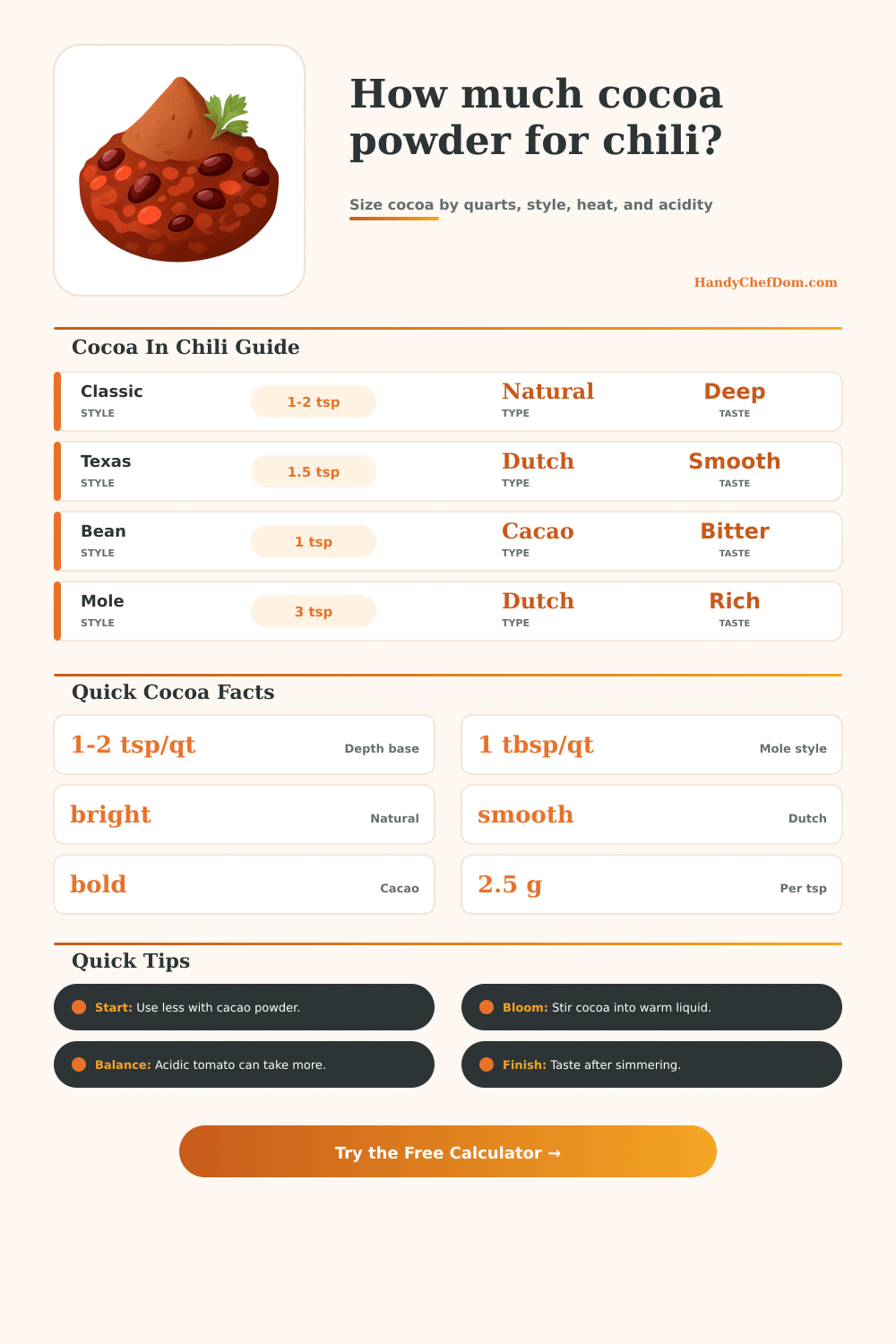
For subtle depth, start around 1 to 2 teaspoons cocoa powder per quart of chili. For mole-style richness, use about 1 tablespoon per quart, then adjust for cocoa type, acidity, heat, and simmer time.
| Cocoa Type | Flavor Impact | Calculator Factor | Grams Per Teaspoon |
|---|---|---|---|
| Natural unsweetened cocoa | Bright, sharp, familiar chocolate depth | 1.00x | About 2.5 g per teaspoon |
| Dutch-process cocoa | Smoother, darker, less acidic taste | 1.08x | About 2.6 g per teaspoon |
| Raw cacao powder | More bitter and roasted, stronger finish | 0.82x | About 2.4 g per teaspoon |
| Cocoa blend | Use the closest match on the label | 0.95x to 1.05x | Usually 2.4 to 2.7 g per teaspoon |
| Chili Style | Starting Cocoa | Best Cocoa Type | Flavor Goal |
|---|---|---|---|
| Classic tomato beef chili | 1.4 tsp per quart | Natural cocoa | Background depth without tasting sweet or chocolatey. |
| Texas-style beef chili | 1.5 tsp per quart | Dutch-process cocoa | Dark chile gravy, beef depth, and smoother bitterness. |
| Bean-heavy homestyle chili | 1.15 tsp per quart | Natural cocoa | Gentle richness that does not make beans taste dusty. |
| Turkey or chicken chili | 0.9 tsp per quart | Natural cocoa | Light depth without overpowering lean meat. |
| Vegetarian or black bean chili | 1.25 tsp per quart | Dutch or cacao | Roasted flavor to support beans, peppers, and vegetables. |
| Mole-inspired chocolate chili | 3 tsp per quart | Dutch-process cocoa | Cocoa-forward richness with chile, cumin, and cinnamon. |
| White chili with light tomato | 0.35 tsp per quart | Natural cocoa | Very small amount only if earthy depth is desired. |
| Spice Pairing | Why It Works | Cocoa Direction | Calculator Note |
|---|---|---|---|
| Ancho chile and cumin | Sweet chile notes make cocoa taste rounded | Use the balanced target | Good for classic or Texas-style chili. |
| Chipotle and smoked paprika | Smoke amplifies roasted cocoa notes | Reduce slightly if bitter | Hot smoky batches can taste darker after simmering. |
| Cinnamon and allspice | Warm spices bridge chili and mole flavors | Increase toward dark target | Works well with Dutch-process cocoa. |
| Tomato paste and vinegar | Acidity brightens and softens cocoa heaviness | Acidic chili can take more | High-acid settings add a small cocoa bump. |
| Browned beef and black beans | Rich base absorbs cocoa bitterness | Use normal or dark target | Hearty pounds increase the result slightly. |
| Spoon Measure | Natural Cocoa | Dutch Cocoa | Cacao Powder |
|---|---|---|---|
| 1/4 teaspoon | 0.6 g | 0.7 g | 0.6 g |
| 1/2 teaspoon | 1.3 g | 1.3 g | 1.2 g |
| 1 teaspoon | 2.5 g | 2.6 g | 2.4 g |
| 1 tablespoon | 7.5 g | 7.8 g | 7.2 g |
| 1/4 cup | 30 g | 31 g | 29 g |
Cocoa act as an additive in chili because it change the way that other flavors are perceived. The addition of a small amount of cocoa help to round out the sharp flavors of both tomato and dried chile. However, the chili should not taste like chocolate.
Many people uses cocoa in chili to add depth to the flavors of the chili, and the interaction between the cocoa and the other ingredient of the chili produce the depth of the flavors. The amount of cocoa that you should add to chili is dependent upon several different variable. One of the variables is the volume of the liquid that you will use in the chili; cocoa must distribute it’s self throughout the chili liquid.
How Much Cocoa to Add to Chili
Additionally, the weight of the meat and the beans that you will use in the chili are variables; chili that contain more meat and beans will have more of the bitterness that is naturaly contained in those ingredient. Other variables includes the acidity of the tomatoes that you will use in the chili. Simmer time is another variable; cocoa becomes less bitter after the first twenty minute of simmering the chili, and cocoa can dissapear completely after many hour of simmering.
Each of these variables is accounted for in the calculator. The type of cocoa that you will add to chili will also change the outcome of adding cocoa to chili. Natural cocoa will provide a more bright and sharper taste to chili than Dutch-process cocoa.
Natural cocoa is a better choice for adding to tomato based beef chili. However, Dutch-process cocoa is darker and smoother, and therefore a better choice for Texas style chili. Raw cacao powder is more bitter and more roasted than other type of cocoa.
Therefore, a small amount of raw cacao powder will have the same flavor strength as a large amount of natural cocoa. Each type of cocoa has its own multiplier that are accounted for in the calculator. One of the decisions that you must make is the target bitterness of the chili.
If you want the cocoa to be a background flavor in the chili that complements the other flavor of chili, then you should add less cocoa than if you wished for cocoa to be one of the main flavor in the chili. By selecting one of these two option in the calculator, the calculator automatically calculate the amount of cocoa that should be added for you. By making this selection you avoid the mistake of adding too much cocoa to chili, which can make chili taste like a dessert.
The heat level of the chili and acidity of the tomatoes affects the amount of cocoa differently. Hotter chiles will mask the bitterness of the cocoa. However, the higher the acidity of the tomatoes, the more the flavor of the cocoa will be enhanced.
Because these variable have an effect on cocoa in chili in such a way, the calculator combines them into a single combined calculation. This combined calculation ensure that the amount of cocoa calculates to an amount that adheres to the intention of the cook. The reference table provide different starting point for chili of different style and flavor with different type of cocoa.
These tables allow you to see the logic behind the calculations before you begin to change any of the number in the calculator. For instance, these tables indicate the reason that chili that contain more beans will contain less cocoa than chili that contain more beef. Additionally, they can show the reason that recipes that utilize Dutch-process cocoa will have a different factor for the amount of cocoa than recipes that use natural cocoa.
These tables are not rule; however, they are the starting point from which the calculator will calculate the amount of cocoa that your chili should contain. Many people make mistake when adding cocoa to chili. One is adding cocoa too late in the process of making chili.
Cocoa need to be in the liquid to develop and to lose its raw edge. If you add cocoa too late, it may leave some small speck of cocoa within your chili. The solution to this mistake is to dissolve the cocoa in a small amount of the broth or sauce that you will cook into the chili prior to adding the cocoa to the chili.
Another mistake is to assume that the taste of chili when first created will be the same as the chili after it simmer for several hours. Simmering chili for twenty minutes will remove some of the bitterness of the cocoa. Therefore, chili that taste bitter when first removed from the pot will likely taste better after simmering for several hour.
It is also important to decide if you want the cocoa to be a main flavor in the chili or if you just want it to enhance the other flavor of chili. Most recipe call for cocoa to be a supporting flavor to the chili; however, mole style chili recipes contain more cocoa than other type of chili because cocoa is to become one of the main flavor in this type of chili. The calculator allow you to decide what type of flavor you want to create in your chili.
Once you have selected the flavor that you would like to create, the calculator will calculate the amount of cocoa that your specific chili pot should contain.