🌽 Cornmeal Per Gallon of Mash Calculator
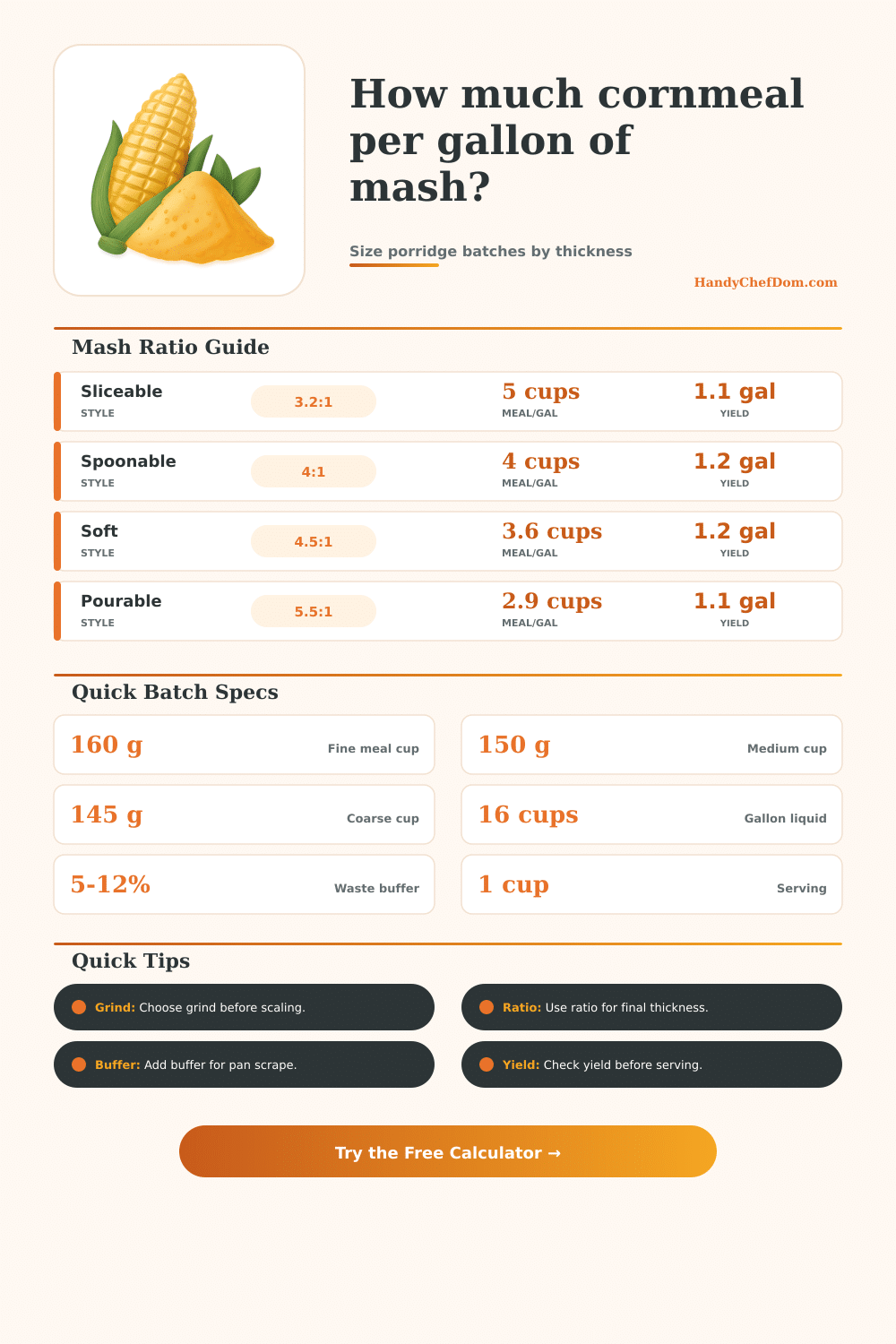
Scale dry cornmeal for non-alcoholic porridge mash, soft polenta, spoonable grits, or sliceable cornmeal mush by liquid gallons, grind, hydration, yield, servings, and buffer.
Enter the liquid batch size, choose a real cornmeal grind, then set the target hydration ratio. The calculator sizes dry meal per gallon and for the full batch, including yield and serving counts.
| Target texture | Liquid:meal ratio | Cornmeal per gallon | Best culinary use |
|---|---|---|---|
| Sliceable firm mush | 3.2 cups to 1 cup | 5.00 cups | Chilled slabs and firm tray portions |
| Firm spoon mash | 3.6 cups to 1 cup | 4.44 cups | Thick side bowls and scoopable pans |
| Spoonable porridge | 4.0 cups to 1 cup | 4.00 cups | Breakfast mush, soft polenta, grits-style bowls |
| Soft breakfast mash | 4.5 cups to 1 cup | 3.56 cups | Looser bowls that still mound on a spoon |
| Loose bowl porridge | 5.0 cups to 1 cup | 3.20 cups | Gentle breakfast porridge and buffet holding |
| Pourable thin mash | 5.5 cups to 1 cup | 2.91 cups | Thin ladled mash and light bowl service |
| Stew or casserole binder | 3.0 cups to 1 cup | 5.33 cups | Dense thickening mash for savory prep |
| Chilled jar porridge | 4.8 cups to 1 cup | 3.33 cups | Meal prep jars that tighten after resting |
| Cornmeal type | Approx grams per cup | Cups per pound | Texture note |
|---|---|---|---|
| Fine yellow cornmeal | 160 g | 2.84 cups | Smooth, tighter body at the same ratio |
| Medium yellow cornmeal | 150 g | 3.02 cups | Balanced body for everyday porridge mash |
| Coarse polenta meal | 145 g | 3.13 cups | Grainy bite and slightly larger cooked volume |
| Stone-ground white meal | 142 g | 3.20 cups | Rustic texture with bran flecks |
| Blue cornmeal | 148 g | 3.07 cups | Earthy flavor and medium body |
| Bolted cornmeal | 152 g | 2.99 cups | Refined meal with cleaner finish |
| Masa harina style | 114 g | 3.98 cups | Very fine flour-like body, lighter by cup |
| Hominy grits meal | 156 g | 2.91 cups | Coarser bite with hearty spoon texture |
| Liquid batch | 3.2:1 firm meal | 4.0:1 spoon meal | 5.0:1 loose meal |
|---|---|---|---|
| 0.5 gallon liquid | 2.50 cups | 2.00 cups | 1.60 cups |
| 1 gallon liquid | 5.00 cups | 4.00 cups | 3.20 cups |
| 2 gallons liquid | 10.00 cups | 8.00 cups | 6.40 cups |
| 3 gallons liquid | 15.00 cups | 12.00 cups | 9.60 cups |
| 5 gallons liquid | 25.00 cups | 20.00 cups | 16.00 cups |
| 8 gallons liquid | 40.00 cups | 32.00 cups | 25.60 cups |
| Serving plan | Portion size | Yield target | Batch note |
|---|---|---|---|
| Small side bowl | 0.75 cup | 10 servings per half gallon | Good for plated sides |
| Standard bowl | 1.00 cup | 16 servings per gallon liquid plus meal | Most common porridge count |
| Hearty bowl | 1.25 cups | 13 servings per gallon liquid plus meal | Breakfast or entree-style service |
| Tray scoop | 0.50 cup | 24 small scoops per gallon liquid plus meal | Useful for tasting lines |
| Meal prep jar | 0.85 cup | 18 jars per gallon liquid plus meal | Allow extra hold thickening |
| Buffet ladle | 1.10 cups | 14 ladles per gallon liquid plus meal | Add service buffer |
Comfort food meets practical kitchen math in the form of cornmeal mash. Whether it’s a loose bowlful to be ladled or a slab to slice are up to you; mostly, it depends based off your choice of dry meal and its reaction with hot liquid like water, milk, or stock. Too little meal, and you’ve got soup; too much, concrete. Strike the proper balance, and you’ll have something that’s just right.
How much meal should goes in each gallon? That depends: What kind of meal did you use? Every grind are different; some absorb moisture faster, others weigh more per volume. A tablespoon of fine yellow meal is denser then the same amount of coarser polenta. The kind of liquid make a difference too. Water yields something lean and light. Milk will thickens it up and add richness. Stock delivers savory flavors, but doesn’t change the proportions much.
How to Make Cornmeal Mash
It is the sort of thing that can gets lost when you scale up the recipe just by looking at it, but it can be the difference between a dish with a spoon mark in it and one where the mash just slips right off. All other decisions flow from there. If you prefer your porridge thick enough to cut into slabs for grilling or frying later in the week, go firm. If you like it soupy for breakfast bowls, go loose. If you are going to thin it down with broth, go loose so that it has something substantial to mix with.
Then it’s easier to fill in the blanks: How big a portion am I making? How will this cook up, how much volume will a batch increase by? If you’d rather have a little wiggle room when you scrape the bowl and the porridge firms up as it cools, how much more meal do you need to measure out? If you’re feeding a crowd (or putting up a jar to eat during the week), yield and servings is important. There needs to be some wiggle room for loss so that that final scoop doesn’t turn stiffer than a board by dinnertime.
This also helps if you make a small test batch on the stove before scaling up to a bigger pan for buffet table. Once you know how much liquid you want to use, what grain you’ll be grinding, and what ratio you’d like, the calculator will do the rest for you. No more fumbling with cups and density calculations in your brain.
Most common errors stem from confusing all cornmeal, or failing to realize that the batch is constantly evolving once removed from the heat. The solution is to measure once and serve at once, or you’ll find an hour later that the rest has gone too thick. Or perhaps they begin with what seems like the correct ratio on paper, yet never taste-test their specific meal in their typical pot. Often, just a tiny tweak to the grain’s grind or the liquid base will solve things more quickly then having to rewrite the entire recipe.
So what’s the practical lesson? Determine texture before determining the numbers. Select the ratio that matches how you will consume the mash. Choose the grind from your pantry shelves. Measure out liquid in liters or gallons, and go from there. The rest slots easily into place, and you arrive at a repeatable batch rather then an inconsistent guessing game with each attempt to cook.
You should of used more meal if it feels too thin. It was actualy moddern furnitures that made me think of this setup. Most people find the texture is more comfortabley to eat when it is light. If the mash dissapears too fast, you need more grain. The person who makes this would of liked a larger bowl. I think they had a luxurius kitchen for making this. It was a very nice meal. One should of checked the amount first. That made it better than last time.