🍬 Cornstarch Powdered Sugar Calculator
Calculate cornstarch for powdered sugar from sugar amount, target anti-caking percentage, commercial or homemade style, sift loss, humidity, use case, and batch multiplier.
Enter the sugar amount you are blending or adjusting. The target anti-caking percentage is treated as a percentage of the final powdered sugar blend, after any current starch and batch scaling.
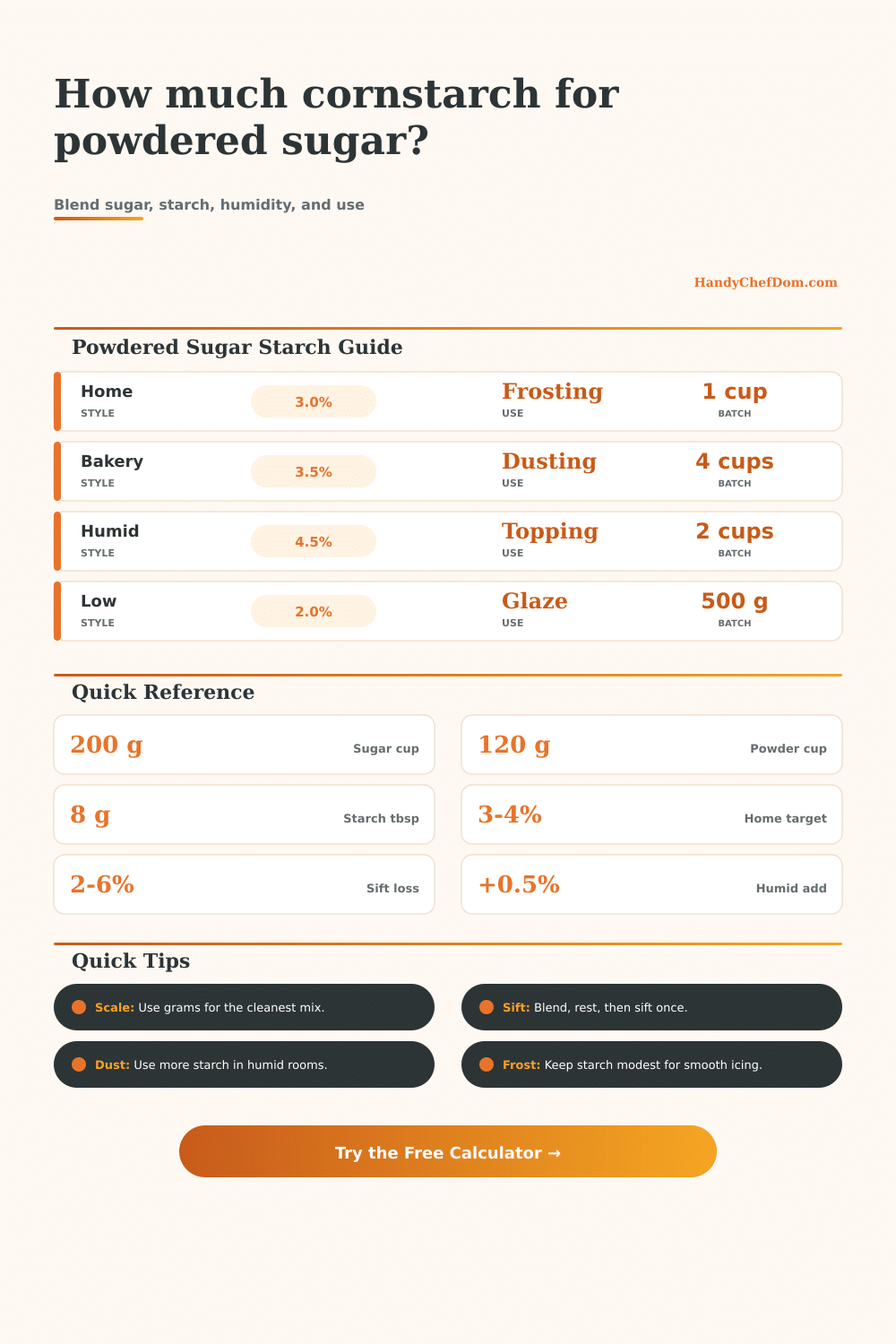
| Blend Style | Target Cornstarch | Best Use | Texture Result |
|---|---|---|---|
| Low-starch powdered sugar | 1.5% | Glaze, drizzle, light icing | Smoothest mouthfeel, shortest storage window |
| Frosting smooth blend | 2.0% | Buttercream, whipped cream, cream cheese frosting | Less chalky, still helps clumps break up |
| Homemade classic blend | 3.0% | General home baking and sweet toppings | Balanced anti-caking and sweetness |
| Commercial-style blend | 3.5% | Stored pantry powdered sugar | Closer to packaged confectioners sugar |
| Dusting sugar blend | 4.0% | Donuts, bars, pastries, and stencil work | Looser sprinkle and better flow |
| Humid storage blend | 4.5% | Topping jars and warm kitchens | Extra clump resistance for damp air |
| Use Case | Target Shift | Humidity Shift | Planning Note |
|---|---|---|---|
| Buttercream or frosting | -0.3 percentage points | Normal kitchen works well | Keep starch modest for smooth spreadable frosting. |
| Dusting donuts or pastries | +0.4 percentage points | Humid rooms benefit from more starch | Useful when sugar sits on a tray before serving. |
| Royal icing | +0.1 percentage points | Normal or dry room preferred | Small starch change keeps flow predictable. |
| Glaze or drizzle | -0.5 percentage points | Avoid extra starch when gloss matters | Lower starch dissolves with less gritty feel. |
| Macarons and meringue | -0.2 percentage points | Dry room preferred | Too much starch can change delicate texture. |
| Storage jar refill | +0.3 percentage points | Humid storage needs the highest target | Prioritizes free-flowing sugar after resting. |
| Ingredient Or Cup Style | 1 Tablespoon | 1/4 Cup | 1 Cup Kitchen Weight |
|---|---|---|---|
| Granulated white sugar | 12.5 g | 50 g | 200 g |
| Caster or superfine sugar | 10 g | 47.5 g | 190 g |
| Powdered sugar, sifted | 7.2 g | 28.75 g | 115 g |
| Powdered sugar, spooned | 7.5 g | 30 g | 120 g |
| Powdered sugar, packed | 8.1 g | 32.5 g | 130 g |
| Cornstarch, level spoon | 8 g | 32 g | 128 g |
| Starting Sugar | Target Cornstarch | Cornstarch To Add | Finished Blend Before Sift |
|---|---|---|---|
| 1 cup granulated, 200 g | 2.0% | 4.1 g | 204.1 g |
| 1 cup granulated, 200 g | 3.0% | 6.2 g | 206.2 g |
| 1 cup granulated, 200 g | 4.0% | 8.3 g | 208.3 g |
| 2 cups granulated, 400 g | 3.0% | 12.4 g | 412.4 g |
| 4 cups granulated, 800 g | 3.5% | 29.0 g | 829.0 g |
| 500 g granulated sugar | 4.0% | 20.8 g | 520.8 g |
If you grind your own granulated sugar in a blender, that doesn’t make it pro confectioners’ sugar. Sure, it appears powdery, but within hours it’s all packed together into hard little rocks that ruin any delicate buttercream or leave gritty chunks throughout cake batter. More often than not, what’s lacking isn’t so much the sugar as the exact right proportion of cornstarch that makes sure those particles stays separate. It is a matter of simple mechanics and yet it feels like magic when done right.
Why? It’s simple chemistry, but it’s also super easy to forget. Even when powdered down into dust, the surface area of the sugar still attracts water vapor from the air. This allow sugar particles to bind together, unless there is an anti-caking agent. Those sugars then become tight clusters that you can barely separate. To prevent them, cornstarch coats individual tiny grains of sugar with its own coating so that the grains don’t get sticky.
Why You Need Cornstarch for Powdered Sugar
But how much? That’s important. Not enough, and it’ll get all gummy. Too much, and you’re left with a sweet treat where the starchy taste overpower any sugary goodness. So, no need for conversion or coefficient guesses, the calculator does that for you after you input weight of your sugar and desired percent amount.
Blend ratios vary depending on what you are using them for. For instance, when creating a smooth American style buttercream, you’ll want less starch, something in the two-percent range. This will ensure icing remains silky without any flour-like taste to it.
If you’re going with higher ratios, closer to four or four-and-a-half, you’re likely storing the powdered sugar in a moist environment (like your kitchen) or using it as a topping for baked goods (such as donuts hot off the fryer). In these cases, the added starch soak up moisture and maintains the lightness of the coating. This helps the mixture stay loose for long periods of time.
It’s all spelled out simply in chart above, illustrating which types require more or less anti-caking. Other factors matter more then any recipe tells you, such as humidity. When the air is dry, the sugar will remain free-flowing with minimal starch. If you have high humidity, then the powder will gain weight from moisture in the air and become compacted. On a rainy week, I’ve been known to change my target percent up half a point, just due to weather. That’s where this tool’s ability to enter environmental humidity conditions comes into play. It isn’t just about the ingredients but also about environment where those ingredients will live.
There’s also the matter of sifting loss. A certain amount of your dry ingredient will get stuck in your sieve or in the bottom of your blender when you mix your sugar and cornstarch. Not taking this into account could of resulted in having just a bit less than desired amount of the final product (especially if you’re making a big batch). Taking into account a small percentage of loss makes sure there’s enough sugar to go around. It is a small thing that keeps panic away halfway through baking.
Weight is a much better measurement than volume. Have you ever tried making a recipe that calls for a cup of powdered sugar? The amount can vary depending on whether you sifted the powder for a loose scoop or packed it down. Grams are consistent. Whether you use a light touch with the spoon or go heavy-handed, one gram of something is going to be exactly one gram of something. It’s convenient that the tool gives you an estimate in tablespoons as well, but if you have a scale, you’ll get a lot more repeatable results.
That’s where reliable, shelf-stable homemade sugar comes in. A handful of grams of starch makes all the difference between a silky bag and a clumpy jar. Moisture, surface area, and anti-caking agents interacts with each other, and knowing how they do allows you to adjust the texture of your sugar instead of leaving it to chance.
Next time you grind up some sugar: Know that the starch isn’t just an additive, it’s also a structural component. Get that right, and your baked goods won’t only taste professional but will have a professional texture. A little shift in the blender: That’s what gives you perfect texture.