Zigzag Diet Calculator
Cycle calories across high, medium, and low days with realistic food choices, stable protein, and practical weekly averages for steady progress.
| Food Type | Raw to Cooked | Metric | Imperial |
|---|---|---|---|
| Chicken breast | 100 g to 75 g | 150 g cooked | 5.3 oz cooked |
| Rice | 1 cup to 3 cups | 60 g dry | 2.1 oz dry |
| Potato | 100 g to 88 g | 240 g cooked | 8.5 oz cooked |
| Oats | 1 cup to 2.5 cups | 40 g dry | 1.4 oz dry |
| Group Size | Protein Needed | Carb Needed | Veg Needed |
|---|---|---|---|
| Dinner for 4 | 700 g | 900 g | 1200 g |
| Family of 6 | 1050 g | 1350 g | 1700 g |
| Party of 12 | 2100 g | 2800 g | 3400 g |
| Meal prep 5 days | 3500 g | 4200 g | 5000 g |
The zigzag approach to dieting is based off the idea that your calorie intake should rise and fall with your training load and recovery needs. Many diet plan require an individual to eat the same number of calories each day. However, it is difficult for many individuals to eat the same number of calories each day due to life’s demands.
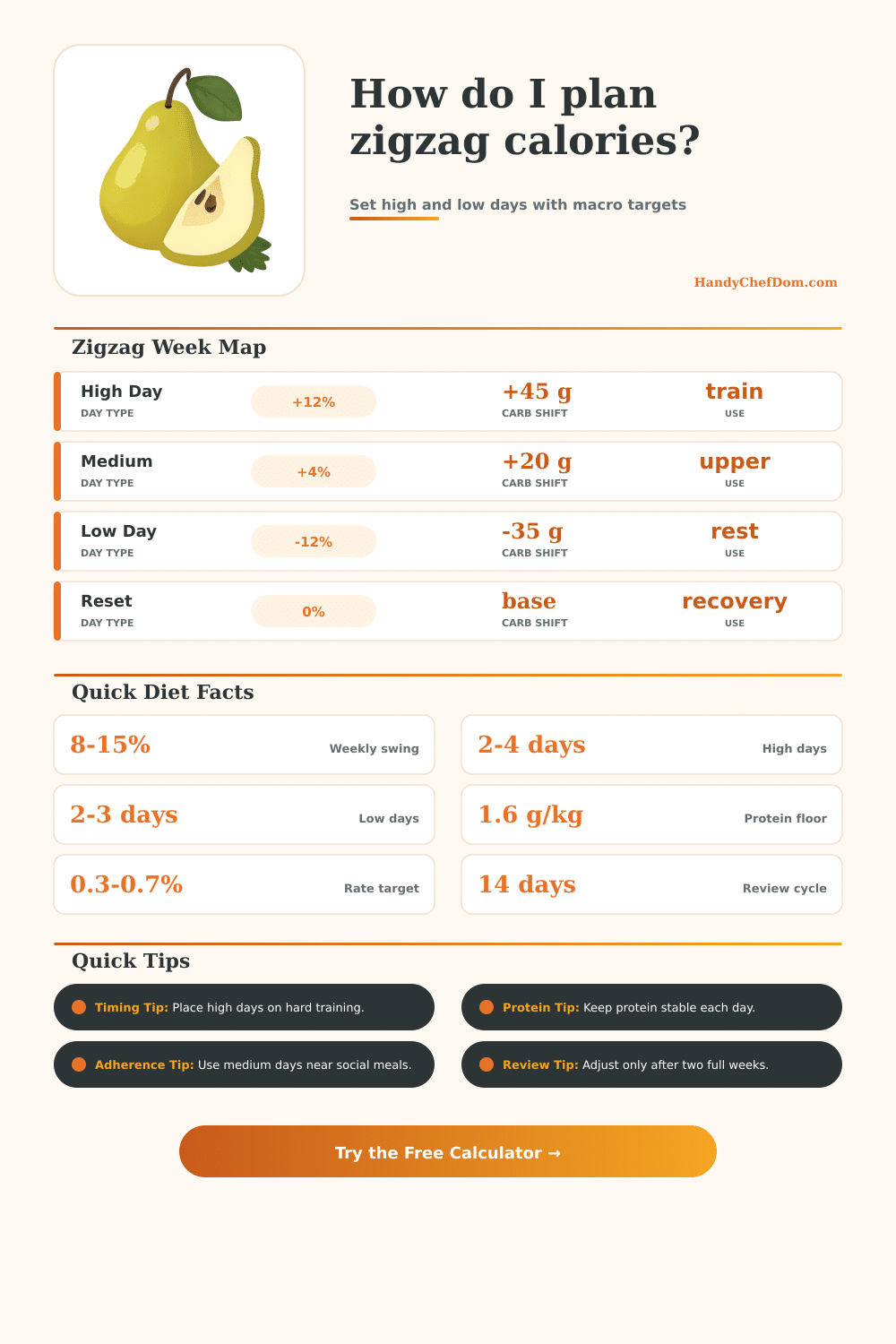
The zigzag diet allow individuals to eat more calories on training days and fewer on days when the individual rests. By doing so, the individual can maintain energy levels throughout the week, and the calorie deficit on the days when the individual is resting will aid in fat loss while avoiding the burnout that often follows rigid diets. The zigzag diet will work for an individual based on the idea that the body responds to the average number of calories consumed over several days rather than the number consumed on a single day.
Zigzag Diet: Eat More on Training Days, Less on Rest Days
On training days, an individual will consume more calories to fuel their workouts. On days when the individual is resting, the body utilizes stored energy for fuel, yet consumes enough protein to protect their muscle. These elements of the diet will result in a weekly total that correlates to fat loss while supporting those diets required workouts.
An individual must choose a base number of calories for their diet. The base number should account for an individual’s body size and their activity level and their desired goal for their body composition. The base number can be established for a fat loss goal, a slow recomposition goal, or a maintenance goal for strength improvements.
Furthermore, the base number will allow an individual to determine how many days each week they train so that their diet can accommodate these workouts. An individual should consume the same amount of protein each day as the body requires protein to repair muscle even on days off from workouts. The amount of carbohydrates consumed will change as an individual puts more fuel into their workouts on certain days rather than others.
Furthermore, the fats consumed will adjust in the opposite direction of the carbohydrate intake so that the total number of calories consumed is accurate to the target number calculated by the diet. An individual can use a calculator to determine the macronutrients they should consume daily by entering their body weight and the number of days per week that they train. The calculator will allow an individual to avoid guessing at their macronutrient requirements.
An individual can vary the types of food they consume in their diet to accommodate there lifestyle. Days that contain more carbohydrates are effective for individuals who feel low on energy and who consume many foods high in carbohydrates. Days that contain more fats are effective for those who prefer food high in fat like olive oil, avocado, nut butters.
Other dietary options include plant-forward diets or Mediterranean diets that use different food sources for the same macronutrients. None of these diets are better than another so that an individual can choose the diet that they are most comfortable cooking. An individual’s step count outside of the gym will affect the calories they need to consume daily.
Ten thousand steps will burn more calories than six thousand steps so that an individual’s calorie target should adjust to reflect their step count. An individual with a desk job will require more calories than an individual with an active job. The serving-size grid and tables for yield will allow an individual to determine the portion sizes of the food an individual should consume daily.
By knowing the portion size of protein, carbohydrates and fat, the individual will avoid mental math calculations. By avoiding mental math, an individual will not eat too little on high-calorie days, nor too much on low-calorie days. Furthermore, an individual can prepare meals for a family or for the entire weekly diet so that they dont have to calculate the individual ingredients.
Adherence to the diet can be improved by accounting for an individual’s lifestyle with the diet. For example, an individual can include a high-hunger adjustment to increase the calories consumed on days with low-calorie targets so that the individual does not feel deprived of the food they need. A conservative cut can be used to minimize the calorie swings if an individual has been dieting for many months.
Finally, an individual can use the diet break setting for a period of time to increase the calories consumed so that an individual’s metabolism does not stall their fat loss progress. These settings are not a magic solution to improving diet adherence but do account for the different life stages an individual may be in. The most common error for individuals with the zigzag diet is changing the diet too often.
The weekly averages of calories consumed become meaningful only after using the diet for at least two week. An individual should not adjust the diet or add more exercise until they have used the diet for two weeks. Small changes in the calories consumed of eighty to one hundred calories may be all that is needed for an individual to adjust their diet.
Another common error is allowing the protein consumed to drop on low-calorie days. The protein consumed is the most satiating macronutrient of the three and the one most associated with the retention of muscle. Thus, an individual must consume protein daily so that their low-calorie days do not become days in which they consume too little fuel for their body.
The calculator for the diet will display the protein lower limit so that an individual can adjust the carbohydrates and fat according to their performance of workouts. An individual can easily incorporate meals with friends or plans for the weekends into the zigzag diet. By planning for a higher-calorie day for a Saturday or Sunday, an individual can enjoy meals with others without disrupting their diet.
Furthermore, provided that an individual incorporates their training days into the calculations for the calories they can consume, a higher-calorie day on the weekend will not ruin the effectiveness of their diet. Medium-calorie days can be used to fill in the gaps between training days and other events in the individual’s life. An individual will gain an awareness of their body with the zigzag diet.
They will be able to recognize which days they need to consume more calories and which days they can allow for a deficit in the calories they consume. This knowledge will be beneficial when the diet moves into the maintenance phase or when they adjust their workouts. Furthermore, the advantage of the zigzag diet is that it allows an individual to even their physical efforts with their dietary efforts.