Matcha Caffeine Calculator
Estimate caffeine from matcha grade, powder grams, scoop size, preparation style, servings, time window, and body weight
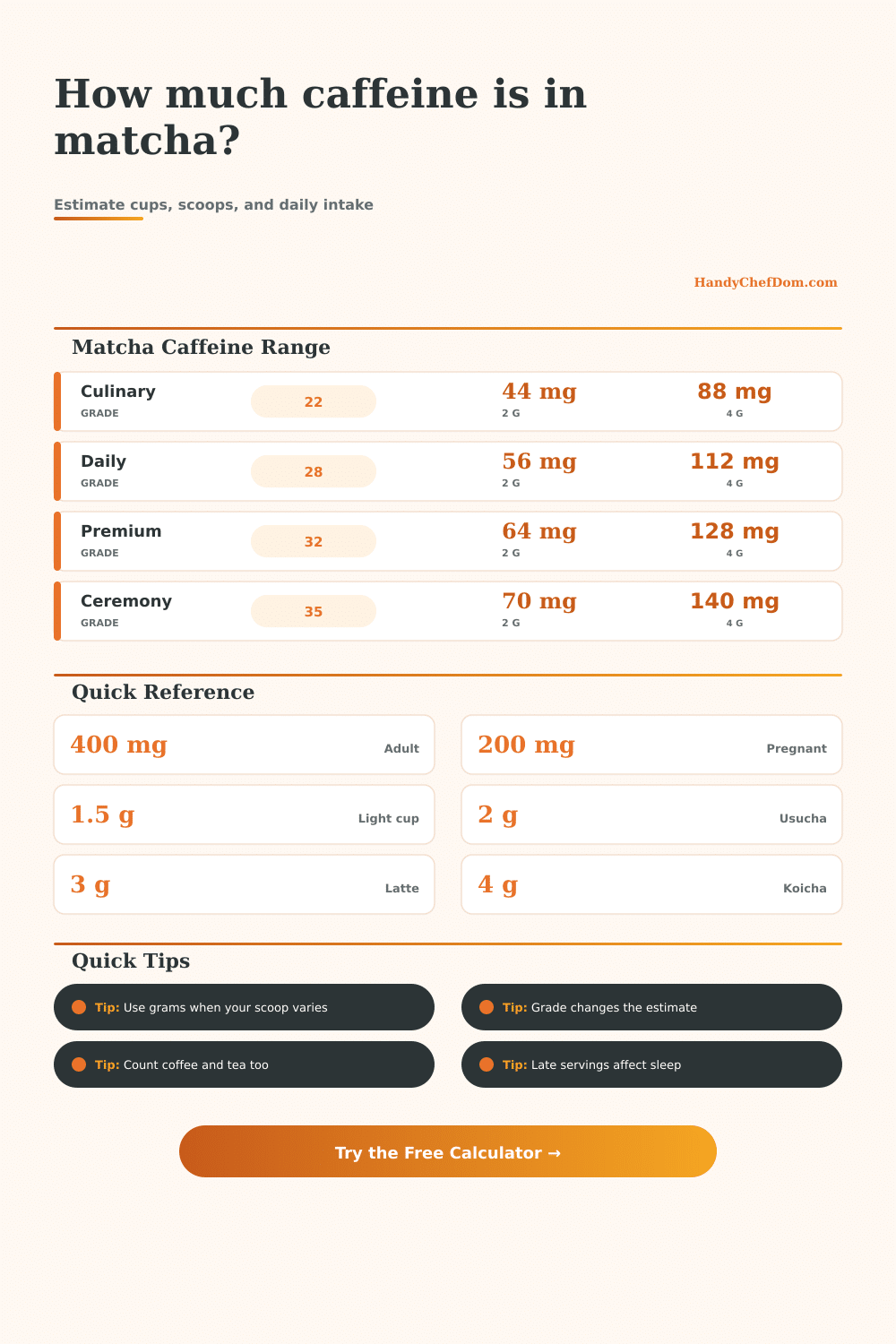
| Grade | Model mg/g | 2 g Cup | 4 g Cup |
|---|---|---|---|
| Culinary | 22 | 44 mg | 88 mg |
| Daily Drinking | 28 | 56 mg | 112 mg |
| Premium | 32 | 64 mg | 128 mg |
| Ceremonial | 35 | 70 mg | 140 mg |
| First Harvest | 38 | 76 mg | 152 mg |
| High Range | 44.4 | 89 mg | 178 mg |
| Style | Typical Powder | Factor | Serving Note |
|---|---|---|---|
| Usucha | 1.5-2.5 g | 1.00x | Thin tea |
| Latte | 2-4 g | 0.98x | Milk drink |
| Iced | 2-4 g | 1.00x | Cold drink |
| Koicha | 3.5-5 g | 1.02x | Thick tea |
| Smoothie | 1-3 g | 0.95x | Some residue |
| Mixed Food | 1-4 g | 0.92x | Recipe loss |
| Reference | Daily Guide | Matcha Example | Use Case |
|---|---|---|---|
| FDA Adult | 400 mg | 5-7 cups | Most adults |
| Mayo Adult | 400 mg | 5-7 cups | General guide |
| Pregnancy | 200 mg | 2-3 cups | Ask clinician |
| Sensitive | 200 mg | 2-3 cups | Lower target |
| Drink | Serving | Caffeine | Matcha Equivalent |
|---|---|---|---|
| Matcha Thin Tea | 2 g powder | 56-70 mg | 1 cup |
| Brewed Coffee | 8 fl oz | 96 mg | 1.4-1.7 cups |
| Black Tea | 8 fl oz | 47 mg | 0.7-0.8 cup |
| Green Tea | 8 fl oz | 28 mg | 0.4-0.5 cup |
Matcha is like that: you’re used to thinking all scoops is created equal, but they’re not, especially when it comes to caffeine factor. Knowing how much caffeine is actualy in your mug will save you from those post-matcha jitters mid-afternoon.
That variance depend on the quality (grade) of powder itself. Higher-grade powders contains more caffeine then lower-grade ones. This means ceremonial grade will be higher because it is made from younger, shade-grown leaves. In contrast, culinary grade use older, later-harvested leaves which typicaly have less caffeine. If you go from coffee to matcha without accounting for these variances, you may find yourself maxing out your limits earlier than expected. Top-quality tea isn’t the same as a budget bag of powder and knowing that distinction is important.
What Changes Your Matcha Caffeine Level?
There’s another variable: Your own body weight. If you weigh one-hundred-twenty-pounds, a two-gram serving are going to feel intense; if you weigh two-hundred, it’ll be a mild serving. Because your body weight is accounted for, it normalizes the dose, that is, it converts a raw milligram count into a measure of what it will actualy feel like in your body. You can use that to determine whether your planned serving match your individual tolerance levels. This page’s calculator does that math for you.
The other factor is preparation style. Just because something say “two grams” doesn’t mean you got two grams. Different scoops has different sizes, and some can absorbs close to twice as much as others depending on how tightly you pack down the powder. By weighing the powder, you eliminate any guessing game.
When you whisk matcha into a thin tea, you’re absorbing all of the powder. But if you add it to yogurt or mix it up in a smoothie, some of it may get left behind. It might also be absorbed different than in your stomach. Therefore, the effective dose will change slightly. This is helpful to know if you shift from hot to cold preparations and want to know what to expect.
The last variable most people don’t consider is timing. Caffeine has a half-life of about five hours. This means if you consume caffeine at 4PM, half of that amount will still be in your bloodstream at 9PM. It matters when you drink your matcha if you spread out multiple cup during the day versus drinking them all before lunchtime. This way you see how much caffeine enters your body over course of the afternoon and into the evening.
But don’t stop there. When tallying consumption, include other parts of diet as well. Some sodas, dark chocolate, coffee, black tea… They’re all adding to your overall amount. If you concentrate solely on matcha, you would of accidentally take in too much. Four-hundred-milligrams-per-day is usually fine for most people, though sensitive individuals or those who is pregnant might find two hundred much more comfortabley. Use these guidelines to keep track and avoid slowly getting too much stimulation. This happens when you don’t take all your sources into account, such as by simply adding another cup without counting previous ones.
Matcha can be used like a precise tool for controlling your energy. Instead of leaving it up to chance, you can choose the strength and timing of lift. By weighing out the powder and keeping track off the grade, what was once a random guess becomes a reliable routine. Once you’re sure of what’s going into your body, you no longer wonder why some days leave you buzzing and others leaves you tired. Know the input and you’ll learn to trust the output.