🧀 Cream Cheese Protein Calculator
Convert tablespoons, ounces, grams, tubs, blocks, bagel schmears, frosting batches, and dip servings into protein, calories, fat, and portion totals.
Pick the label style first because whipped cream cheese fills a tablespoon with less weight than block cream cheese. Nutrition uses typical label data per 100 grams.
| Cream cheese label | Calories / 100 g | Protein / 100 g | Fat / 100 g |
|---|---|---|---|
| Regular block | 342 | 6.2 g | 34.0 g |
| Regular whipped | 320 | 6.0 g | 31.0 g |
| Spreadable tub | 330 | 6.0 g | 32.0 g |
| Light block | 230 | 7.5 g | 16.0 g |
| Neufchatel | 253 | 9.0 g | 23.0 g |
| Fat free | 120 | 11.0 g | 0.8 g |
| Plant-based style | 285 | 3.0 g | 25.0 g |
| Flavored whipped | 335 | 5.2 g | 30.0 g |
| Measure | Block weight | Whipped weight | Best use |
|---|---|---|---|
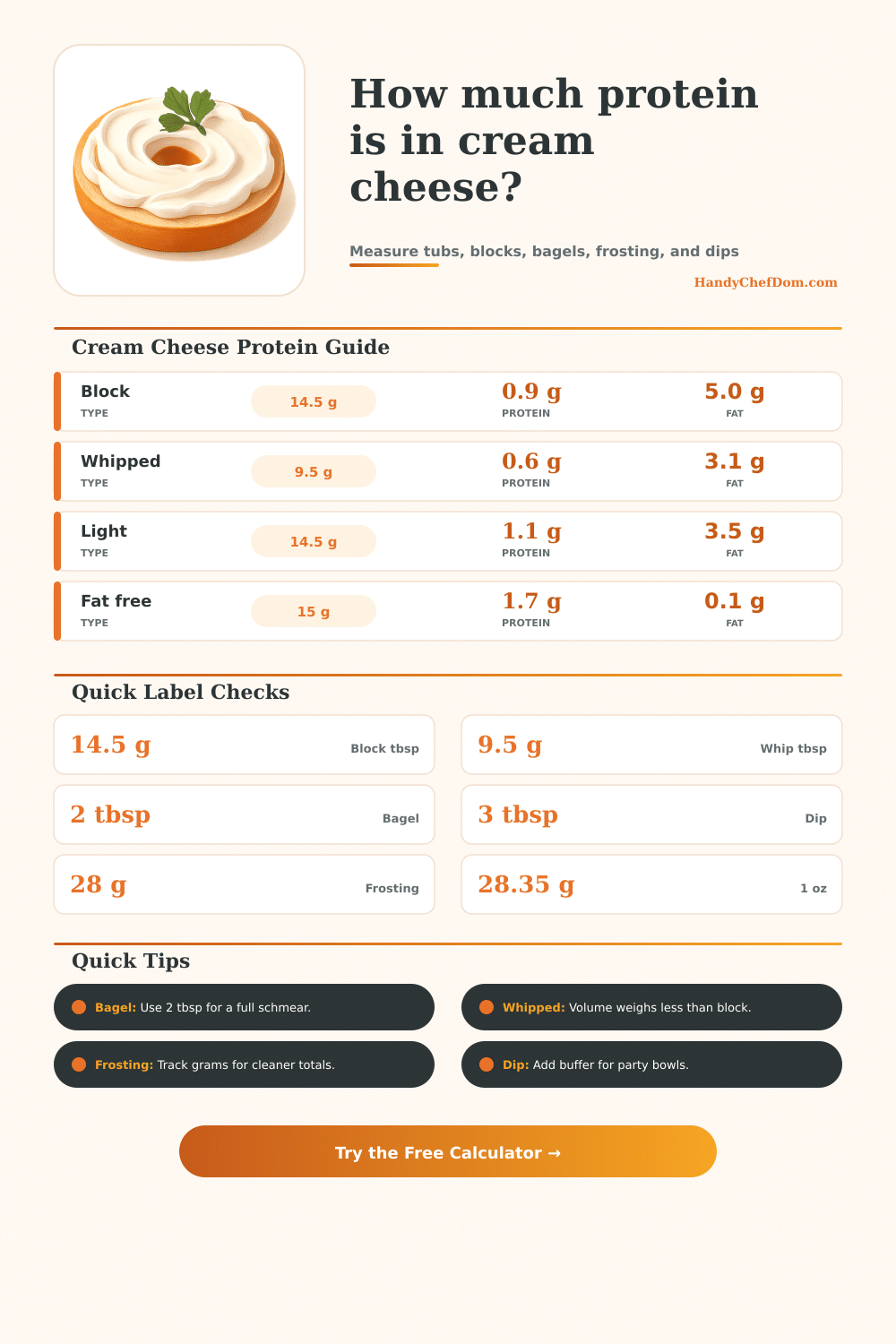
| 1 tablespoon | 14.5 g | 9.5 g | Small spread |
| 2 tablespoons | 29 g | 19 g | Bagel schmear |
| 1 ounce | 28.35 g | 28.35 g | Label math |
| 1/4 cup | 58 g | 38 g | Dip base |
| 1/2 cup | 116 g | 76 g | Frosting bowl |
| 8 ounce block | 227 g | 227 g | Full package |
| Portion use | Typical amount | Block grams | Portion note |
|---|---|---|---|
| Thin bagel spread | 1 tbsp | 14.5 g | Light schmear |
| Bagel schmear | 2 tbsp | 29 g | Full bagel |
| Frosting serving | 28 g | 28 g | Cupcake swirl |
| Dip scoop | 3 tbsp | 43.5 g | Party dip |
| Cracker bite | 1/2 tbsp | 7.25 g | Snack board |
| Mini dessert cup | 35 g | 35 g | Small cup |
| Cheesecake bite | 45 g | 45 g | Dessert bite |
| Scenario | Label choice | Amount | Protein estimate |
|---|---|---|---|
| One bagel | Block | 2 tbsp | 1.8 g |
| Six bagels | Block | 12 tbsp | 10.8 g |
| Dip for 10 | Light | 30 tbsp | 32.6 g |
| 12 cupcakes | Block | 336 g | 20.8 g |
| Toast prep 5 | Neufchatel | 10 tbsp | 13.1 g |
| Snack bites 20 | Whipped | 10 tbsp | 5.7 g |
Until you read back of package. Turns out cream cheese isnt just some neutral filler, it’s a lot of fat with little else, at least by calorie. In fact, you buy it primarily for its ability to carry flavor, whether as a bagel topper or frosting ingredient.
Sure, we care about the taste and texture in normal life. But when you’re counting calories, that rich texture masks a tradeoff: high fat density versus low protein return. One scoop look like any other, right? Wrong, almost every time.
Cream Cheese Choices and Calories
To help you out here’s a calculator (above) which does all the math for you when you plug in how much of something you’re eating. You won’t have to wonder if it makes a difference what kind of label you buy. Because it does: Aerated cheeses is lighter but have air pockets that boost their volume while maintaining weight. That means you may be able to fit three tablespoons of whipped cheese into the space occupied by one solid tablespoon of block cheese. The illusion of extra volume will alter its protein content.
One tablespoon of regular old block cream cheese will weigh roughly fourteen and a half grams. A tablespoon of whipped cream cheese? It weighs more like nine and a half grams. So you’ll end up consuming fewer calories and less protein per scoop then your eyes perceive. But what’s up with that? How do you get accurate information if you don’t know what kind of cheese you’re looking at? The answer lies in the labels.
Cream cheese isn’t created equal. Some are regular block cheese, which packs most fat and bulk, delivering little protein per serving. Others are light, which has less fat (sometimes more moisture) without changing the protein amount much (depending on the stabilizer). Others are fat free and, as such, have greatest proportion of protein per ounce because they’ve removed nearly all the lipids. But this is where you make a tradeoff: you trade mouthfeel for numbers. When heated, it get grainy. So although the numbers look good, you’re limited in how you can bake with it. It’s a matter of losing texture for nutritional info.
When making frosting or dips, use weight instead of volume. Measuring by tablespoons is not a good technique for ingredients whose consistency will change upon mixing. As demonstrated in table on the page, the number of spoons varies depending on the stiffness, but the number of grams remains consistent throughout. This guarantees that your cheesecake won’t be soggier because the cheese brand changed, or crack at the top because the fat-to-water-to-protein balance was off. Weight eliminates all variables.
We all underestimate the amount we smear onto our bagel breakfasts. When I put two tablespoons on, it feels so slight, but it’s almost half an ounce (thirty grams). Two tablespoons account for almost two whole grams of protein. If that one serves as part of your daily intake, no big deal. But if you’re on a weekly streak of mornings, those little bits add up fast. Add in feeding others, and it can really add up.
A dip bowl at a party looks innocent enough. You might think surely everyone is just having a nibble. Ten people who take three spoons apiece will have gobbled down nearly forty-three grams worth, which equals a lot of calories and fat for everybody. Knowing how many spoonfuls you should of aim for beforehand lets you see what kind of impact all of this will make long before the last drop of cheese dissapears.
Things get more complicated when you add flavor-enhancing ingredients. Herbs and a bit of fruit preserve will change things. Without counting them in, standard labels don’t consider these variables. If you’re making sweet frosting, all that added sugar will dilute the protein density of your base ingredient, adding calories without adding protein. So even though dairy does have some protein, this gets drowned out by all that sugar.
Mix-ins can be accounted for on the calculator, so you can adjust input and see how this changes the resulting numbers. In most cases, it’s never simply “no cheese at all.” You just want to know what else you might be putting on it. That’s where it gets interesting: Match your decision to what you’re trying to achieve.
If you like a richer, spreadable consistency, block cheese is better (and don’t complain about the fat!). Want a big ‘ole tub of frosting, but you can only afford so many calories? Go whipped/light, as that’ll give you the most bang for your buck, in terms of getting more volume out of fewer grams of protein. There’s no such thing as a “best” cream cheese. Every variation gives up one trait to get a different benefit. Know the trade-off that will serve your plate best today.