Cornstarch to Thicken Pot Roast Calculator
Estimate the right cornstarch slurry for pot roast gravy using braising liquid, roast weight, vegetable load, reduction, servings, and your target texture.
🥘Pot Roast Presets
⚖Pot Roast Gravy Inputs
Recommended Pot Roast Slurry
🥣Pot Roast Gravy Texture Grid
📊Slurry Ratio Reference
| Reduced gravy liquid | Light coating | Classic gravy | Hearty gravy | Equal water for slurry |
|---|---|---|---|---|
| 2 cups / 475 ml | 1 tbsp / 8 g | 1 1/2 tbsp / 12 g | 2 tbsp / 16 g | Match cornstarch tablespoons |
| 3 cups / 710 ml | 1 1/3 tbsp / 11 g | 2 1/4 tbsp / 18 g | 3 tbsp / 24 g | Use cool water, not hot |
| 4 cups / 950 ml | 1 3/4 tbsp / 14 g | 3 tbsp / 24 g | 4 tbsp / 32 g | Whisk until no dry pockets |
| 6 cups / 1.4 L | 2 3/4 tbsp / 22 g | 4 1/2 tbsp / 36 g | 6 tbsp / 48 g | Add in two passes |
🥕Vegetable and Reduction Adjustments
| Pot condition | Effect on gravy | Adjustment | Calculator use |
|---|---|---|---|
| Potatoes and root vegetables | Absorb liquid and add body | Usually 5% to 12% less starch | Select high vegetable load |
| Strained onion and carrot broth | Smoother but thinner finish | Usually 6% more starch | Select strained smooth |
| Long open simmer | Concentrates gelatin and salt | Reduce starch after volume drops | Enter reduction percent |
| Slow cooker liquid | Often less evaporated | May need a full classic dose | Select slow cooker finish |
🍽Common Pot Roast Gravy Batches
| Roast meal | Typical liquid | Classic cornstarch | Slurry water | Servings |
|---|---|---|---|---|
| Small dinner roast | 2 to 3 cups | 1 1/2 to 2 1/4 tbsp | Same tablespoons as starch | 3 to 4 |
| Family chuck roast | 3 1/2 to 5 cups | 2 2/3 to 3 3/4 tbsp | Same tablespoons as starch | 5 to 8 |
| Holiday brisket roast | 6 to 8 cups | 4 1/2 to 6 tbsp | Same tablespoons as starch | 10 to 14 |
| Crowd roaster pan | 9 to 12 cups | 6 3/4 to 9 tbsp | Add in several small passes | 18 to 28 |
🧪Cornstarch Conversion Table
| Cornstarch measure | Approx grams | Water for slurry | Best use |
|---|---|---|---|
| 1 tablespoon | 8 grams | 1 tablespoon / 15 ml | Lightly thickens about 1 to 2 cups |
| 2 tablespoons | 16 grams | 2 tablespoons / 30 ml | Classic small pot roast gravy |
| 4 tablespoons | 32 grams | 1/4 cup / 60 ml | Family-size gravy batch |
| 6 tablespoons | 48 grams | 6 tablespoons / 90 ml | Large roaster or holiday batch |
🔍Thickener Comparison Grid
Cornstarch
Glossy, fast thickening, gluten-free, and best added as a cool slurry near the end.
Flour Roux
Opaque and savory, but needs fat and longer cooking than a cornstarch slurry.
Reduction
Deepens flavor while lowering volume, so the calculator reduces the starch need.
Vegetable Puree
Adds body from softened onions, carrots, or potatoes and can lower starch slightly.
The last part of most pot roasts. Thickening the gravy, can make or break it all. It’s all that good braising liquid in the pan and only a few spoonfuls of some sort of starchy thickeners can turn it into a proper spoon-coating sauce instead of thin jus. Flour makes a roux that requires time on the stove, while cornstarch cooks fast and delivers shiny gloss; trouble is, it’s not hard to overdo it when you’re going by feel alone.
The trick is that the cooked liquid won’t be the same as when it went in. Fat make the finished sauce thicker or thinner, some of it got cooked away, vegetables absorbed a bit. A little math will remind you not to add too little or too much so you can tweak things at the table. Enter your desired thickness, number of diners, volume of liquid after reduction and roast size, and this gravy calculator do the rest for you.
How to Make Perfect Gravy for Pot Roast
One surprise input is the vegetable load. If your braising pot is loaded up with root vegetables or potatoes, they’ve sucked some liquid out of the broth; in this case you’ll want to add just a little less starch (less potato) then what the recipe calls for by weight. Likewise, if you’ve strained all the vegetables away leaving behind a broth that’s thinner but perhaps smoother, then the same amount of liquid as called-for will take a bit more cornstarch to get it up to the same thickness. But the calculator takes care of both of these situations so you don’t have to do math in your head.
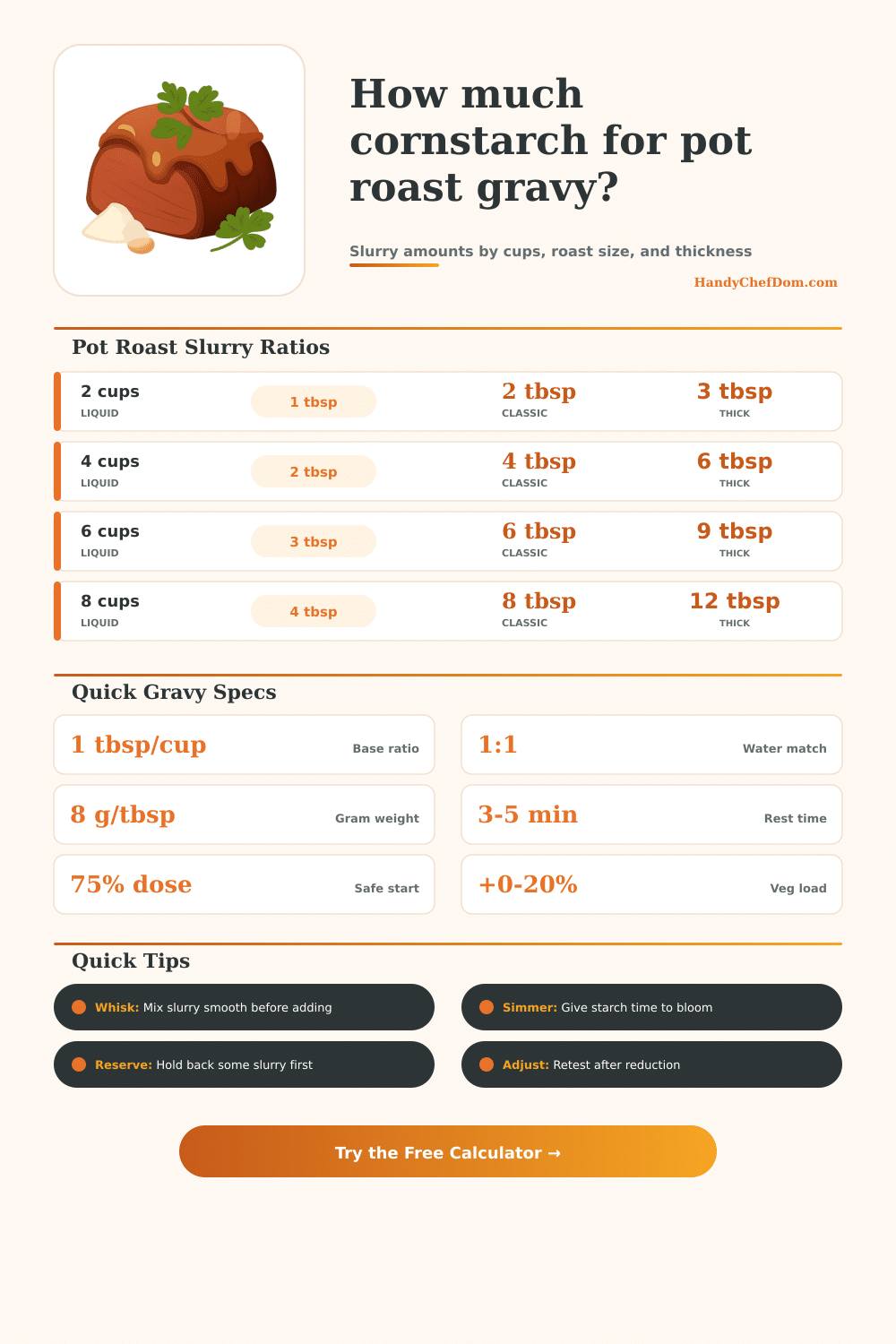
Another factor related to fat: Since there is fewer fat particles to get in the way, the broth will thicken better if it are skimmed thoroughly. Compensate a little if you left behind some fat to add flavor. The same applies to type of finish. A Dutch-oven reduction that lost 20 percent of its volume will be more concentrated than a slow-cooker version that never quite achieved a good simmer. All of this change how much liquid you are trying to thicken. The ratios shows that this scales up and down easily. Here is the reference table from the page which will help you do a quick check before making a full batch of slurry.
After that, there isn’t much to it. Just combine an equal amount of cool water with your cornstarch in a bowl and whisk really well until completely smooth. Pour most of it into the simmering pot while whisking continuously. Let it sit for two or three minutes to bloom. At that point, decide if you need any more of the remaining starchy mixture.
It’s only that brief pause that transforms a murky mess into a shiny sauce: This is where many cooks go wrong by going too far. Don’t think that adding cornstarch should of make your gravy instantly thick; it takes some time and heat to get fully thickened, and even once off the heat the gravy will thicken up a bit more. Making a conservative first pass and keeping a small amount of slurry back help you avoid going too far. Same thing if you’re making the gravy ahead. Be careful when reheating as it tends to become even thicker. Maybe aim for a bit looser than you’d like during the initial cooking, then tweak it when warming it up.
The real payoff comes at the table. The gravy needs to be thick enough that it sticks to meat and absorbs into the mashed potatoes without making either one gloopy. And it needs to be thick enough that you’re not dumping watery broth onto your plate, creating a moat for the food to swim in. After a few times with the calculator, you begin to get an idea of how much slurry corresponds to your standard roast size and vegetable mix, but if tonights batch is bigger or smaller than normal, the calculator eliminates the guesswork. This kind of consistency makes a good pot roast into a dependable one.