🍞 Flour Cups to Grams Converter
Convert flour cups to grams with flour type, US or metric cup volume, spooning method, sifted status, recipe scaling, batch count, and rounding precision.
Start with the cups written in the recipe. The calculator converts the cup volume into grams, then adjusts for flour density, how the cup was filled, whether it was sifted before measuring, and the final recipe multiplier.
| Flour type | Base grams per US cup | Typical baking use | Conversion note |
|---|---|---|---|
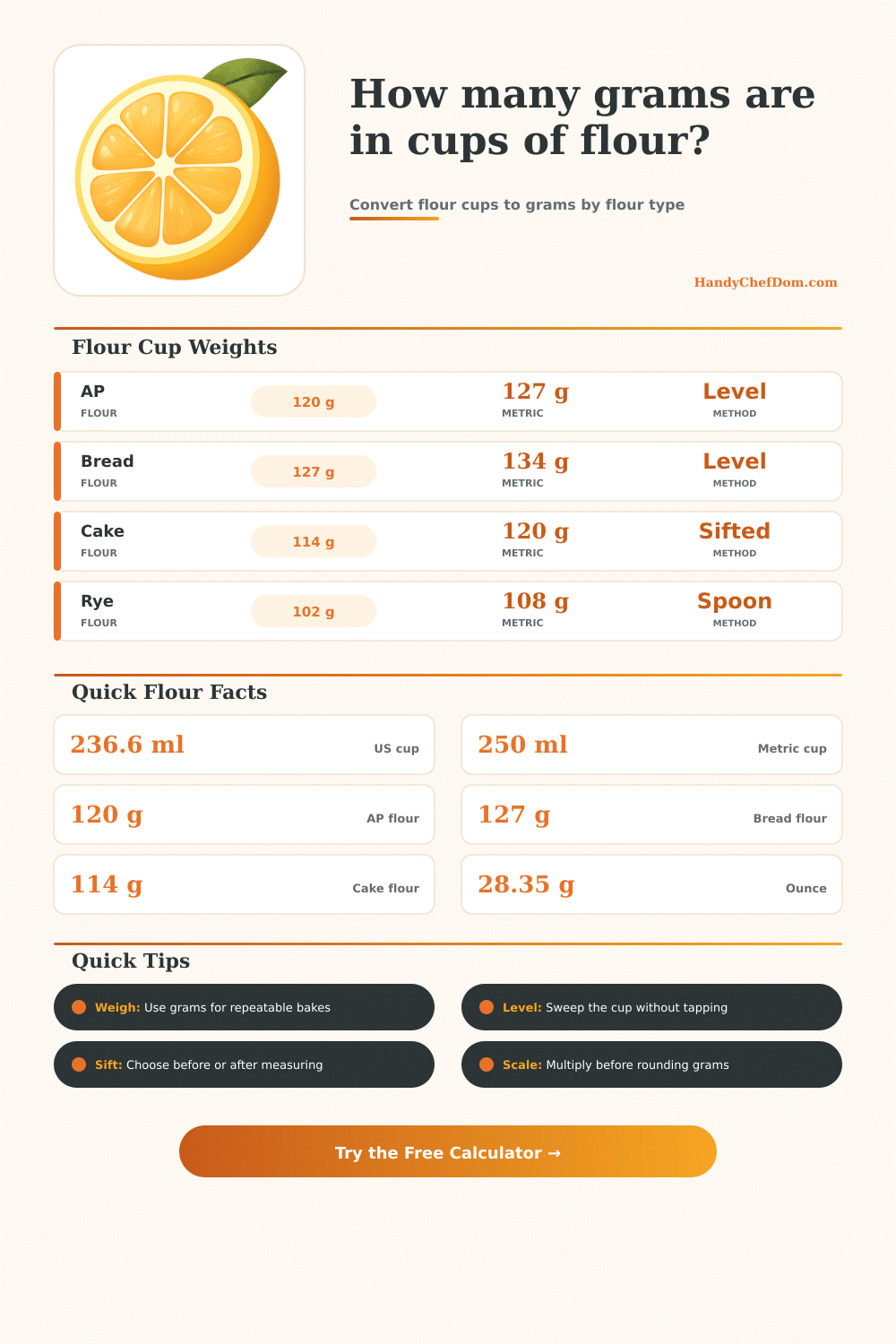
| All-purpose flour | 120 g | Cookies, muffins, quick breads | Balanced default for most US recipes. |
| Bread flour | 127 g | Lean bread, pizza, bagels | Denser protein-rich flour often weighs more per cup. |
| Cake flour | 114 g | Layer cakes, sponge cakes | Often sifted, so method changes matter a lot. |
| Pastry flour | 106 g | Tarts, biscuits, tender pastry | Lower protein flour can measure lighter by volume. |
| Whole wheat flour | 120 g | Muffins, sandwich bread | Bran can settle; avoid tapping the cup. |
| Rye flour | 102 g | Starters, rye loaves | Spoon-level cups stay lighter than dipped cups. |
| Self-rising flour | 120 g | Biscuits, pancakes | Use the flour weight only; leavening is already included. |
| Almond flour | 96 g | Cookies, gluten-free cakes | Nut flour has a lower cup weight than wheat flour. |
| Oat flour | 92 g | Pancakes, muffins | Fine oat flour packs differently than home-ground oats. |
| Gluten-free flour blend | 140 g | 1:1 gluten-free baking blends | Starch-heavy blends can be much heavier by cup. |
| Cup style | Volume | AP flour equivalent | When to choose it |
|---|---|---|---|
| US customary cup | 236.6 mL | 120 g AP flour | Most US cookbooks and online baking recipes. |
| US nutrition cup | 240 mL | 121.7 g AP flour | Nutrition-panel style measures or rounded US metric charts. |
| Metric cup | 250 mL | 126.8 g AP flour | Australian, New Zealand, and many metric baking notes. |
| UK imperial cup | 284.1 mL | 144.1 g AP flour | Older imperial references; verify recipe origin if unsure. |
| Method | Adjustment | What happens | Best use |
|---|---|---|---|
| Spoon into cup and level | 1.00x | Flour is moved gently into the cup, then swept level. | Default for repeatable flour cup conversions. |
| Light spooned cup | 0.97x | A slightly airier cup gives a lower gram result. | Tender cakes or recipes warning not to compact flour. |
| Dip cup into flour, then sweep | 1.08x | The cup compresses flour while scooping from the bag. | Older household recipes that expect dipped cups. |
| Packed or tapped flour cup | 1.18x | Tapping or pressing can add a lot of extra flour. | Use only when a recipe specifically says packed flour. |
| Whisked/fluffed before scooping | 0.94x | Flour is aerated before measuring, so cups get lighter. | Flour stored in a bin that has settled hard. |
| Cup amount | Selected flour grams | Ounces | Kitchen note |
|---|---|---|---|
| 1/4 cup | 30 g | 1.1 oz | Small roux, dusting, or batter correction. |
| 1/3 cup | 40 g | 1.4 oz | Common muffin or pancake increment. |
| 1/2 cup | 60 g | 2.1 oz | Useful for halving a one-cup flour line. |
| 3/4 cup | 90 g | 3.2 oz | Often paired with extra tablespoons. |
| 1 cup | 120 g | 4.2 oz | Base conversion for selected cup style. |
| 2 cups | 240 g | 8.5 oz | Typical loaf, pizza, or batch-bake amount. |
When a recipe asks for two cups of flour and you grab for your measuring cup with trepidation, you probably know what I mean: That’s panic. No, it’s not panic over dinner; it’s panic over the variable density of flour. Sure, those cups all look the same in the bag, but did you know a cup of bread flour have a different weight then a cup of rye? It is no wonder because professional bakers don’t use volume measurements anymore; instead, they measure everything by weight. Why? Because air pockets and compaction make volume measures tricky; gravity doesn’t. ) Use the calculator above.
It does the math after you enter your recipe details so you don’t guess your way to a loaf that turn out more like a brick than a cloud. This goes back to the fact that flour is not water. Flour is a bunch of particles. Some are tightly packed and others is fluffy. How you treat the bag will determine its final density.
Why Weight Measurements Are Better Than Cups
If you stick a measuring cup straight down in the bag, you’re going to squash all those flour particle together, resulting in anywhere from eight- to twenty-percent heavier weight than desired. Lightly spoon it into the cup then level it off, now we’ve got something light. To make things work, this tool allows you to choose how you want to scoop. Knowing what original recipe writer did is essential to replicating their results. In most cases, though, if you don’t know how they did it, assuming spoon-and-level is probably your best bet for contemporary recipes.
Then there’s sifting: Most home cooks don’t think about it much, but it adds another level of difficulty to the equation. “One cup of sifted flour” is not the same thing as “one cup of flour, sifted.” If it’s the former, then you’re aerating the flour before measuring it, which will be less than one cup by weight. In the latter case, however, you’d take out one cup from the bag as-is, then proceed to sift it after measuring, which will change the texture. That affects the hydration ratio of your dough enough to impact the final crumb structure. Mess up here, and delicate cakes becomes dense sponges.
Precision matters if you’re working with chemical leaveners; that’s why you can say what stage the inputs are in. Flour weights vary because not all flours is the same in terms of particle size or protein content. Cake flour tends to be lighter than bread flour because it is sometimes bleached and conditioned. Whole wheat flour settles as the bran packs down. The density of almond flour do not work with standard wheat flour conversions. Even keeping your volume unchanged when swapping one flour for another alter the ratio of ingredients. A chart at the top of the page explains how drastically different a cup of cake flour is from a cup of gluten-free blend, which tend to be denser because of the type of starchy component.
The other often misused area is scaling a recipe. A lot of folks will scale up a recipe by converting cups to grams and then multiplying that amount to make two or three times the batch size. It seems reasonable enough, except when you notice that every time you do that, the rounding error build up on each of those batches. Instead use the calculator to compute the total number of grams you need for the whole project and only round it up/down at the last moment. The calculator takes that into account and corrects for the final weight after all the density factors have been taken into consideration. This prevents you from going off track during a 10-batch cookie making spree because you cut off a small decimal amount on the first batch.
So: Baking is basically just chemistry, and it’s wrapped in a package called “comfort food.” But comfort comes from knowing what will happen. And for that, you should of ditch the uncertainties of volume measurements. Why? Because when you weigh your flour, there’s no question about whether you packed in that final scoop too hard. When you measure by weight, you don’t have to wonder if the recipe is referring to US cups or metric. And with grams, who cares, grams are grams everywhere.
Going from measuring cups to measuring scales does require some retraining (it takes a few minutes of adjustment). But the reward is the confidence of knowing your results will turn out exactly the same each time. It’s worth learning the numbers for that moment when you bake your first bread without fear.