Flour Cups To Pounds Converter
Convert cups of flour to pounds, ounces, and grams using flour type, cup filling method, humidity, and recipe scaling.
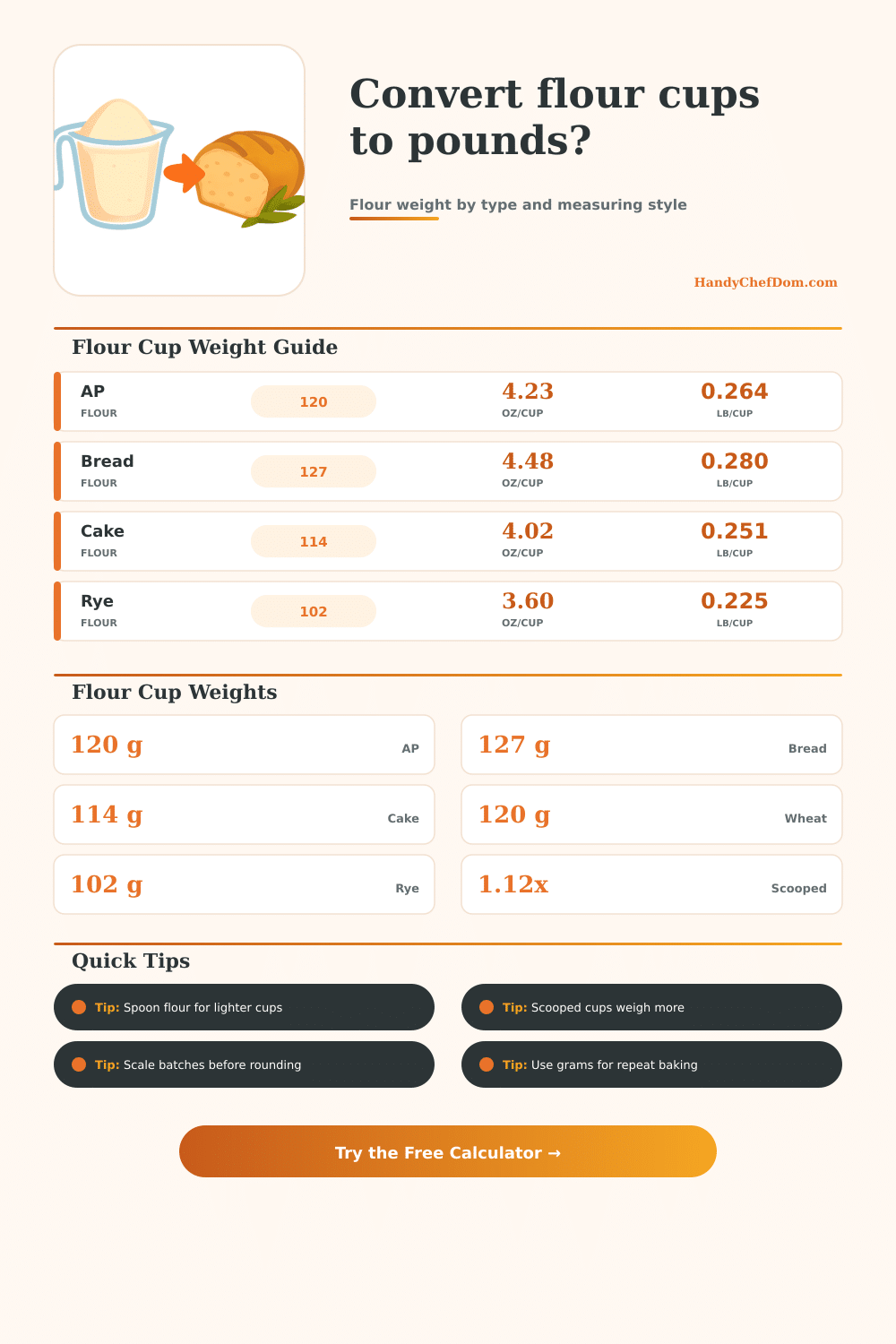
Cup weights are based on common baking references: all-purpose 120 g/cup, bread 127 g/cup, cake 114 g/cup, whole wheat 120 g/cup, and rye 102 g/cup before measuring-style adjustments.
For best repeatability, treat cups as an estimate and grams as the final baking target. Scooped flour can easily weigh 10% or more above a spooned-and-leveled cup.
| Flour Type | Reference g/Cup | lb Per Cup | Best Use In This Converter |
|---|---|---|---|
| All-purpose flour | 120 g | 0.2646 lb | Cookies, biscuits, quick breads |
| Bread flour | 127 g | 0.2800 lb | Yeasted breads, pizza dough |
| Cake flour | 114 g | 0.2513 lb | Cakes and soft batters |
| Whole wheat flour | 120 g | 0.2646 lb | Muffins, hearty breads |
| Rye flour | 102 g | 0.2249 lb | Rye loaves and blends |
| Pastry flour | 106 g | 0.2337 lb | Scones, pie dough, tender bakes |
| Self-rising flour | 120 g | 0.2646 lb | Biscuits and quick bakes |
| Semolina flour | 167 g | 0.3682 lb | Pasta dough and dense blends |
| Cup Filling Style | Factor | AP Example | Why It Matters |
|---|---|---|---|
| Sifted before measuring | 0.88x | 105.6 g/cup | More air in the cup makes it lighter |
| Spooned and leveled | 1.00x | 120.0 g/cup | Reference method for most baking charts |
| Settled after measuring | 1.06x | 127.2 g/cup | Tapping or settling compacts flour |
| Dipped or scooped | 1.12x | 134.4 g/cup | Dragging the cup through flour packs it |
| Firmly packed | 1.20x | 144.0 g/cup | Useful only when a recipe clearly says packed |
| Spooned Cups | All-purpose | Bread Flour | Cake Flour |
|---|---|---|---|
| 1 cup | 0.265 lb / 4.23 oz | 0.280 lb / 4.48 oz | 0.251 lb / 4.02 oz |
| 2 cups | 0.529 lb / 8.47 oz | 0.560 lb / 8.96 oz | 0.503 lb / 8.04 oz |
| 3 cups | 0.794 lb / 12.70 oz | 0.840 lb / 13.44 oz | 0.754 lb / 12.06 oz |
| 4 cups | 1.058 lb / 16.93 oz | 1.120 lb / 17.92 oz | 1.005 lb / 16.08 oz |
| 8 cups | 2.116 lb / 33.86 oz | 2.240 lb / 35.84 oz | 2.011 lb / 32.17 oz |
| Recipe Move | Scale Setting | Batch Setting | Example From 4 Cups AP |
|---|---|---|---|
| Half batch | 50% | 1 | 2 cups, about 0.53 lb |
| Double batch | 200% | 1 | 8 cups, about 2.12 lb |
| Three identical batches | 100% | 3 | 12 cups, about 3.17 lb |
| Bakery prep with dusting | 100% | 4 plus 5% | 16.8 cups, about 4.44 lb |
| Scale up by one quarter | 125% | 1 | 5 cups, about 1.32 lb |
So many recipes begin this way: Simple enough on paper, then baking begins to go wrong. Chocolate chip cookie batter spreads out too much in the oven. The dough’s so dense you think maybe it’s the butter that wasn’t soft enough or the type of vanilla. That is not quite the case. It was probably your method of measuring out the four cups of all-purpose flour called for in the recipe.
Dry ingredient (like flour) are tricky to measure by volume. The amount you get each time change based off humidity levels and how tightly packed the ingredient is in its packaging. It also changes because each one has its own unique density. Baking errors typicaly come from confusing volume with weight. A cup of flour is never the same amount of material.
Why Weight Is Better Than Cups for Baking
When we say a cup of flour, we mean the cup itself, which is a vessel filled differently each time. Depending on whether or not your flour was tapped or patted down, the exact same measurement can contain as much as 12% more stuff. And this added weight lead directly to drier dough and tougher crumb structures. This is a simple bit of physics that completely spoils everything in the end.
To understand the process, consider the nature of different flours: not all flour are equal when it comes to weight-per-unit-volume. One cup of cake flour weighs about a hundred fourteen grams because it’s finer and less dense than bread flour. Bread flour weigh closer to a hundred twenty-seven grams per cup because it is packed a little tighter due to having more protein. Rye flour is even lighter.
If a recipe specifies a particular kind of flour and you swap it out but don’t account for weight, you’re introducing error. The larger your batch size the bigger those errors will be if you’re multiplying them across multiple batches. It’s a piece of math solved by a conversion tool into which you plug name of whichever kind of flour you prefer to use. You won’t have to remember density coefficients for each kind of grain you keep on hand.
This leads me into the next area: environmental variables that most home bakers don’t consider at all. The amount of moisture your food receives while it is exposed to the air in your kitchen depends entirely upon humidity. Because flour absorbs water from its surroundings, it will absorb more moisture when the surrounding air contain high levels of water vapor. When you measure flour on a damp summer afternoon, it’s going to settle tighter into your measuring cup and contain more moisture then if you measured a cup of flour on a dry winter day.
Accounting for this variation can help explain why a recipe that was perfect last month fail miserably today. Any time you scale up, this is when things can go wrong the worst. Every slight miscalculation you’ve made with measuring ingredients, be they cups or other volume measurements, is magnified when you multiply those numbers by a big factor. You’ve got a 3% extra on your scoop? Double the recipe and you double that; triple it, compound it. Before long, you’re off the rails with your ratios.
That’s why professional bakers operate nearly entirely by weight: because scaling up means being able to keep your ingredient proportions exactly right, no matter what size batch you need. Convert your recipes from cups to pounds or grams before scaling them up and then go at it.
At the bottom of the page they include this table which shows how much your measurement style can differ from these common volume measurements. This is where it really hits home; seeing that weight of a sifted cup of flour is almost 20% less than a scooped cup makes me realize the importance of consistency.
This doesn’t mean you have to turn into a baking pro overnight, but measuring flour like you would a liquid will help close that gap in accuracy vs. Guessing. It is chemistry in disguise as comfort food. Respect the physical properties of your ingredients instead of just guessing amounts with your eyes to get it wrong on purpose; respect physics to get it right.
Stop thinking in terms of cups and think in terms of mass, and you’ll know how things should turn out regardless of what bag you use or wherever you are. You should of leave the scoop behind, because it’s all about knowing what is really being measured in that thing.