🍕 Pizzas per Person Calculator
Estimate pizzas needed from adults, kids, pizza size, slices per pizza, appetite, crust style, topping heaviness, sides, leftovers, and buffet duration.
Choose the guest mix and serving setup. Slices per pizza can follow the size default, but you can override it if your shop cuts pizzas differently.
| Pizza Size | Common Cut | Approx Area | Best Planning Use |
|---|---|---|---|
| Personal 8 inch | 4 slices | 50 sq in | Individual meals or kid portions |
| Small 10 inch | 6 slices | 79 sq in | Small flavor variety |
| Medium 12 inch | 8 slices | 113 sq in | Mixed adult and kid groups |
| Large 14 inch | 8 slices | 154 sq in | General party baseline |
| Extra large 16 inch | 10 slices | 201 sq in | Large adult groups |
| Party 18 inch | 12 slices | 254 sq in | Buffets and sports meals |
| Guest Type | Light Serving | Average Serving | Heavy Serving |
|---|---|---|---|
| Adult lunch | 2 slices | 2.5 slices | 3 slices |
| Adult dinner | 2.5 slices | 3 slices | 4 slices |
| Hungry teen | 3 slices | 4 slices | 5 slices |
| Kid under 12 | 1 slice | 1.5 slices | 2 slices |
| Snack table | 1 slice | 1.5 slices | 2 slices |
| Late night group | 2 slices | 3 slices | 4 slices |
| Event Size | Guest Mix | Pizza Size | Typical Pizza Count |
|---|---|---|---|
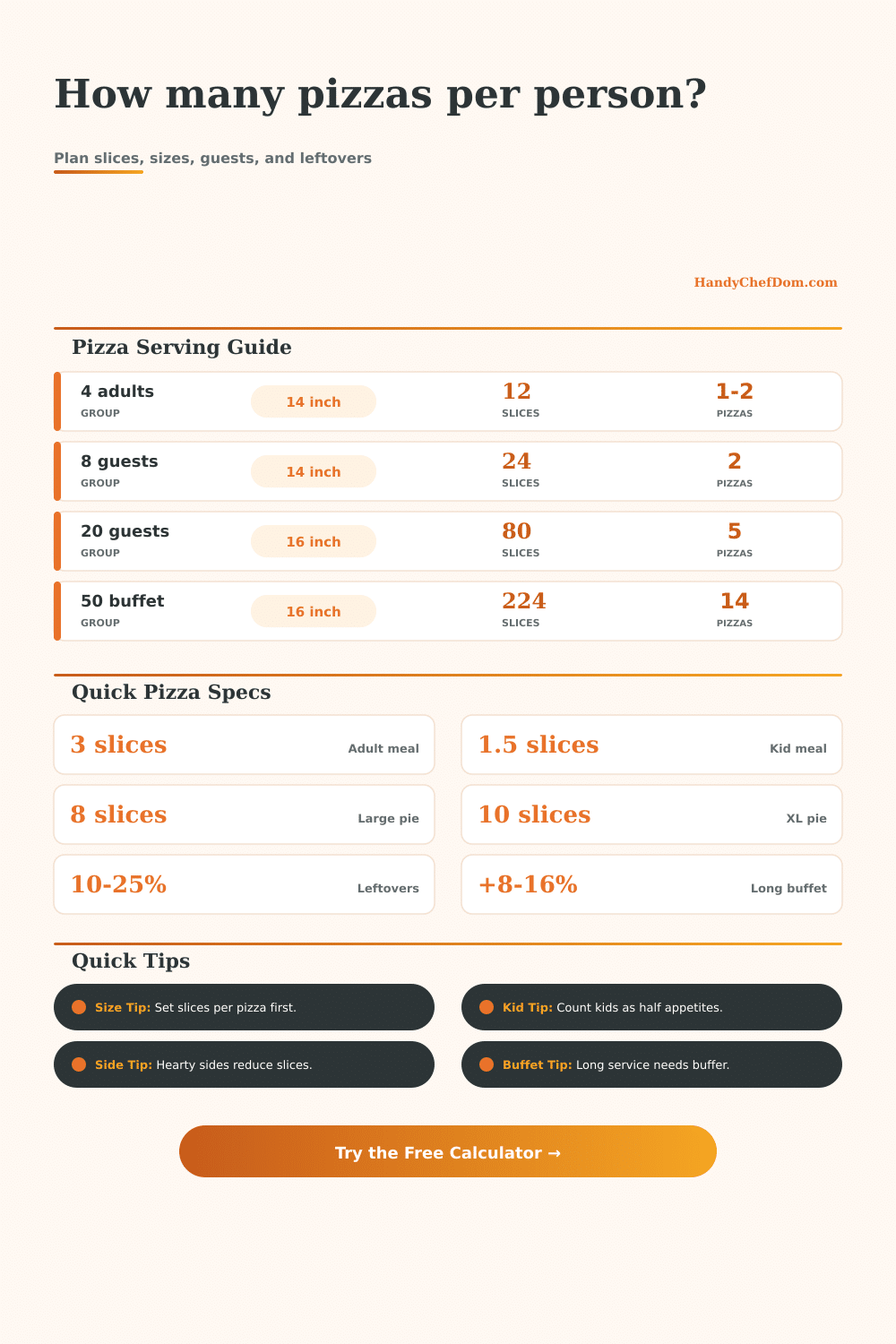
| Family meal | 4 adults, 2 kids | 14 inch, 8 slices | 3 pizzas with light leftovers |
| Kids birthday | 6 adults, 14 kids | 12 inch, 8 slices | 5 to 6 pizzas |
| Game night | 12 adults | 14 inch, 8 slices | 5 to 6 pizzas |
| Office lunch | 24 adults | 16 inch, 10 slices | 8 to 9 pizzas |
| Sports team | 18 hungry teens | 16 inch, 10 slices | 8 to 10 pizzas |
| Open house | 50 mixed guests | 18 inch, 12 slices | 14 to 17 pizzas |
| Adjustment | Multiplier | Use When | Planning Effect |
|---|---|---|---|
| Thin crust | 1.10x | Lighter slices | Plan slightly more slices |
| Deep dish | 0.82x | Very filling slices | Plan fewer slices |
| No sides | 1.18x | Pizza is the only food | Add a full appetite cushion |
| Hearty sides | 0.90x | Wings, pasta, or salad | Reduce pizza demand |
| Long buffet | 1.08x to 1.16x | Guests graze for hours | Add extra slices |
| Planned leftovers | 1.10x to 1.25x | Next-day slices matter | Round up another pizza |
Data can replace guesswork to spare you from being disappointed by not having enough pizza. Based off some fuzzy idea of how much we’ll be full, most of us over- or under-order what our guests will eat. When you plug in information about your crowd and the food you’re serving, the calculator figure out the math for you. That’s a plan, not an uncertainty.
But here’s the kicker: you need to split out kids from adults. Adults will usually consume 3 slices of normal pizza (as their primary meal), but kids under 12 will consume an average of 1.5. Unless you account for this, you’re going to under-order for the adults and over-order for the kid. That’s where the tool comes in. You can enter these figures separately. It will then calculate a weighted average based on who’s in your party. It takes into account that a ravenous teenager could possibly put away more than a sedentary adult. Adjusting the sliders changes how “hungry” people are.
Why Pizza Calculators Are Useful
And then there’s the matter of pizza. Because size isn’t just a matter of diameter. A party pie with an eighteen inch diameter is going to be a different planning problem different than a fourteen-inch one. An eighteen-inch party pie sliced into twelve pieces is going to be a different planning problem than a fourteen inch one sliced into eight. This is why the calculator asks how many slices per pizza. Shops cut them differently. Some shops cut ’em into manageable wedges; others hand you huge, floppy triangles. And if your assumption about slice count is wrong, if you think they’re cutting it in eights but the shop actualy cuts it into tens, you’ll be off by twenty five percent. You will miss a whole pizza from your plan. Always check the cut count before finalizing your order.
However, topping and crust matter. Lighter thin crust pizzas is easier to consume, so people tend to eat more of them. Dense deep dish is heavier and more difficult to finish, meaning each slice will be consumed more slowly. To account for this, multipliers are applied to the starting hunger level depending on what type of crust and toppings you’re serving. Offering a heavy meat lovers pizza with stuffed crust? Guests will become full quicker. Serving a plain cheese with a mild vegetable side? They may even want seconds.
Don’t forget about the sides. Breadsticks or a salad will decrease the desire for pizza. A full-on buffet with pasta and wings will make pizza part of the meal. Depending on all of these factors, the calculator will adjust your total count. This will stop you from ordering a heap of pizza when the actual meal is buffalo chicken dip.
Timing is surprising. An open-house buffet with three-hour window will be very different than a one hour lunch affair. The longer you go, the more people graze. Conversations take them away and they drift back in for another slice. Duration adds a buffer for this tool; more time means more consumption. Run an all evening party? You’ll want some additional coverage for that second round. A small thing, yes. But it matters. Running out on the dessert announcement is what happens when you ignore time.
It’s optional (but still delicious). Is there a host who doesn’t want some leftover? Maybe they’re going for a no-waste dinner party. Or maybe they want to have pizza for breakfast the following day. That’s fine! Set your desired leftover amount in the calculator and it will build in any extra slices from the beginning. That way, you don’t end up ordering just barely enough for everyone and then realizing too late that you should of gotten more. Leftover planning is all about controlling your own story: does this become tomorrow’s morning treat, or tonight’s midnight snack?
A lot of common scenarios are laid out on the page. But then you realize that your event isn’t common at all. That’s when you use the tool: it lets you play with different scenarios. Will it be a light or heavy topping load? How many kids will there be, and does that change the overall number? What’s most important to me? Guest satisfaction? Budget? Fewer boxes to deal with? More variety in toppings? It helps you understand the tradeoffs. It is not about getting a number; it is about making an informed decision.
But really, it’s all about managing expectations: how much food will your guests need to stay happy? Do I want leftovers in my fridge or a bunch of doughy circles to try and revive? The calculator takes that guessing out of the equation. It puts real inputs into a defensible plan. Yes, you’ll have to place the phone call to the shop and verify their cut size. Yes, you’ll have to get to know your friends. But no, you don’t have to fret over the numbers. You order confidently, knowing that the last slice will vanish because your stomachs are full, not because you didn’t order enough.
A good party vs. It is a disaster.