Popcorn Bar Calculator
Build a party popcorn bar plan from guest count, cups per person, event duration, popped yield, serving bags, flavor split, topping intensity, and a realistic self-serve buffer.
Start with a real event style, then adjust the cups, bags, flavors, and buffer. The calculator separates popped volume, kernels, serving containers, seasonings, sweet mix-ins, and refill waves.
Your popcorn bar estimate
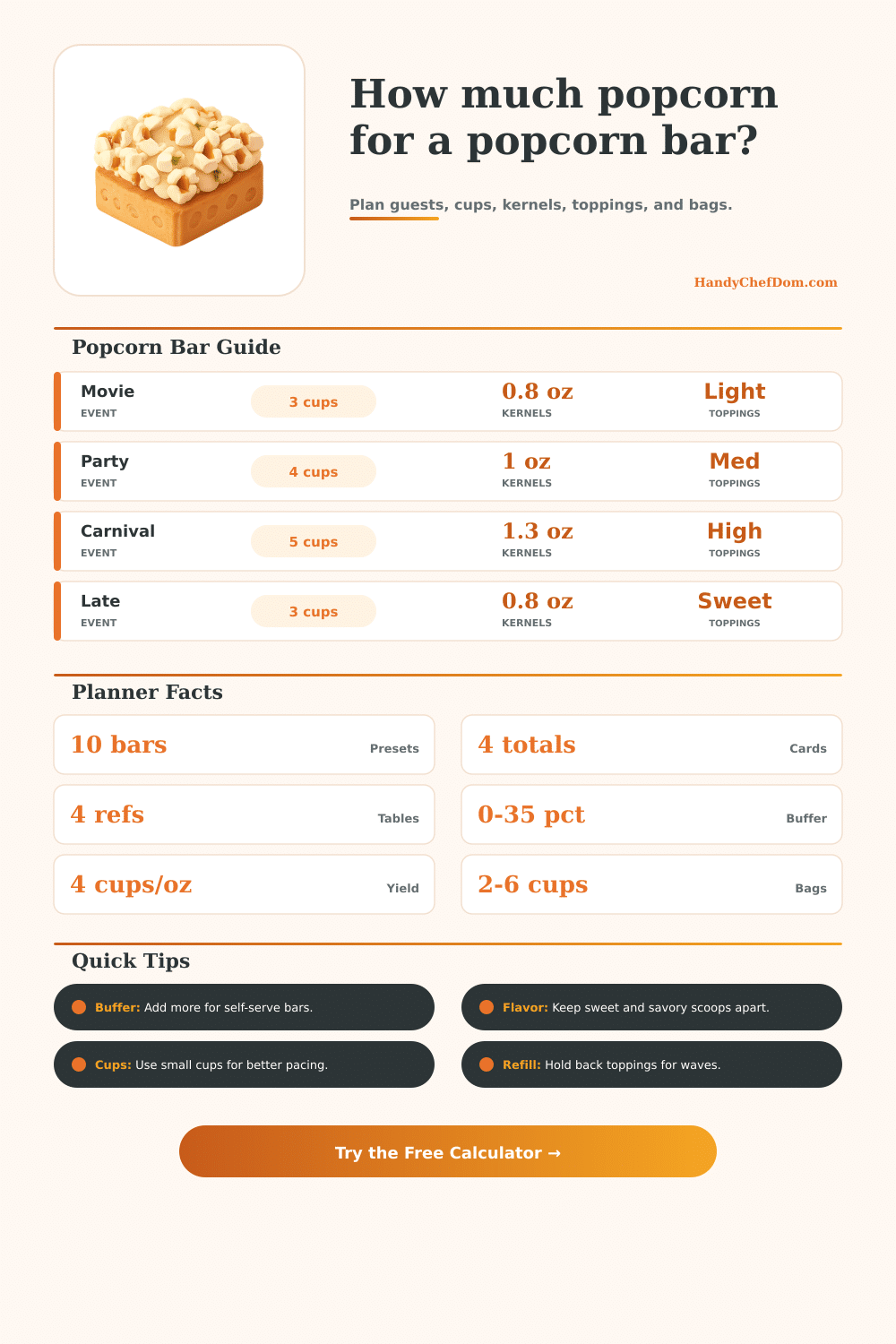
Best for a short arrival snack when popcorn is decorative and guests will eat a meal soon.
The safest starting point for birthdays, showers, watch parties, and mixed-age gatherings.
Use when popcorn is a main activity with several flavors, candy mix-ins, and return trips.
Works well after dinner, especially with salty and sweet choices in smaller bags.
| Bar role | Popped cups per guest | Container cue | Best use | Buffer cue |
|---|---|---|---|---|
| Welcome nibble | 1.5 to 2.5 cups | 2 cup tasting cup | Arrival snack before dinner. | 8 to 12 pct is usually enough. |
| Party snack | 3 to 4 cups | 3 cup cup or small bag | Birthdays, showers, casual gatherings. | 12 to 18 pct covers seconds. |
| Featured popcorn bar | 4.5 to 6 cups | 4 cup bag or snack box | Movie parties, game nights, carnival bars. | 18 to 25 pct keeps bowls abundant. |
| Late-night snack | 2.5 to 3.5 cups | 2 to 3 cup bags | Wedding exits, after-party tables, dances. | 10 to 18 pct works after dinner. |
| Dessert popcorn bar | 3 to 4.5 cups | 3 cup cup plus candy bowls | Sweet mixes, drizzles, chocolate, sprinkles. | 15 to 25 pct for candy-heavy bars. |
| Kernel or base | Typical popped yield | Kernel amount | Texture note | Best flavor plan |
|---|---|---|---|---|
| Butterfly kernels | 4 cups per oz kernels | 1 cup kernels makes about 32 cups | Fluffy wings catch butter and seasoning. | Classic salt, cheese powders, herb blends. |
| Mushroom kernels | 3.5 cups per oz kernels | 1 cup kernels makes about 28 cups | Round pieces hold coatings and candy better. | Caramel, chocolate drizzle, kettle-style mixes. |
| Yellow kernels | 4.1 cups per oz kernels | 1 cup kernels makes about 33 cups | Reliable party popcorn with sturdy crunch. | Butter, ranch, spicy savory, cheddar-style. |
| White kernels | 4.3 cups per oz kernels | 1 cup kernels makes about 34 cups | Tender smaller pieces with delicate crunch. | Light salt, herbs, sweet dusts, plain base. |
| Ready-popped bulk | 1 cup per cup purchased | Measure popped cups directly | Fastest option when popping on-site is not planned. | Shakers and separate toppings work best. |
| Topping style | Mix-ins per 10 cups | Seasoning per 10 cups | Salt or sweet cue | Bar note |
|---|---|---|---|---|
| Light toppings | 0.5 cup | 2 tsp | Mostly popcorn flavor. | Good when guests serve themselves quickly. |
| Medium toppings | 1.2 cups | 1 tbsp | Visible but not overloaded. | Best default for mixed sweet and savory bars. |
| Heavy candy and crunch | 2 cups | 1 tbsp | More mix-in than seasoning. | Use deeper bowls and smaller serving cups. |
| Seasoning shakers | 0.25 cup garnish | 2 tbsp | Dry flavor control. | Offer separate scoops so powders stay tidy. |
| Dessert toppings | 1.8 cups | 2 tsp | Sweet mix-ins plus drizzle. | Serve sticky toppings in small refill batches. |
| Guest count | Light bar | Party snack | Featured bar | Container estimate |
|---|---|---|---|---|
| 10 guests | 23 cups popped | 40 cups popped | 58 cups popped | 12 to 20 small cups. |
| 25 guests | 58 cups popped | 100 cups popped | 144 cups popped | 31 to 50 party cups. |
| 50 guests | 115 cups popped | 201 cups popped | 288 cups popped | 63 to 100 bags or boxes. |
| 75 guests | 173 cups popped | 302 cups popped | 431 cups popped | 94 to 150 bags or boxes. |
| 100 guests | 230 cups popped | 403 cups popped | 575 cups popped | 125 to 200 containers. |
| 150 guests | 345 cups popped | 604 cups popped | 863 cups popped | 188 to 300 containers. |
This calculator uses common popcorn planning ratios: roughly 4 popped cups per ounce of kernels for butterfly popcorn, slightly less for mushroom popcorn, and larger buffers for long self-serve events.
To plan a popcorn bar, you need to calculate the amount of popcorn that you will need. The amount of popcorn that you will need depends on various factor. For instance, the number of people that will attend the event, the size of the container in which the popcorn will be served, and the length of the event will all affect the total amount of popcorn that the guests will consume.
If you dont take into consideration these factor when planning your popcorn bar, you may either find that you do not have enough popcorn for all of the guests, or that you will have too much popcorn remaining after the event. The role that the popcorn will play at the event will impact the amount of popcorn that each guest will consume. For instance, if the popcorn is to be a small snack that the guests eat prior to eat a meal, then each guest will consume less popcorn.
How Much Popcorn Do You Need for a Popcorn Bar
However, if the popcorn is to be the major activity of the event, such as if it is to be hosted as a movie night, then each guest will consume more popcorn during the event. Additionally, the length of the event will impact the amount of popcorn that the guests consume. The longer that the event will last, the more popcorn that will be consumed by the guests.
In order to determine how much popcorn is required for the event, it is important to understand how much popcorn can be made from the raw popcorn kernels. Raw popcorn kernels will expand when they are popped. One cup of raw popcorn kernels will produce approximately thirty cups of popped popcorn.
Additionally, the types of popcorn kernels that is used will impact the amount of popcorn that is created. For instance, butterfly kernels will create large pieces of popcorn and will hold to seasoning good. Mushroom kernels will also create popcorn but the pieces will be round instead of large.
Additionally, mushroom kernels will be better used in toppings with candy because they are round and will stick to the candy. Instead, a host can purchase ready-popped popcorn which will save them from having to calculate how much popcorn will expand when the kernels are popped. The size of the containers in which the popcorn will be served will also impact the amount of popcorn that must be prepared.
For instance, if the containers are small, such as two cup tasting sizes, then the popcorn will be appropriate for short event. Small containers will limit the amount of popcorn that each guest will consume. However, if the event will last for longer periods of time, such as three or four cups, then those larger containers will save the host from having to refill each container of popcorn.
Therefore, the host should consider the size of the containers to ensure that there is enough popcorn for each guest, and that there will be no instances of guests coming to the popcorn bar and finding that there is no more popcorn to eat. The type of toppings that are used for the popcorn will also impact the amount of popcorn that will be consumed by the guests. For instance, seasoning shakers can be used to allow the guests to add flavor to the popcorn, but the seasoning will dissapear quick from the shakers.
Additionally, candy and crunch mixes will increase the amount of popcorn that is consumed by the guests, as the candy and crunch will take up space within the containers of popcorn. Additionally, the sweet toppings should be kept in separate bowls from the savory toppings to preserve the popcorn and the toppings. In addition to considering each of the factors described above, it is also important to include a buffer in the calculation of the amount of popcorn that will be needed.
A buffer for popcorn is created to account for the popcorn that may be spilled from the containers, popcorn that is shared with others as second helpings, and the visual appearance of the popcorn is almost all consumed by each guest. Therefore, adding fifteen to twenty percent of popcorn to the total calculation will ensure that there is enough popcorn for each guest. A buffer of fifteen to twenty percent will prevent the host from running out of popcorn for the guests.
The length of the event can be another factor to consider when preparing the popcorn. For instance, if the event will only occur for ninety minutes, it is likely that there will be less popcorn needed from the guests than if the event lasts four hour. Instead, the host will have to prepare the popcorn in stages so that the popcorn does not lose its freshness after being prepared and served to the guests.
By preparing some of the popcorn in advance, it will retain its freshness and be available for the guests who attend the event. Common mistakes in preparing a popcorn bar can be avoided by considering the guests that will attend the event, and the characteristics of each of those guests. For instance, some people may prepare too little popcorn for the guests, while other may prepare too much.
To avoid these potential mistakes, it is important to ensure that the portion sizes of the popcorn are matched with the length of the event, and the number of guests that will attend the event. Additionally, it is also important to consider the type of guests that will come to the event. For instance, teenagers will eat popcorn more faster than adults.
After calculating the amount of popcorn that will be needed based on these factor, the host can begin thinking about the staging of the popcorn bar.