🍞 Rye Flour to Add to Sourdough Bread Calculator
Plan the rye flour in your sourdough formula while counting starter flour, starter water, hydration shift, loaf count, crumb style, and dough strength.
Enter total flour as the full flour weight in the formula, including the flour already inside your starter. The calculator subtracts starter rye before giving the final rye flour to add.
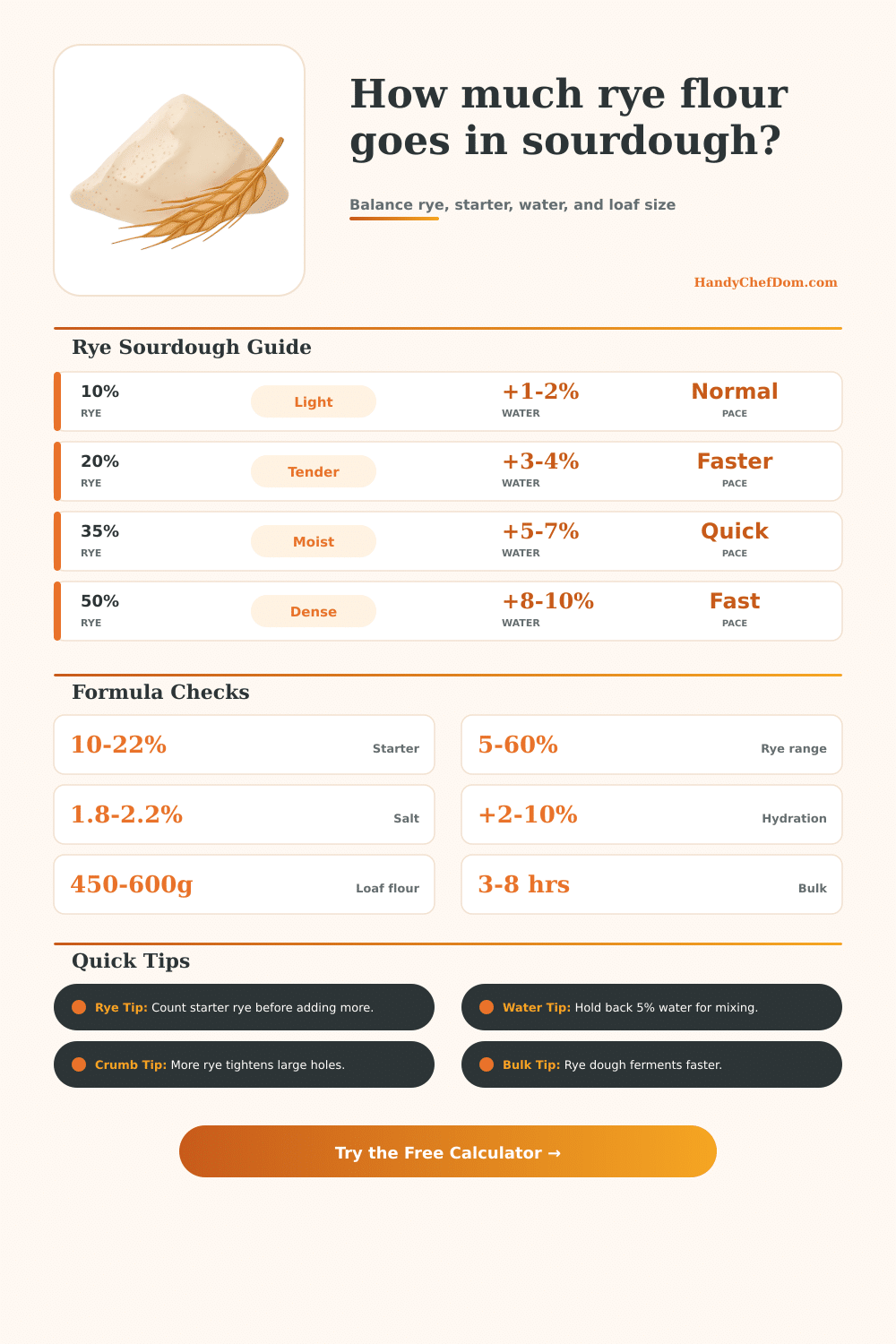
| Rye Level | What Changes | Hydration Move | Dough Feel |
|---|---|---|---|
| 5% to 10% | Light rye aroma without much gluten loss | Add 1% to 2% | Still stretchy |
| 15% to 25% | Noticeable rye flavor and softer crumb | Add 3% to 5% | Slightly tacky |
| 30% to 40% | Moister slice, faster fermentation | Add 5% to 8% | Less elastic |
| 45% to 60% | Rye-forward loaf with compact structure | Add 8% to 11% | Paste-like dough |
| Rye Flour Style | Absorption Add | Flavor Weight | Use In Formula |
|---|---|---|---|
| Light rye, sifted | +2.0% | Mild | Good for open country loaves |
| Medium rye | +3.5% | Balanced | Reliable for 15% to 35% rye |
| Whole rye | +5.5% | Earthy | Best when crumb should stay moist |
| Dark rye | +6.5% | Deep | Pairs with pan loaves and seeds |
| Coarse pumpernickel rye | +7.5% | Bold | Needs gentle shaping and more water |
| Sprouted rye | +4.0% | Sweet | Useful for softer crumb targets |
| Fermentation Target | Starter Flour Guide | Typical Bulk | Rye Effect |
|---|---|---|---|
| Cold slow retarded | 8% to 12% | 7 to 10 hours before chill | Rye still speeds early rise |
| Overnight room temp | 11% to 15% | 6 to 8 hours | Keep rye below 35% for shape |
| Balanced same-day | 14% to 18% | 4 to 6 hours | Works for most medium rye loaves |
| Quick warm dough | 18% to 22% | 3 to 4.5 hours | Watch volume, not the clock |
| Very quick rye bake | 22% to 28% | 2.5 to 3.5 hours | Higher rye can overproof quickly |
| Crumb Target | Hydration Move | Strength Need | Best Rye Range |
|---|---|---|---|
| Tight sandwich slice | -3% | Moderate | 15% to 45% |
| Balanced table loaf | 0% | Moderate | 10% to 35% |
| Moist rye crumb | +2% | Lower shaping stress | 25% to 55% |
| Open country crumb | +4% | Strong flour helps | 5% to 25% |
| Very open, high hydration | +6% | Strong flour required | 5% to 18% |
Once you grasp how mechanics of sourdough change when using rye flour, it’s easy to predict effects (though not so much the math). Rye adds a moist crumb and an earthy flavor. However, because rye is so dense, dough doesn’t behave as you’d expect. It rise quicker, feels heavier, and slice differently.
Much of that comes down to how much rye you’re putting into final dough versus how much is already present in your starter. That accounting step matter more than most bakers realize. The rye-fed starter add water and flour to the overall formula. You has to account for weight of the rye in both cases. This means when you add more rye later, you must also account for how much went into the starter.
How to Use More Rye in Your Bread
Hydration is the same, as rye doesn’t absorb water like wheat. How much extra moisture you need depend on strength of your main flours, the type of rye you use, and the type of crumb you want. It can be dialed in manually but it’s easy to get off track with a tiny adjustment that makes your dough go from tacky to stiff part-way through mixing.
This is where that tool on the page come into play. All you do is plug in what percent rye you want, your overall weight of flour (your target), your starter volume/hydration/ratio, and what kind of rye. Then it tell you exactly how much more rye to weigh out and how much more water to add after accounting for your starter’s water. It also give an approximate range for how long bulk fermentation should of take with your specific combination of starter and rye. The side tables also includes a guide to how the water levels and the texture of dough change as more rye is added, moving from lighter loaves to heavier breads.
For those of us wrestling with rye loaf, we’re not doing anything terribly wrong. We simply regard rye as interchangeable with wheat and we don’t alter any other factors to account for it. Results are much more manageable once you take into account: (1) Rye absorbs water different; (2) Rye alters your absorption (count your starter flour); and (3) The safer bulk window shorten with increasing levels of rye.
What’s too-wet when rye is at 25 percent might be just-right at 40 percent after you’ve reduced the amount of starter and shortened length (and warmed the temperature) of your bulk. It gets really good when you begin to think of the rye content as a dial, not a precise formula.
If you want just a touch of flavor without losing the elasticity needed for your tall loaf, go for tiny bit, which adds enough aroma but won’t impede the rise. Want something even moister that’ll keep longer once cut? Go ahead, but realize that this will also make shaping slightly harder. Keep an eye out for signs the dough is ready to shape faster, too, as you’ll need to watch the clock a little more.
The calculator take the math out of the picture so you can get into the business of making those decisions rather than questioning whether you got the number right or not.