🌿 Sesame Seeds Per Day Calculator
Estimate a practical daily sesame serving by form, tablespoons or grams, servings, nutrition target, recipe use, calorie target, blend percentage, and unit preference.
Values are practical kitchen estimates for comparing seed forms. Nutrition varies by brand, grind, hull status, and how tightly tablespoons are packed.
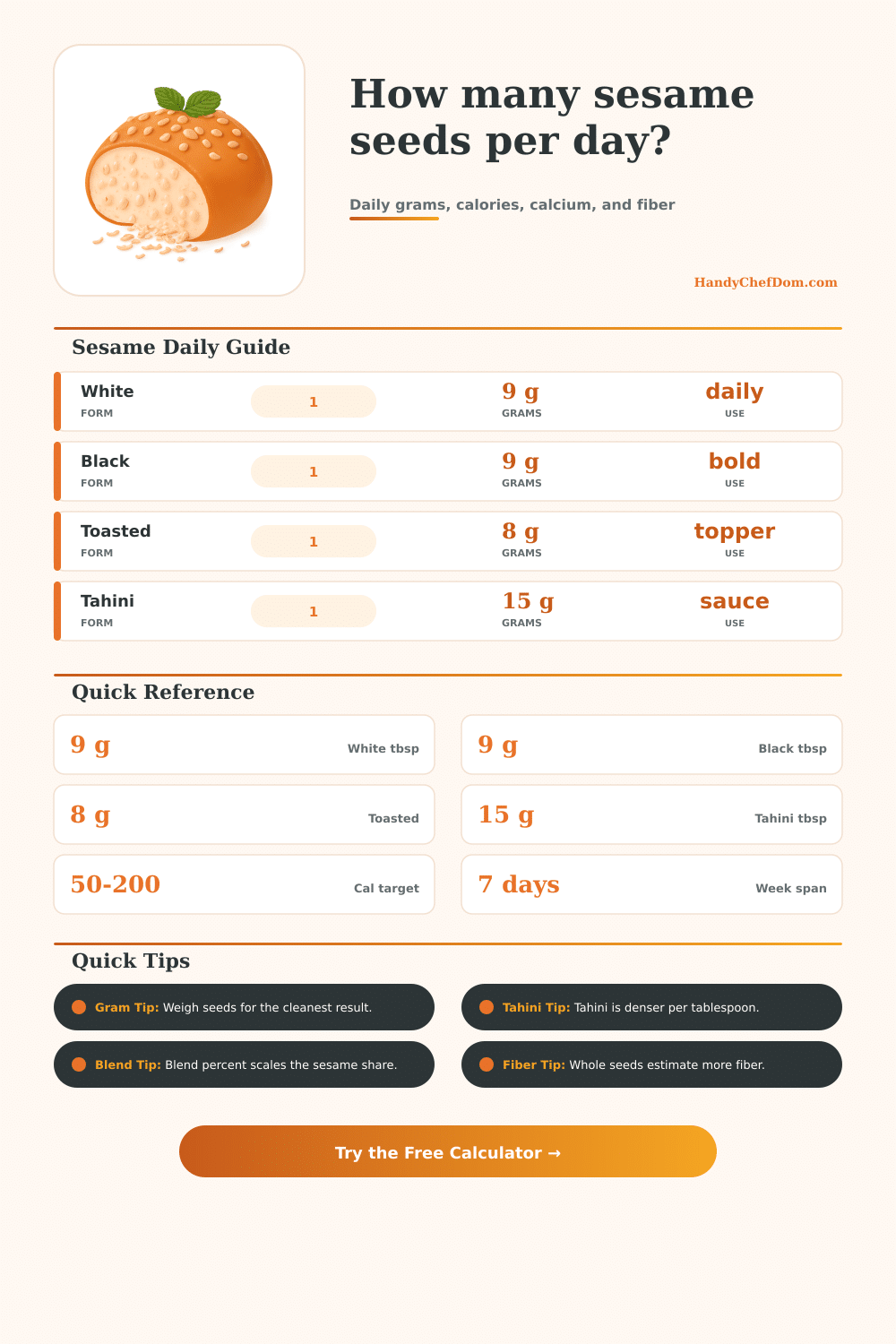
| Sesame form | Best calculator use | Kitchen texture | Default tbsp weight |
|---|---|---|---|
| White sesame seeds | Daily topping, baking, coating | Mild whole seed crunch | 9 g |
| Black sesame seeds | Bowls, rice, noodle garnish | Bold color and slightly nuttier flavor | 9 g |
| Toasted sesame seeds | Finishing sprinkle | Drier, aromatic, lighter spoon | 8 g |
| Tahini equivalent | Sauces, hummus-style tracking | Ground paste, denser tablespoon | 15 g |
| Measure | White or black seeds | Toasted seeds | Tahini equivalent |
|---|---|---|---|
| 1 teaspoon | 3 g | 2.7 g | 5 g |
| 1 tablespoon | 9 g | 8 g | 15 g |
| 2 tablespoons | 18 g | 16 g | 30 g |
| 1/4 cup | 36 g | 32 g | 60 g |
| 1/2 cup | 72 g | 64 g | 120 g |
| Nutrition per tbsp | Calories | Calcium | Fiber |
|---|---|---|---|
| White sesame seeds | 52 kcal | 88 mg | 1.1 g |
| Black sesame seeds | 52 kcal | 90 mg | 1.2 g |
| Toasted sesame seeds | 46 kcal | 78 mg | 1.0 g |
| Tahini equivalent | 89 kcal | 64 mg | 1.4 g |
| Seed comparison | Typical daily range | Calorie fit | Planning note |
|---|---|---|---|
| Sesame seeds | 1-2 tbsp | About 50-105 kcal | Strong calcium and crunch |
| Chia seeds | 1-2 tbsp | About 60-120 kcal | Higher gel-forming fiber |
| Flaxseed meal | 1-2 tbsp | About 35-75 kcal | Often used ground |
| Sunflower seeds | 1-2 tbsp | About 50-105 kcal | Milder calcium contribution |
Sesame seeds is a small food item. However, sesame seeds can become a significant part of a diet if people uses sesame seeds in many recipe every day. A person’s nutritional goals determine the number of sesame seeds a person consume in a day.
Depending on the recipe in which people use sesame seeds, a person may consume more sesame seeds than others. Sesame seeds contain the necessary nutrition and add flavor to dish in which they are used. In recipes, there are two form of sesame seeds that people can use: whole sesame seeds and tahini.
How to Measure and Track Sesame Seeds
These two products contain different amounts of nutrients. For instance, whole sesame seeds contain more fiber than tahini because grinding sesame seeds makes tahini. Tahini contains more calories and more fat than whole sesame seeds because of the density of tahini.
Depending on a person’s nutritional goals, they may have to track either the amount of tahini they consume or the amount of tahini they consume for fat intake. Using a calculator will make it more easier for a person to calculate the number of sesame seeds in different forms. When using sesame seeds in a mixture with other ingredients, a person has to account for the other ingredients.
For instance, if someone mixes sesame seeds with flax seeds or sunflower seeds, the percentage of sesame seeds in the mixture has to be calculated. Otherwise, the number of sesame seeds a person consumes may be more than expected. A person has to make this calculation for a person’s weekly meal.
One tablespoon of sesame seeds per day will eventually become a large amount of sesame seeds by the end of the week. Calculating the total amount of sesame seeds a person will consume during the week will allow them to decide whether to purchase sesame seeds in bulk or if the current amount they have will be enough for that weeks meals. The preparation of sesame seeds will alter the weight and calories of the sesame seeds a person consumes.
For instance, toasted sesame seeds will have fewer grams and fewer calories than white or black sesame seeds because sesame seeds loses weight during toasting. Thus, using toasted sesame seeds will allow a person to enjoy the aroma of sesame seeds without increasing there calorie intake. Black sesame seeds contain more taste than white sesame seeds.
Therefore, people will need to use fewer black sesame seeds than white sesame seeds to enjoy the same level of flavor. Using a calculator will make it easier for a person to test these different form of sesame seeds. The amount of sesame seeds used in a recipe will depend on the specific task to be performed using those sesame seeds.
For instance, if someone uses sesame seeds as a garnish for rice, only a small amount of sesame seeds will be used. However, if someone uses tahini to make a sauce for vegetables, more tahini will be used. If sesame seeds are used in a baking recipe, sesame seeds will have to be distributed throughout the batter so that every bite of the baked good will contain sesame seeds.
The amount of sesame seeds used for a specific task will prevent a person from using too few sesame seeds or consuming too many sesame seeds. Many people believe that all seeds are the same. However, sesame seeds contain a significant amount of calcium.
For those who consume limited amount of dairy products, sesame seeds are an excellent food source of calcium. However, the amount of sesame seeds consumed must be consistent. Consuming sesame seeds on one day will not have the same effect on a person’s nutrition as consuming the same amount of sesame seeds every day.
The total amount of sesame seeds calculated each week will allow a person to ensure that there habits of consuming sesame seeds are consistent. People might forget to measure the amount of sesame seeds they use in recipes. If people dont measure the amount of sesame seeds they use, they might consume too few or too many calories.
To prevent this, a person has to weigh the sesame seeds they use with a weighing scale to determine how many gram are in one tablespoon of sesame seeds. With this information, a person can use one tablespoon of sesame seeds in place of weighing the sesame seeds. With time, people will develop a habit of measuring the amount of sesame seeds they use in there cooking.
People will become familiar with the different forms of sesame seeds and the percentage of sesame seeds in a mixture. Additionally, people will know how many tablespoons of sesame seeds they use weekly. This habit will be the difference between a person achieving their nutritional goals or not achieving them at all.
Thus, developing a habit of measuring sesame seeds is the way that people can achieve their nutritional goals.